'%3e%3cpath%20d='M34.1406%205.85938C30.3906%202.10547%2025.3047%200%2020%200C14.6953%200%209.60938%202.10547%205.85938%205.85938C2.10938%209.61328%200%2014.6953%200%2020C0%2025.3047%202.10547%2030.3906%205.85938%2034.1406C9.61328%2037.8906%2014.6953%2040%2020%2040C25.3047%2040%2030.3906%2037.8945%2034.1406%2034.1406C37.8906%2030.3906%2040%2025.3047%2040%2020C40%2014.6953%2037.8945%209.60938%2034.1406%205.85938ZM37.0117%2023.543H31.1602V13.5391H27.6328V19.9414C28.1211%2020.6914%2028.3711%2021.582%2028.3711%2022.5625V22.625C28.3711%2023.668%2028.1172%2024.6055%2027.6328%2025.4297V26.6094H36.082C33.4883%2032.9375%2027.2891%2037.3789%2020.0039%2037.3789C10.3711%2037.3789%202.62109%2029.6289%202.62109%2020C2.62109%2010.3711%2010.3711%202.62109%2020%202.62109C29.6289%202.62109%2037.3789%2010.3711%2037.3789%2020C37.3789%2021.1484%2037.2617%2022.2656%2037.0508%2023.3477C37.0391%2023.4141%2037.0234%2023.4766%2037.0117%2023.543Z'%20fill='white'/%3e%3cpath%20d='M22.3086%2018.5352C20.4336%2018.125%2019.9531%2017.8398%2019.9766%2017.1836V17.1406C19.9766%2016.6992%2020.3477%2016.2148%2021.4023%2016.2148C22.582%2016.2148%2023.8867%2016.6797%2025.0781%2017.4766L26.8516%2015.0195C25.4453%2013.8906%2023.707%2013.3398%2021.5547%2013.3398C18.5195%2013.3398%2016.4375%2015%2016.4063%2017.4766V17.5352C16.3633%2020.2617%2018.5859%2020.9805%2021.293%2021.6016C23.0391%2021.9766%2023.5703%2022.3164%2023.5703%2022.9609L23.5469%2022.9766C23.5469%2023.3906%2023.2578%2023.7031%2022.7852%2023.8359C22.5742%2023.9062%2022.1289%2023.9727%2021.5156%2023.9727C20.7617%2023.9727%2019.7539%2023.8633%2018.6328%2023.4844C18.0898%2023.2891%2017.4727%2023.0039%2016.8047%2022.6133L20.1406%2026.625C20.2813%2026.6602%2021.0977%2026.8516%2021.7734%2026.8516C25.0039%2026.8516%2027.0859%2025.2461%2027.1094%2022.6328V22.5703C27.1602%2020.1133%2025.2148%2019.1719%2022.3086%2018.5352Z'%20fill='white'/%3e%3cpath%20d='M5.24219%2013.5664V26.6133H8.75391V23.7578L10.2969%2021.9531L14.2031%2026.6133H18.3867L12.3555%2019.5195L17.4023%2013.5664H13.4531L8.75391%2019.0586V13.5664H5.24219Z'%20fill='white'/%3e%3c/g%3e%3cdefs%3e%3cclipPath%20id='clip0_97_2430'%3e%3crect%20width='40'%20height='40'%20fill='white'/%3e%3c/clipPath%3e%3c/defs%3e%3c/svg%3e)




This archived news story is available only for your personal, non-commercial use. Information in the story may be outdated or superseded by additional information. Reading or replaying the story in its archived form does not constitute a republication of the story.
- ICE arrests of unauthorized immigrants have tripled in eight western states since January.
- President Donald Trump's deportation agenda faces criticism for targeting non-criminal immigrants, causing fear.
- Economic and social impacts of mass deportations are debated by communities and businesses.
SALT LAKE CITY — President Donald Trump's promise of mass deportations picked up momentum over the first six months of his second term and is making itself deeply felt in communities throughout the American West.
The number of unauthorized immigrants arrested each month by Immigration and Customs Enforcement has nearly tripled across eight western states — Utah, Idaho, Nevada, Montana, Arizona, Colorado, Wyoming and California — since Trump took office.
The spike in ICE enforcement across the country has been accompanied by a massive surge in arrests occurring outside the usual criminal justice pipeline, including a fourfold increase of street arrests in these states, and a fivefold increase in arrests of immigrants who have no criminal charges or convictions.
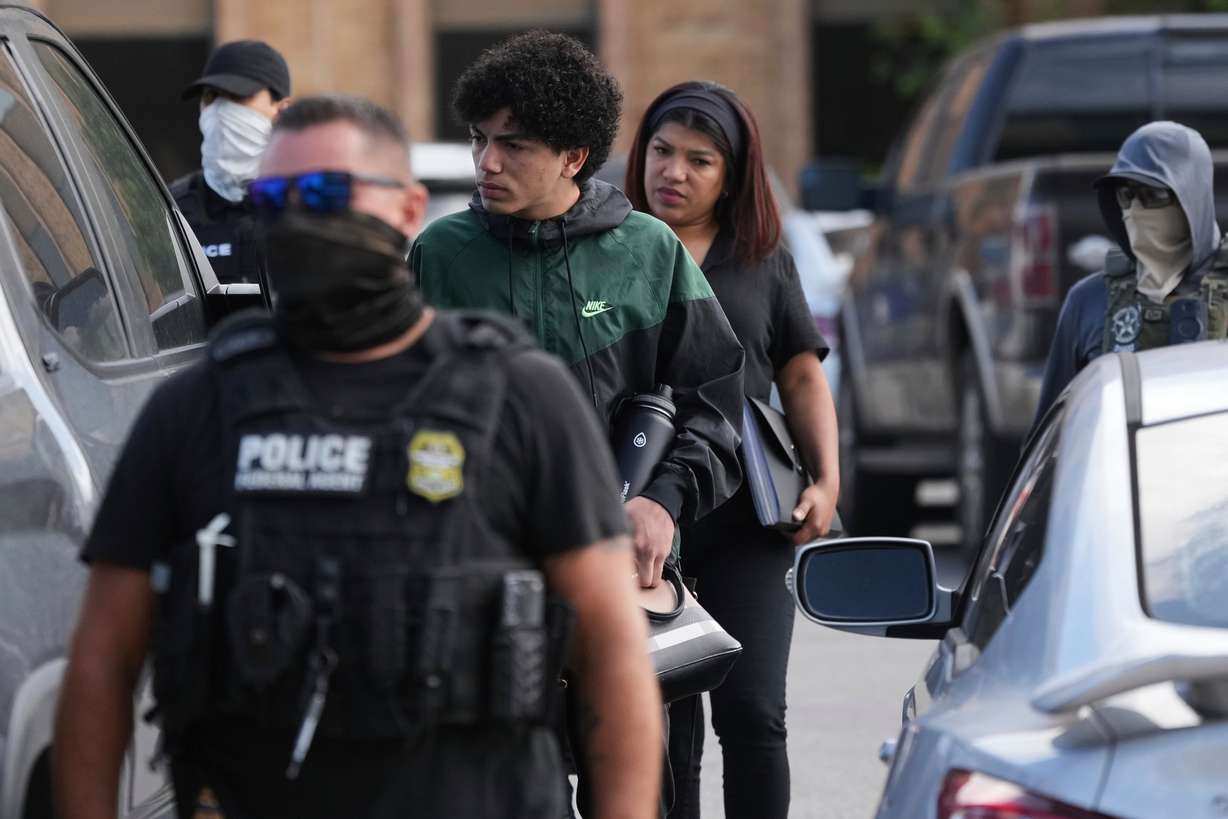
To supporters, the acceleration of federal agents arresting, detaining and removing unauthorized immigrants is the fulfillment of a nationwide mandate. Following the largest wave of net migration in U.S. history during the Biden administration, Trump vowed to advance a deportation agenda unlike anything the country had seen before.
But advocates on both sides of the issue — and the people caught in the middle — seem to agree there is no easy way out of the country's immigration dilemma. There have been real economic and social costs to unrestrained illegal immigration. And uprooting the immigrants who have made their home in the U.S. will likewise prove to be economically and socially painful.
The crux of the debate is which trade-off is worth it — an impasse that, according to a variety of western voices, stems from the failure of elected officials to achieve two apparently consensus positions: ensuring a secure border and providing a legal pathway for immigrants to meet U.S. labor needs and to maintain America's status as a beacon to the world.
Related:

Gov. Cox announces efforts to assist in deportations once Trump again takes office
Gov. Spencer Cox announced plans to assist the Trump administration in deporting undocumented immigrants who have committed crimes and demonstrate a public safety threat.Arrests in the West by the numbers

Trump's immigration crackdown has left no state untouched, but in the West it has shifted most significantly in states like Utah, Nevada and Idaho, where deportation efforts were previously small, and in California, where the administration has ramped up enforcement tactics in recent weeks.
The Deseret News was able to identify trends in ICE apprehensions across western states by analyzing a national dataset published on June 21 by the Deportation Data Project, obtained from ICE through a Freedom of Information Act lawsuit brought by the UCLA Center for Immigration Law and Policy.
The data include nearly 250,000 anonymous records of ICE apprehensions dating from Sept. 1, 2023, to June 10, 2025, categorized by location, method, ICE program, criminal status and country of origin. Arrest information is organized by ICE areas of responsibility, which often include multiple states, but can be broken down into approximate totals for each state.
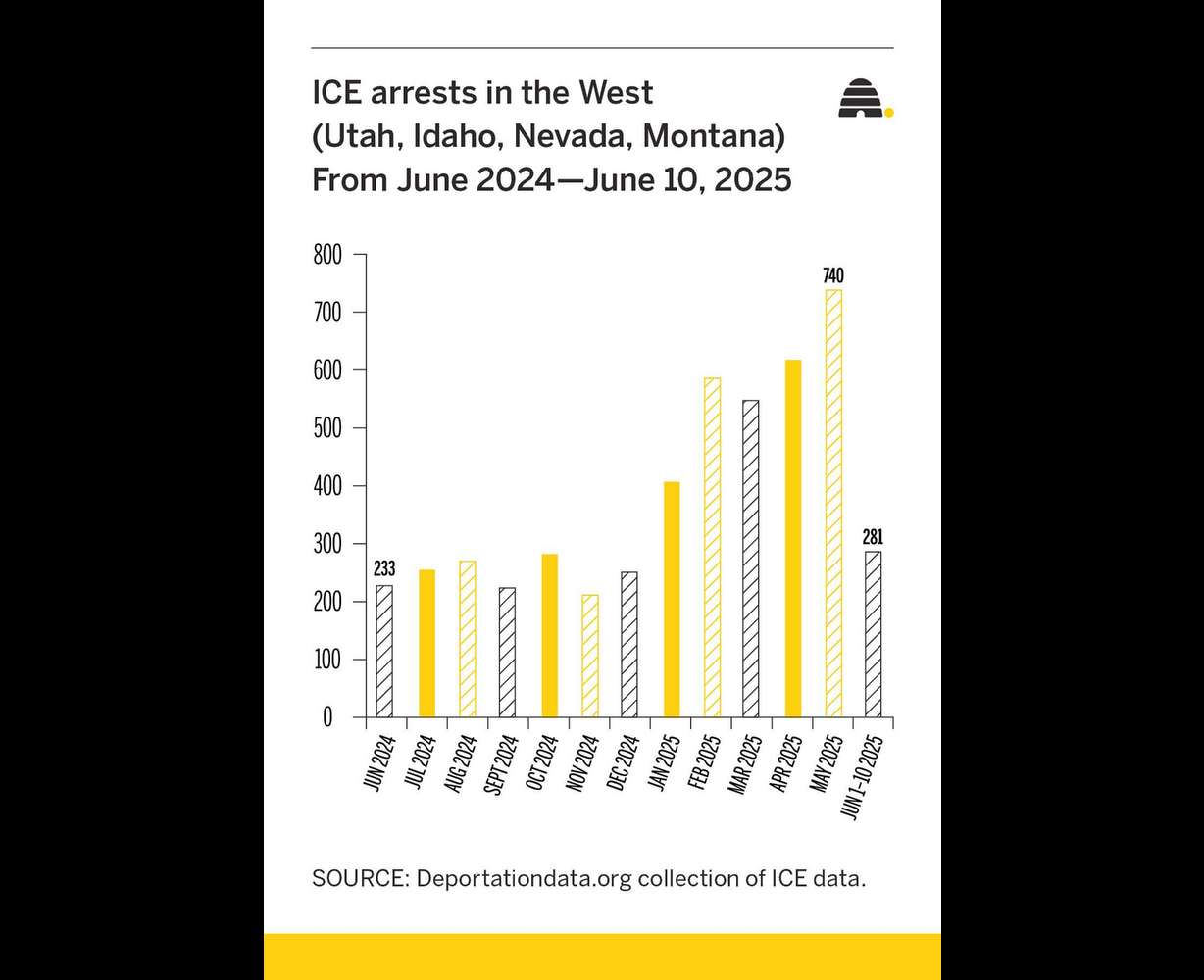
The ICE Salt Lake City area of responsibility, spanning Utah, Nevada, Idaho and Montana, has seen monthly ICE arrests triple from 250 in December 2024 to 740 in May, the last month with complete data.
There were 281 ICE arrests in the first 10 days of June, putting ICE on track to surpass May's total by at least 100 arrests across the four states.
Along with this jump in total arrests, ICE's Salt Lake City Field Office has increasingly targeted individuals who are not already in police custody — which saw a more than eightfold jump since December — and those with no pending criminal charges or convictions, which saw a ninefold increase.
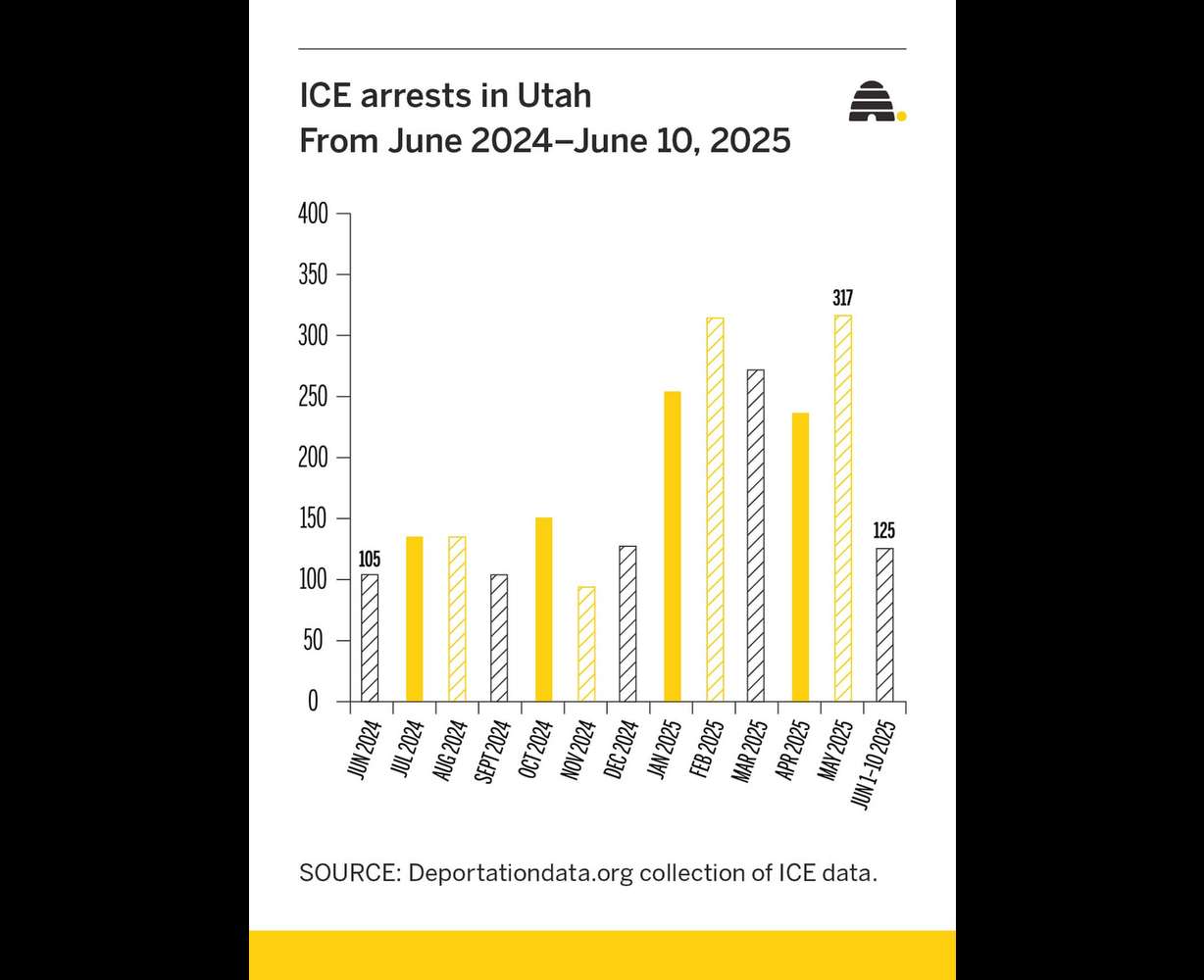
This trend was magnified in Utah where total ICE arrests increased by 150% from around 127 in December to 317 in May, and 125 in the first 10 days of June, with street arrests and non-criminal arrests comprising up to one-fifth of the total — a ratio that increased to one-third in June.
During this six-month period, the number of Utah "non-custodial" ICE arrests — occurring outside the jail or prison system — increased from just two in December to 37 in May, and the number of unauthorized immigrants arrested without any prior run-ins with the law increased from five per month to 63, with 42 in the first 10 days of June.
One source of the increase in ICE arrests can be attributed to more cooperation between ICE and local law enforcement in Utah via the federal government's 287(g) program, which trains sheriff's offices to verify the legal status of immigrants, according to Weber County Sheriff Ryan Arbon.
"In Utah, this year, our conversation and partnership with ICE has been a big improvement," Arbon told the Deseret News.
Nevada and Idaho have seen similar jumps in ICE arrests. In Nevada, total arrests went up fivefold from around 60 a month to 284 a month; and in Idaho, they climbed fourfold from around 23 a month to 89 a month, with both states experiencing a new focus on unauthorized immigrants with no criminal record.
Despite having a higher baseline of immigration law enforcement, border states like Arizona and California, which have their own ICE field offices, had the exact same pattern play out over the previous six months.
ICE apprehensions in Arizona, where monthly arrests stood at 346 before January, doubled to 693 by May, with June numbers on track to hit 950. Likewise, monthly arrests in California spiked from 548 in December to 1,570 in May, with 1,279 arrests already recorded in the first 10 days of June — 60% of which involved individuals with no criminal record.
The effect on Utah immigrants

The Trump administration's approach to immigration inspires conflicting sentiments for Carlos Moreno. Last year, two years after becoming a U.S. citizen, Moreno was carried to victory in his bid to represent the West Side of Salt Lake County with his slogan, "America is not a dream, America is a miracle."
A decade ago, Moreno was charged with treason by the Venezuelan government for speaking out against its socialist dictatorship. Moreno was granted political asylum in the U.S. before applying for a green card and completing his naturalization in 2022.
A firm conservative, Moreno has been outspoken about the dangers of organized crime associated with illegal immigration and even helped local agents investigate the presence of Tren de Aragua, a violent Venezuelan gang, in Utah.
But while he believes the Trump administration is focusing deportations on those who pose a threat to Utahns, he said a change in rhetoric has created a climate of fear among immigrants who make up a big part of his constituency in places like Magna and Kearns.
Last month, Moreno met with Latino and non-Latino pastors from his district at the Utah Capitol who told him that their congregants were so scared of the Trump administration's policy of allowing immigration raids at houses of worship that they had stopped coming to church altogether.
"When a leader is telling you that the people are afraid to show up to church, that's a problem," Moreno told the Deseret News. "We don't want that in our community."
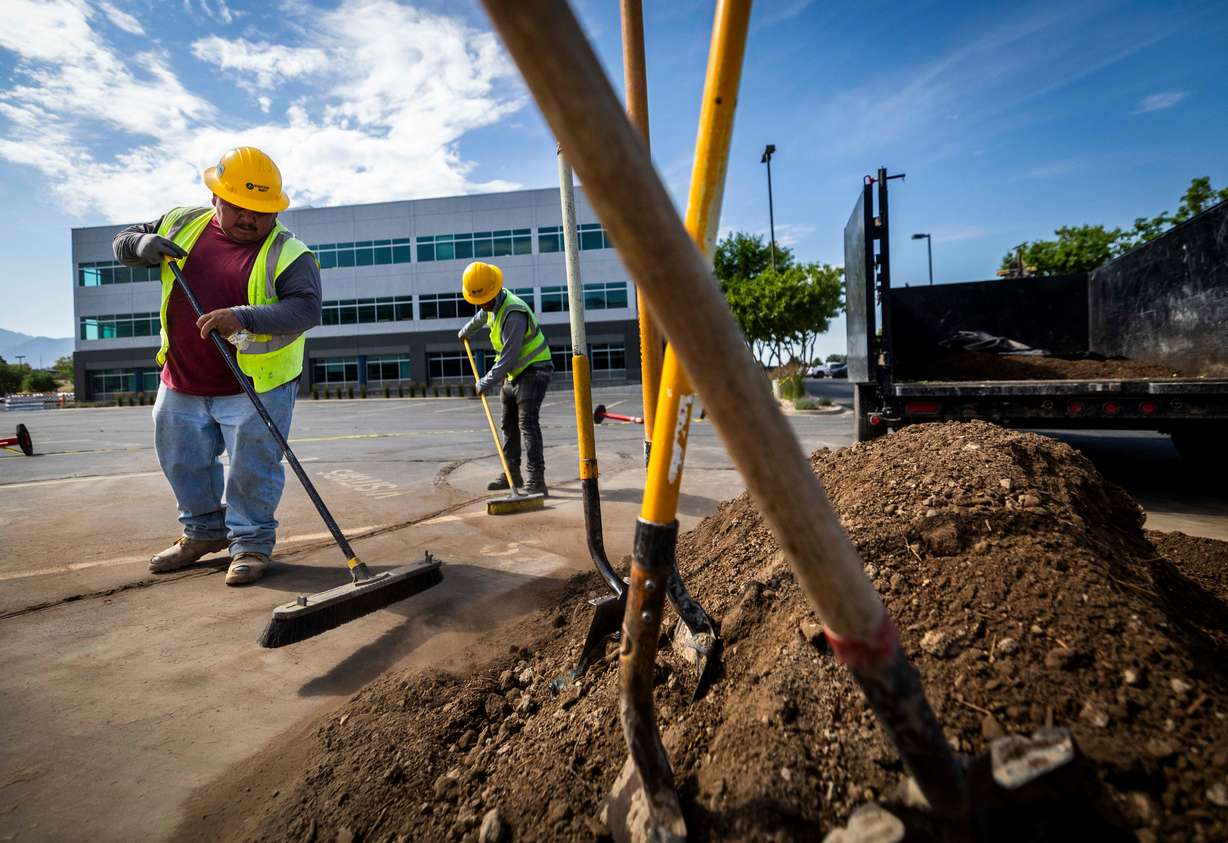
Juan Herrera, a permanent Utah resident, and Julio Hernandez, a seasonal visa applicant, both work for the Utah-based Stratton Landscape Group, and have seen first-hand what Moreno described.
Hernandez, who has come to Utah as a H-2B worker every summer for the past eight years, said the difficult situation of those who come to the U.S. illegally from countries with struggling economies has been exacerbated by Trump policy that has caused many to avoid public spaces.
"They have fear; they don't want to go to the store, or work or church," Hernandez said in Spanish. "They work out of necessity; they have to work, but they're still afraid."
Herrera, who came to the U.S. 45 years ago as a 15-year-old, was given a path to legal residency by President Ronald Reagan's signing of amnesty legislation in 1986.
Illegal immigration, he said, often hurts legal immigrants by depressing wages for construction jobs and filling up open gig-work spots like with DoorDash delivery. But that doesn't mean Herrera believes deportations are the answer.
"You don't have to get angry — we all come to search for a better future," Herrera said in Spanish.
The case against deportations
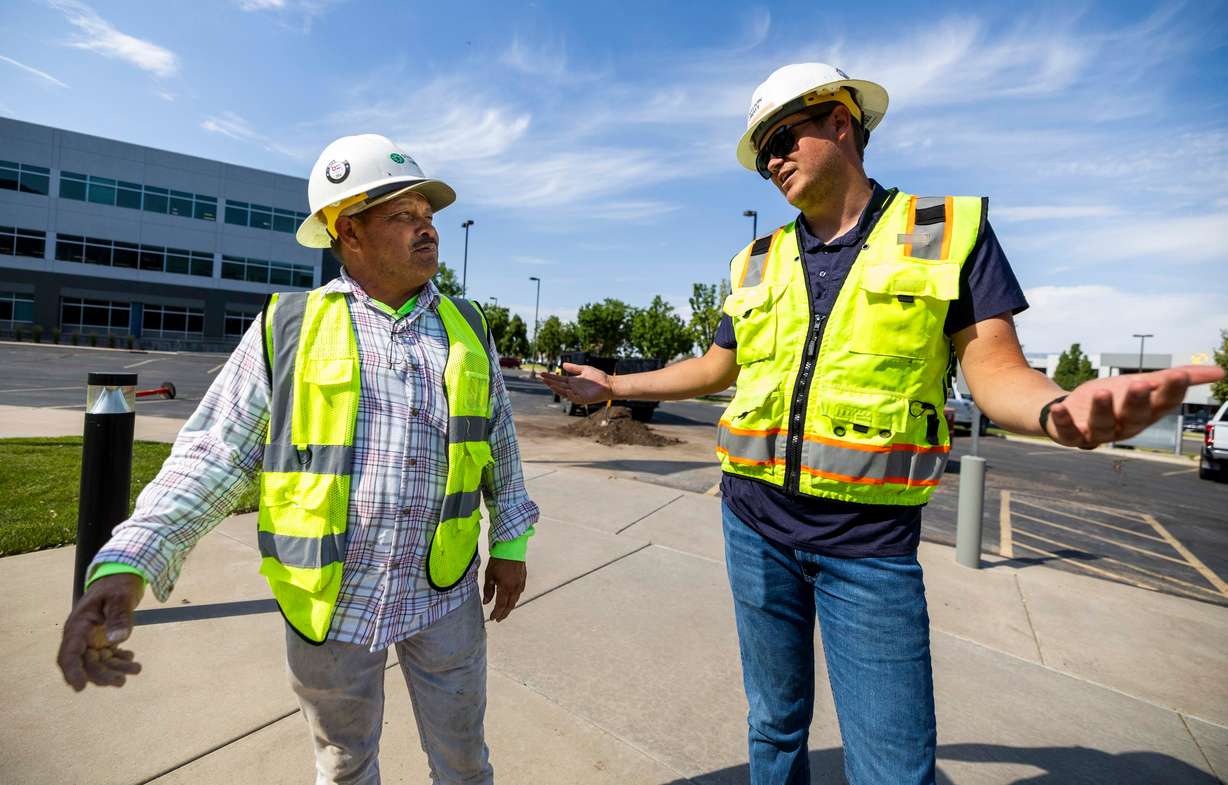
A single-minded focus on deportations ignores the needs of many businesses who are unable to find enough workers who are U.S. citizens, according to Keven Stratton, the chief impact officer and general counsel for Stratton Landscape Group.
For years, the company has struggled to maintain a sufficient workforce by applying for 30-60 H-2B visa workers each season through the government's antiquated lottery program that changes its nationwide quotas every year depending on Congress.
"I've never seen a more arbitrary process in deciding who can come and who can't," Stratton said.
To qualify for seasonal immigration visas, companies have to prove that they advertised their open positions to citizens and were unable to find employees: Stratton Landscape Group is lucky if it ever gets one local applicant, Stratton said.
Not only does a "deport-them-all" mindset obscure this economic reality, it is "antithetical" to the western ethos of a "pioneer" community, Stratton said, pointing to the Utah Compact which committed to maintain the rule of law, integrate immigrants into the economy and avoid family separation.
"I still think that is ... who we are; we believe in pragmatic solutions that can help our neighbors," Stratton said. "We've got to remember that the people at the heart of this debate are people."
Related:
After 15 years, do Utah Compact principles on immigration and policing still hold true?
The Utah Compact was praised in 2010 for saying police should focus on criminal, not civil violations. Fifteen years later, do law enforcers believe that principle still rings true today?Whether Trump's deportation policies actually remove a significant number of unauthorized workers, or just cause legal immigrants to stay indoors, the impact will be negative for Utah restaurants, according to Melva Sine, the CEO of the Utah Restaurant Association.
Approximately 25% of Utah restaurants are immigrant-owned, Sine said. A 2023 report by the American Immigration Council calculated there were roughly 113,000 unauthorized immigrants in the state of Utah, with immigrants making up around 20% of the construction workforce.
Nationwide, about two-thirds of crop workers are immigrants and more than 40% of them are not legally authorized to work in the U.S., according to the Department of Agriculture. Around 40% of meat packers are also immigrants, with over 20% being unauthorized, the Wall Street Journal reported.
In Nevada, the message coming from the Trump administration has pushed local immigration advocacy groups to cancel events, prompted vendors to close outdoor markets and has threatened to discourage domestic and international travel, according to Ted Pappageorge, the secretary-treasurer for the Nevada Culinary Union.
"Everybody agrees that drug dealers, terrorists and violent criminals should be deported," Pappageorge said. "Going after anybody that they view potentially could be an immigrant and, who might be undocumented or might not, we don't think people voted for that."
The most recent ICE arrest and detention data is a "total refutation" of statements from Trump and his border czar, Tom Homan, during the 2024 election cycle that they would initially focus their deportation efforts on violent criminals, according to David Bier, the Cato Institutes' director of immigration studies.
Nonpublic data obtained by Cato found that two-thirds of unauthorized immigrants recently booked into ICE detention facilities during the first half of 2025 had not been convicted of a crime. During that time, only 11% of all ICE book-ins had been convicted of either violent or property crimes.
The Department of Homeland Security, which oversees ICE, published an article disputing this data, arguing that during Trump's first 100 days, 70% of ICE arrests were of unauthorized immigrants with convictions or pending charges, and that operations continue to be "highly targeted."
But this was before a clear change in strategy beginning last month, Bier said. By June, ICE was arresting an average of 4,000 people per week with no criminal charges or convictions, Bier reported, up from around 250 a week under Biden and around 1,000 a week during the first Trump administration.
What makes current ICE enforcement efforts so unprecedented is actually the shift in focus away from violent offenders to those with no criminal record, Bier said, likely in an effort to reach a quota of 3,000 daily ICE arrests implemented in late May.
"They're just showing up at businesses that they think hire a lot of immigrants, lining people up and demanding to see their documents," Bier told the Deseret News. "And if they say, 'no,' they arrest them. That's what we're seeing."
Bier grants that population growth of the kind spurred by an open border policy creates serious problems. But these are not as impactful on communities, businesses and the nation's fiscal balance sheet, including its welfare system, as population decline, he said.
I've never seen a more arbitrary process in deciding who can come (to the U.S.) and who can't.
–Keven Stratton, chief impact officer and general counsel for Stratton Landscape Group
The case for deportations
In a statement given to the Deseret News, an ICE spokesperson said that, "All immigration enforcement operations, including those in the Salt Lake City area of responsibility are consistent with efforts to prioritize the apprehension and removal of individuals who pose significant threats to public safety."
"However, all aliens who remain in the United States without a lawful immigration status may be subject to arrest and removal," the statement continued. "For such aliens, the safest and most efficient option is self-deportation."
This is, in fact, what a majority of U.S. voters voted for, said Mark Krikorian, who has helmed the Center for Immigration Studies as its executive director since 1995, as a leading national voice against mass immigration.
Polls conducted this year seem to support Krikorian's claim, but may tell a shifting story as voters get a taste for what mass deportations look like. An Axios/Ipsos poll conducted in January found that 66% of Americans supported deporting immigrants who are in the country illegally.
A Deseret News/HarrisX poll from February found that 56% of the country supported the deportation of all undocumented immigrants. An Axios/Ipsos poll from April put the number at 51%. But a PBS News/NPR/Marist poll conducted in June found that 54% of U.S. adults thought ICE actions had "gone too far."
Independent of public opinion, the changes taking place over the past several months are really just the first steps toward putting an end to what Krikorian sees as decades of refusal by both Democrats and Republicans to enforce the nation's immigration laws.
In addition to increasing public safety by removing criminals who shouldn't be here in the first place, Krikorian said that deportations will also improve opportunities for those who have dropped out of the workforce, help taxpayers by reducing the strain on social services and benefit the political order by showing voters that their voices actually matter.
"The president clearly has a mandate to remove illegal immigrants regardless of whether they've committed crimes or not," Krikorian told the Deseret News.
A visible increase in worksite raids, visa overstay enforcement and apprehension of those who stayed in the country through Biden's expanded asylum programs is exactly what will convince millions of immigrants to leave the country on their own to achieve Trump's aims, according to Krikorian.
There will obviously be "disruptions" to society as the government attempts to "unwind this mess" that was multiple administrations in the making, Krikorian said. But he believes that the benefits of reversing mass immigration will outweigh the "inconvenience" of ending "a decades-long impunity for breaking immigration laws."