'%3e%3cpath%20d='M34.1406%205.85938C30.3906%202.10547%2025.3047%200%2020%200C14.6953%200%209.60938%202.10547%205.85938%205.85938C2.10938%209.61328%200%2014.6953%200%2020C0%2025.3047%202.10547%2030.3906%205.85938%2034.1406C9.61328%2037.8906%2014.6953%2040%2020%2040C25.3047%2040%2030.3906%2037.8945%2034.1406%2034.1406C37.8906%2030.3906%2040%2025.3047%2040%2020C40%2014.6953%2037.8945%209.60938%2034.1406%205.85938ZM37.0117%2023.543H31.1602V13.5391H27.6328V19.9414C28.1211%2020.6914%2028.3711%2021.582%2028.3711%2022.5625V22.625C28.3711%2023.668%2028.1172%2024.6055%2027.6328%2025.4297V26.6094H36.082C33.4883%2032.9375%2027.2891%2037.3789%2020.0039%2037.3789C10.3711%2037.3789%202.62109%2029.6289%202.62109%2020C2.62109%2010.3711%2010.3711%202.62109%2020%202.62109C29.6289%202.62109%2037.3789%2010.3711%2037.3789%2020C37.3789%2021.1484%2037.2617%2022.2656%2037.0508%2023.3477C37.0391%2023.4141%2037.0234%2023.4766%2037.0117%2023.543Z'%20fill='white'/%3e%3cpath%20d='M22.3086%2018.5352C20.4336%2018.125%2019.9531%2017.8398%2019.9766%2017.1836V17.1406C19.9766%2016.6992%2020.3477%2016.2148%2021.4023%2016.2148C22.582%2016.2148%2023.8867%2016.6797%2025.0781%2017.4766L26.8516%2015.0195C25.4453%2013.8906%2023.707%2013.3398%2021.5547%2013.3398C18.5195%2013.3398%2016.4375%2015%2016.4063%2017.4766V17.5352C16.3633%2020.2617%2018.5859%2020.9805%2021.293%2021.6016C23.0391%2021.9766%2023.5703%2022.3164%2023.5703%2022.9609L23.5469%2022.9766C23.5469%2023.3906%2023.2578%2023.7031%2022.7852%2023.8359C22.5742%2023.9062%2022.1289%2023.9727%2021.5156%2023.9727C20.7617%2023.9727%2019.7539%2023.8633%2018.6328%2023.4844C18.0898%2023.2891%2017.4727%2023.0039%2016.8047%2022.6133L20.1406%2026.625C20.2813%2026.6602%2021.0977%2026.8516%2021.7734%2026.8516C25.0039%2026.8516%2027.0859%2025.2461%2027.1094%2022.6328V22.5703C27.1602%2020.1133%2025.2148%2019.1719%2022.3086%2018.5352Z'%20fill='white'/%3e%3cpath%20d='M5.24219%2013.5664V26.6133H8.75391V23.7578L10.2969%2021.9531L14.2031%2026.6133H18.3867L12.3555%2019.5195L17.4023%2013.5664H13.4531L8.75391%2019.0586V13.5664H5.24219Z'%20fill='white'/%3e%3c/g%3e%3cdefs%3e%3cclipPath%20id='clip0_97_2430'%3e%3crect%20width='40'%20height='40'%20fill='white'/%3e%3c/clipPath%3e%3c/defs%3e%3c/svg%3e)




Estimated read time: 4-5 minutes
This archived news story is available only for your personal, non-commercial use. Information in the story may be outdated or superseded by additional information. Reading or replaying the story in its archived form does not constitute a republication of the story.
SALT LAKE CITY — The U.S. economy is improving by many measures. Yet, pessimism persists when it comes to how the public feels about the economy.
A December report from the U.S. Department of Labor showed that employers added 199,000 jobs in November and the unemployment rate dropped to 3.7%. Inflation has also seen a sharp decline, dropping from 9.1% to 3.2% without causing a recession, something many economists thought was imminent (and some still do).
At the same time, consumer sentiment is low. Below pre-pandemic levels, even.
Consumer sentiment is a statistical measurement of the overall health of the economy as determined by consumer opinion, taking into account people's feelings toward their current financial health, the health of the economy in the short term, and the prospects for longer-term economic growth, according to Investopedia. A higher consumer sentiment is typically considered good news for the economy.
Preliminary December data from the University of Michigan's Index of Consumer Sentiment measures consumer sentiment for this month at 69.4 — a rise from November's 61.3 but still, many Americans don't feel good about how the economy is working for them.
The disconnect
So, what's the explanation for this? And if consumer sentiment is low, are people still participating in the economy?
"Since the pandemic ... consumer sentiment isn't fully reflected in actual economic activity," said Phil Dean, chief economist at the University of Utah's Kem C. Gardner Policy Institute. "There's kind of this disconnect that's emerged since the pandemic where people are very pessimistic about what's going on in the economy and even so, they're still out buying a lot of things."
So, perhaps unexpectedly considering consumer sentiment, economic activity is still happening, and Dean thinks there are a couple of reasons that point to why.
One, he said, is that Americans have been through a lot of volatile economic times over the past few years.
"People were already not feeling great about the economy during the early pandemic, but where we really started to see significant declines was as inflation emerged. As prices went up faster than normal, that's when we saw these declines (in consumer sentiment), and it's kind of stayed at lower levels. We have seen some upticks but, you know, levels still lower than the early pandemic when it seemed like the economy was in free-fall."
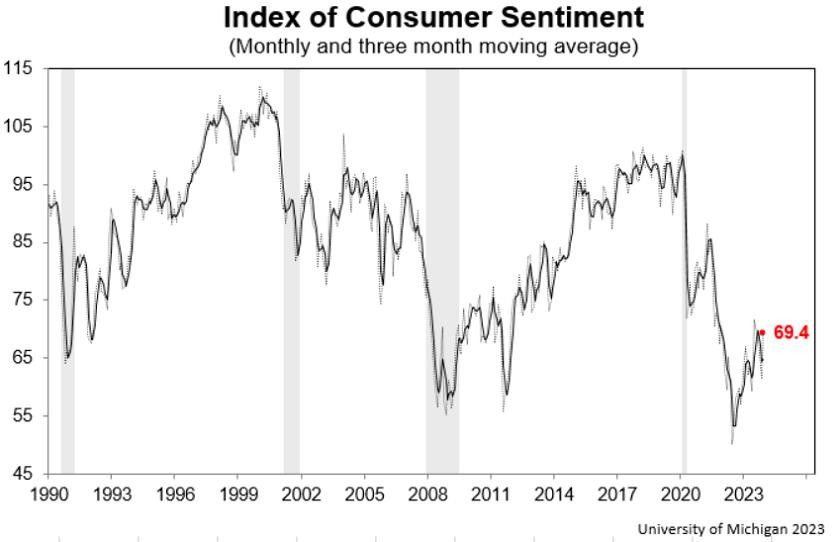
Dean said a lot of this can be tied to the general frustration people are feeling around inflation. Even though inflation has been dropping as of late, it's not much cause for celebration as prices for things like groceries and gas are still a lot higher than they used to be.
"Inflation coming down doesn't mean prices coming down, it just means prices are going up at a slower rate," Dean said.
This, as Dean sees it, is the heart of the issue when it comes to the imbalance between recent economic trends and consumer sentiment.
He also said that news cycles — which people are more tapped into than ever with smartphones and social media — can have an impact on people's thoughts about the economy.
"Whether it's news cycles about inflation or about other things, that as well as the prices people actually see in their day-to-day lives ... those both influence consumer sentiment," Dean said.
How Utah compares to the country
Piggybacking off the University of Michigan's consumer sentiment survey, which was created in the 1940s, the Gardner Institute has carried out its own consumer sentiment survey that measures Utahn's feelings about the economy.
November data from the Gardner Institute shows Utah's consumer sentiment at 73.6, far higher than the country, which came in at 61.3. While the institute's survey generally tracks the same trends as the University of Michigan's survey, Utahns feeling better about the economy than their fellow Americans isn't a new trend.
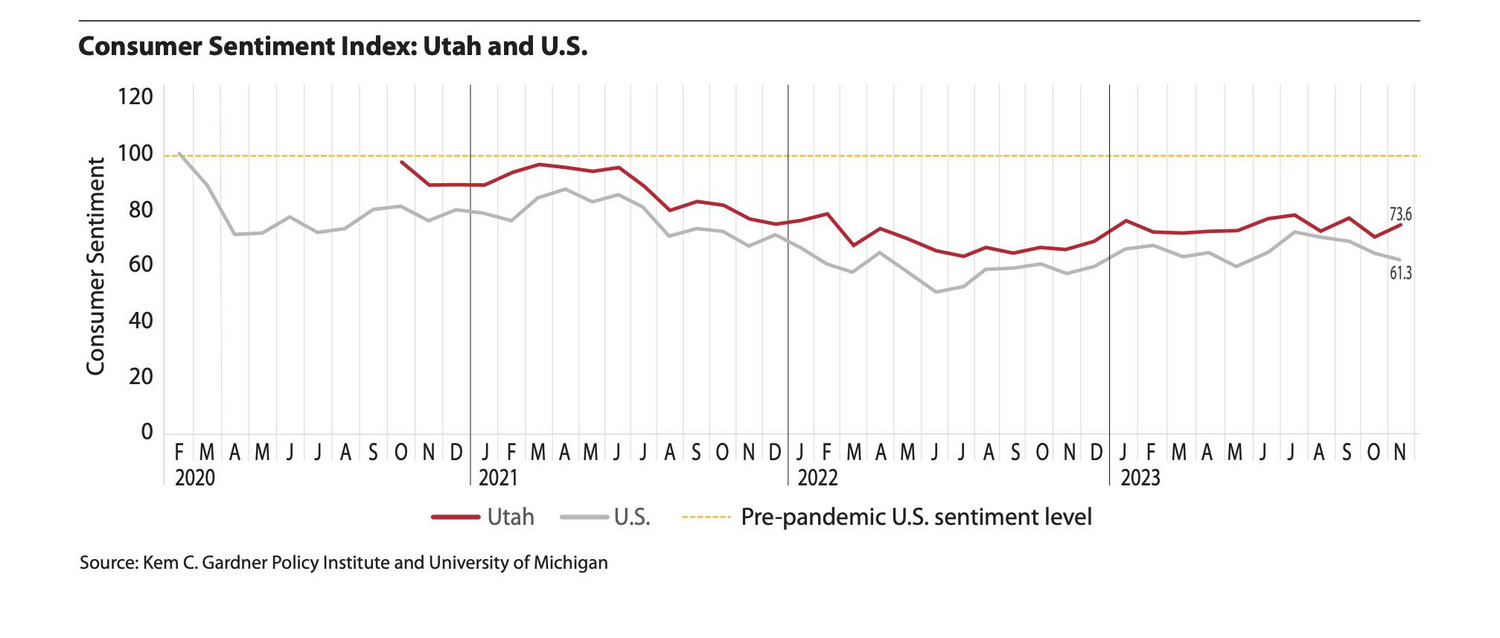
"Utah's economy definitely has outperformed the U.S. economy pretty consistently," Dean said. "Definitely through the pandemic period but even before then. So, I think Utahns are rightly more optimistic about the economy because they're feeling more comfortable in their own day-to-day lives."
Is consumer sentiment still a good economic measuring stick?
As far as recent years, when asked how he feels about using consumer sentiment to measure the overall health of the economy, Dean said, "Not great."
But he doesn't think that will last.
"I do think over time, as the economy normalizes, I do think it will again be a more meaningful measure than it has been over the last couple years," Dean said. "Going back to this (University of Michigan) survey, it has been a fairly consistent, leading indicator for what consumers are doing and their actual buying habits, so I expect over time, it will return to that."