'%3e%3cpath%20d='M34.1406%205.85938C30.3906%202.10547%2025.3047%200%2020%200C14.6953%200%209.60938%202.10547%205.85938%205.85938C2.10938%209.61328%200%2014.6953%200%2020C0%2025.3047%202.10547%2030.3906%205.85938%2034.1406C9.61328%2037.8906%2014.6953%2040%2020%2040C25.3047%2040%2030.3906%2037.8945%2034.1406%2034.1406C37.8906%2030.3906%2040%2025.3047%2040%2020C40%2014.6953%2037.8945%209.60938%2034.1406%205.85938ZM37.0117%2023.543H31.1602V13.5391H27.6328V19.9414C28.1211%2020.6914%2028.3711%2021.582%2028.3711%2022.5625V22.625C28.3711%2023.668%2028.1172%2024.6055%2027.6328%2025.4297V26.6094H36.082C33.4883%2032.9375%2027.2891%2037.3789%2020.0039%2037.3789C10.3711%2037.3789%202.62109%2029.6289%202.62109%2020C2.62109%2010.3711%2010.3711%202.62109%2020%202.62109C29.6289%202.62109%2037.3789%2010.3711%2037.3789%2020C37.3789%2021.1484%2037.2617%2022.2656%2037.0508%2023.3477C37.0391%2023.4141%2037.0234%2023.4766%2037.0117%2023.543Z'%20fill='white'/%3e%3cpath%20d='M22.3086%2018.5352C20.4336%2018.125%2019.9531%2017.8398%2019.9766%2017.1836V17.1406C19.9766%2016.6992%2020.3477%2016.2148%2021.4023%2016.2148C22.582%2016.2148%2023.8867%2016.6797%2025.0781%2017.4766L26.8516%2015.0195C25.4453%2013.8906%2023.707%2013.3398%2021.5547%2013.3398C18.5195%2013.3398%2016.4375%2015%2016.4063%2017.4766V17.5352C16.3633%2020.2617%2018.5859%2020.9805%2021.293%2021.6016C23.0391%2021.9766%2023.5703%2022.3164%2023.5703%2022.9609L23.5469%2022.9766C23.5469%2023.3906%2023.2578%2023.7031%2022.7852%2023.8359C22.5742%2023.9062%2022.1289%2023.9727%2021.5156%2023.9727C20.7617%2023.9727%2019.7539%2023.8633%2018.6328%2023.4844C18.0898%2023.2891%2017.4727%2023.0039%2016.8047%2022.6133L20.1406%2026.625C20.2813%2026.6602%2021.0977%2026.8516%2021.7734%2026.8516C25.0039%2026.8516%2027.0859%2025.2461%2027.1094%2022.6328V22.5703C27.1602%2020.1133%2025.2148%2019.1719%2022.3086%2018.5352Z'%20fill='white'/%3e%3cpath%20d='M5.24219%2013.5664V26.6133H8.75391V23.7578L10.2969%2021.9531L14.2031%2026.6133H18.3867L12.3555%2019.5195L17.4023%2013.5664H13.4531L8.75391%2019.0586V13.5664H5.24219Z'%20fill='white'/%3e%3c/g%3e%3cdefs%3e%3cclipPath%20id='clip0_97_2430'%3e%3crect%20width='40'%20height='40'%20fill='white'/%3e%3c/clipPath%3e%3c/defs%3e%3c/svg%3e)




Estimated read time: 4-5 minutes
This archived news story is available only for your personal, non-commercial use. Information in the story may be outdated or superseded by additional information. Reading or replaying the story in its archived form does not constitute a republication of the story.
PROVO — Line them up, one by one, and then send the entire bunch packing.
Welcome to November, the season of change in college football. For all the teams struggling this year, including BYU, passionate fan bases often demand the coaches pay the ultimate price.
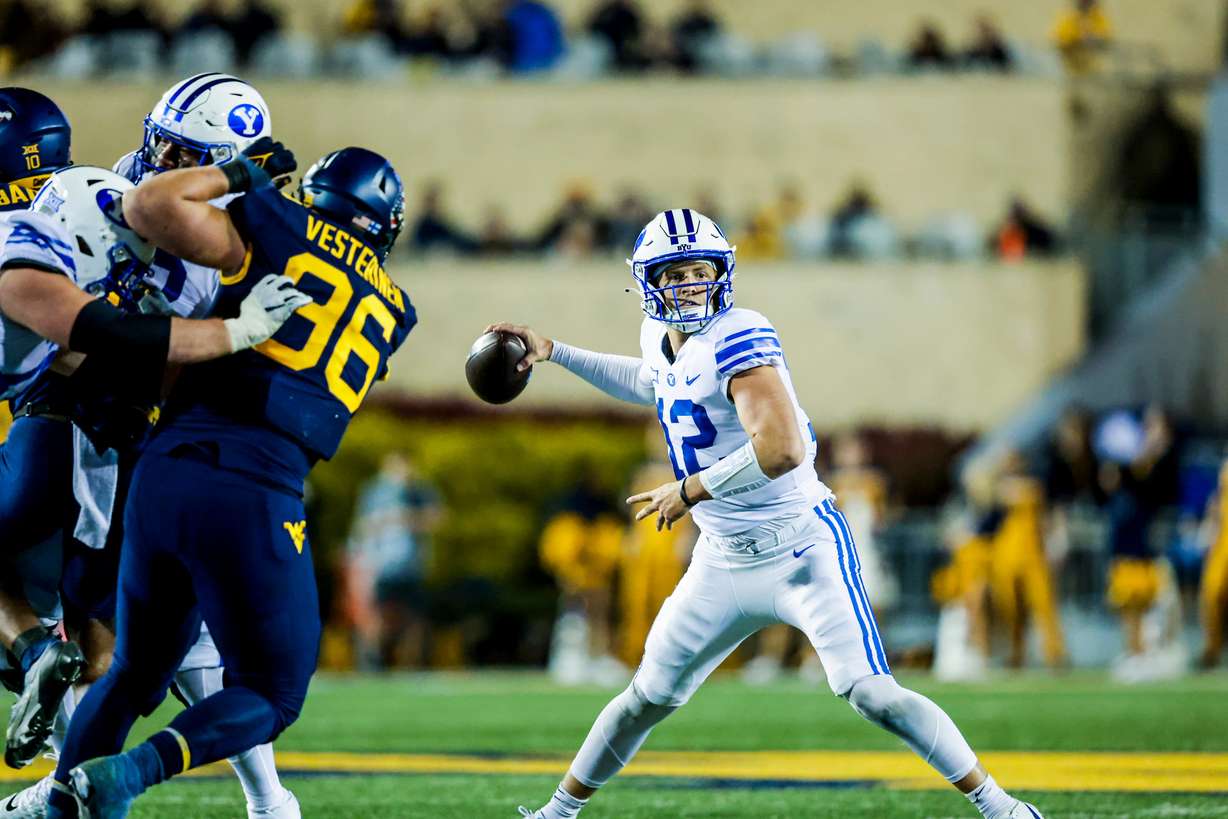
Social media has been ablaze with criticism directed at BYU, which has suffered three embarrassing defeats over the last four games. In losses to Texas Christian, Texas, and last week at West Virginia, the Cougars have been outscored a combined 116-24.
Each successive blowout has understandably intensified the heat on the coaches. With games against Iowa State at home, in which BYU is almost a double-digit underdog, and then against two nationally-ranked teams (No. 17 Oklahoma and No. 15 Oklahoma State), it's reasonable to conclude several on staff are coaching for their jobs.
"I have an obligation as a coach to make sure our team is functioning at a high level," Kalani Sitake said. "Are we doing that? No, that's my responsibility, and I'll figure that out."
More than likely, considering the wholesale changes made last offseason, first-year defensive coordinator Jay Hill and his coaches are safe unless athletic director Tom Holmoe prematurely fires coach Sitake. Unfair or not, the offensive staff could be in danger.
But be forewarned, sweeping coaching changes offer no guarantees of future success. In many cases, stability is the better answer.
Think back 13 years ago, the difference between Utah and Arizona State was startling. Fast forward to the present, the gap is still gaping, but the roles are significantly reversed.
As BYU apparently is in its first year in the Big 12, Utah was in no position to consistently compete upon entering the Pac-12. As good as Utah's roster was for years in the Mountain West Conference, the deficit in talent on a weekly basis in the Pac-12 was easily apparent.
The difference was clear to any discernible eye. The Pac-12 had an abundance of better athletes all over the field.
ASU was a prime example, a team that was typically bigger and stronger than the Utes. Pretty much nothing more than a middling Pac-10 program for two-plus decades, minus the occasional surprise season, the Sun Devils owned the Utes in the early days of the Pac-12.
ASU won the first four games between the two teams, even as the cycle of replacing fired coaches about twice a decade continued. The Sun Devils also took six out of the initial eight games.
But that was then. And this is now.
In a dramatic swing, beginning in 2019, the annually-ranked Utes have treated the desert-dwellers like a lousy high school program. The latest game was no different as Utah cruised to a 52-point win Saturday.
Why the change? Start at the top.
Since then-athletic director Chris Hill opened the bank to promote defensive coordinator Kyle Whittingham to head coach in 2004, ASU has stumbled through a battery of coaches. The parade of mediocrity included Dirk Koetter and continued down the line with Dennis Erickson, Todd Graham and Herm Edwards.
Meanwhile, Whittingham chugs along producing winning seasons like clockwork. Good thing Hill didn't decide to change coaches after the Utes endured consecutive losing seasons in 2012-13.
Down in Tempe, the search for the difference maker lingers on. And on.
Each coach was booted after no more than six seasons, in some cases getting a hefty paycheck to go away quietly. Edwards was the worst, overseeing a program that is still under NCAA investigation for serious recruiting violations during COVID lockdowns.
A former client of athletic director Ray Anderson, who was an NFL agent, Edwards had last coached in the NFL in 2008 and last coached in college in 1989. Yet Anderson thought the then-63-year-old was the man for the job.
All he did was drive the program into the ground and jobbed the university of gobs of money. The Sun Devils are on pace for their worst two-year run in 80 years.
The latest great hope is Kenny Dillingham, a 33-year-old boy wonder with a strong reputation of developing quarterbacks. Bo Nix, who thrived last season when Dillingham was offensive coordinator at Oregon, is the latest example.
At least the new coach has more in mind than banking a nice paycheck for a few years before moving on to the next gig. A Phoenix native, Dillingham graduated from ASU and has deep roots and connections in the Valley of the Sun.
Facing an arduous building task, Dillingham has stated his desire to follow Utah's blueprint.
As with the Utes and most teams, patience is required. Will BYU have that patience?