'%3e%3cpath%20d='M34.1406%205.85938C30.3906%202.10547%2025.3047%200%2020%200C14.6953%200%209.60938%202.10547%205.85938%205.85938C2.10938%209.61328%200%2014.6953%200%2020C0%2025.3047%202.10547%2030.3906%205.85938%2034.1406C9.61328%2037.8906%2014.6953%2040%2020%2040C25.3047%2040%2030.3906%2037.8945%2034.1406%2034.1406C37.8906%2030.3906%2040%2025.3047%2040%2020C40%2014.6953%2037.8945%209.60938%2034.1406%205.85938ZM37.0117%2023.543H31.1602V13.5391H27.6328V19.9414C28.1211%2020.6914%2028.3711%2021.582%2028.3711%2022.5625V22.625C28.3711%2023.668%2028.1172%2024.6055%2027.6328%2025.4297V26.6094H36.082C33.4883%2032.9375%2027.2891%2037.3789%2020.0039%2037.3789C10.3711%2037.3789%202.62109%2029.6289%202.62109%2020C2.62109%2010.3711%2010.3711%202.62109%2020%202.62109C29.6289%202.62109%2037.3789%2010.3711%2037.3789%2020C37.3789%2021.1484%2037.2617%2022.2656%2037.0508%2023.3477C37.0391%2023.4141%2037.0234%2023.4766%2037.0117%2023.543Z'%20fill='white'/%3e%3cpath%20d='M22.3086%2018.5352C20.4336%2018.125%2019.9531%2017.8398%2019.9766%2017.1836V17.1406C19.9766%2016.6992%2020.3477%2016.2148%2021.4023%2016.2148C22.582%2016.2148%2023.8867%2016.6797%2025.0781%2017.4766L26.8516%2015.0195C25.4453%2013.8906%2023.707%2013.3398%2021.5547%2013.3398C18.5195%2013.3398%2016.4375%2015%2016.4063%2017.4766V17.5352C16.3633%2020.2617%2018.5859%2020.9805%2021.293%2021.6016C23.0391%2021.9766%2023.5703%2022.3164%2023.5703%2022.9609L23.5469%2022.9766C23.5469%2023.3906%2023.2578%2023.7031%2022.7852%2023.8359C22.5742%2023.9062%2022.1289%2023.9727%2021.5156%2023.9727C20.7617%2023.9727%2019.7539%2023.8633%2018.6328%2023.4844C18.0898%2023.2891%2017.4727%2023.0039%2016.8047%2022.6133L20.1406%2026.625C20.2813%2026.6602%2021.0977%2026.8516%2021.7734%2026.8516C25.0039%2026.8516%2027.0859%2025.2461%2027.1094%2022.6328V22.5703C27.1602%2020.1133%2025.2148%2019.1719%2022.3086%2018.5352Z'%20fill='white'/%3e%3cpath%20d='M5.24219%2013.5664V26.6133H8.75391V23.7578L10.2969%2021.9531L14.2031%2026.6133H18.3867L12.3555%2019.5195L17.4023%2013.5664H13.4531L8.75391%2019.0586V13.5664H5.24219Z'%20fill='white'/%3e%3c/g%3e%3cdefs%3e%3cclipPath%20id='clip0_97_2430'%3e%3crect%20width='40'%20height='40'%20fill='white'/%3e%3c/clipPath%3e%3c/defs%3e%3c/svg%3e)




Estimated read time: 3-4 minutes
This archived news story is available only for your personal, non-commercial use. Information in the story may be outdated or superseded by additional information. Reading or replaying the story in its archived form does not constitute a republication of the story.
SALT LAKE CITY — The Utah Bionic Leg was just named one of the best inventions of 2023 by TIME Magazine.
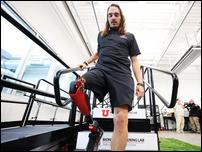
Developed by Tommaso Lenzi, associate professor at the University of Utah's Department of Mechanical Engineering and director of the HGN Bionic Engineering Lab, the Utah Bionic Leg uses motors, processors and advanced artificial intelligence that work in concert to give amputees the power and mobility to do things that might seem routine to the average person, such as walk, stand up, sit down, walk up and down stairs and ramps and even traverse uneven ground.
Lenzi said that the technologies that make up the bionic leg "fundamentally work like the muscle cells in the nervous system of the leg."
Typically, amputees rely heavily on their upper body and intact leg to compensate for the lack of assistance from their prescribed prosthetics. This isn't as much of an issue with the Utah Bionic Leg, as the extra power from the prosthesis makes mobility easier.
"The 'passive' joints in traditional prostheses can't fully replicate the biomechanical functions of a biological leg," Lenzi said. "This makes walking substantially harder, especially on inclines or when climbing stairs. It also leads to users compensating for their prostheses' deficiencies with other parts of their bodies, which can cause secondary complications, such as back pain and osteoarthritis."
The Utah Bionic Leg was named to TIME's "Experimental" category.
It's the advanced technology in the bionic leg that truly sets it apart from other motorized leg prostheses that have existed for more than 30 years.
"The leg uses custom-designed force and torque sensors as well as accelerometers and gyroscopes to help determine the leg's position in space. Those sensors are connected to a computer processor that translates the sensor inputs into movements of the prosthetic joints," said a release from the U.
"Based on that real-time data, the leg provides power to the motors in the joints to assist in walking, standing up, walking up and down stairs, or maneuvering around obstacles. The leg's 'smart transmission system' connects the electrical motors to the robotic joints of the prosthetic. This optimized system automatically adapts the joint behaviors for each activity, like shifting gears on a bike."
Essentially, the robotic knee, ankle and toe joints allow users to control the prosthetic intuitively and for long periods of time, just like they would with an intact leg.
Related:
A leg up on the competition: U. develops the most advanced bionic leg ever created
The University of Utah is announcing a partnership with Ottobock — a leader in prosthetics — to bring the Utah Bionic Leg to more individuals with lower-limb amputations.It's also extremely lightweight, something essential for usability, said Alec McMorris, a Grantsville High School football coach and amputee who's worked closely with the U. for the last five years throughout the development of the Utah Bionic Leg.
"It's just so different. It's so much more technical and allows you to do so much more and it takes so much less energy. That's like the real big benefit for me," McMorris said.
As a football coach, McMorris is on his feet all the time and the Utah Bionic Leg allows him to do things he normally isn't able to do.
"Going upstairs and everything like that is awesome and I can't go upstairs naturally like that on my everyday device. But just being able to feel, like, how much less of a toll it takes on my body really makes a big difference," McMorris said.
A year ago, Lenzi and his team partnered with Ottobock — the world's largest prosthetics company — to bring the Utah Bionic Leg to more individuals with lower-limb amputations.
"We want to make sure the good ideas go from the lab to the market as soon as possible," Lenzi said. "With this partnership, engineers from my lab and Ottobock research and development division will work together. Together, we will build the most advanced bionic leg in the world, and bring it to the people."