Estimated read time: 3-4 minutes
This archived news story is available only for your personal, non-commercial use. Information in the story may be outdated or superseded by additional information. Reading or replaying the story in its archived form does not constitute a republication of the story.
CLEARFIELD — A northern Utah aquatics center has implemented the state's first public pool drowning detection technology to increase swimmers' safety.
WAVE Drowning Detection Systems consists of a lightweight headset worn by swimmers that sends wireless signals to devices worn by lifeguards. If a swimmer has been underwater for more than 20 seconds, lifeguards' devices will vibrate, alerting them that a swimmer may be in danger of drowning.
Shaundra Rushton, Clearfield's communications manager, said the city pursued WAVE not because of any past drownings but out of a desire to improve public safety measures.
A report from the U.S. Centers for Disease Control and Prevention reveals that drowning is the No. 1 cause of death for children ages 1-4 and the No. 2 cause of death for children ages 5-14, after car crashes.
Clearfield Aquatic and Fitness Center director Clint Warnick emphasized that using WAVE is an added safeguard. He compared it to the way airbags enhance drivers' safety in conjunction with using a seat belt.
"If an airbag will help, why would you not want an airbag?" Warnick said. "(WAVE) was never intended to replace lifeguards. … It's an extra layer of protection to make sure that our pool is as safe as possible."
As of May 1, the city pool requires patrons 12 and younger to use WAVE. Older swimmers are also welcome to use the technology as an extra precaution or to help normalize the technology for younger patrons.
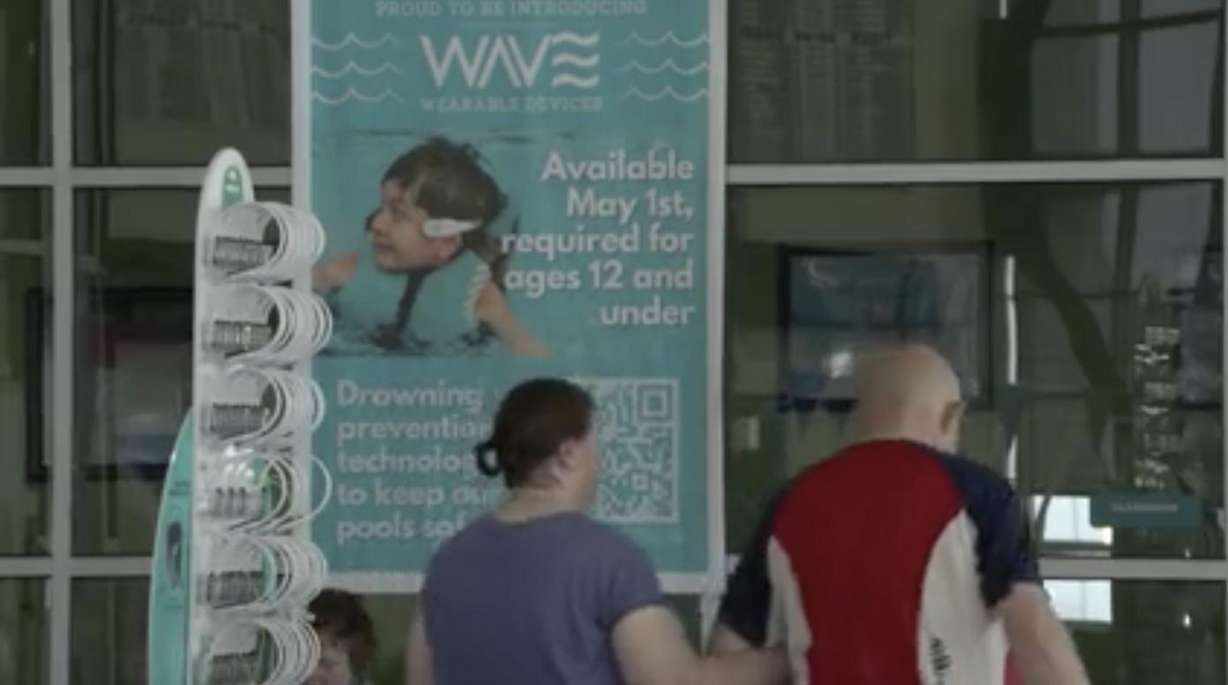
WAVE was launched in 2020 out of Westport, Connecticut. Co-founders Mark Caron and Dave Cutler started the company after a 9-year-old boy drowned at a town park where Cutler lived, despite the presence of five lifeguards and six camp counselors.
Park City School District was the first to bring WAVE to Utah, Warnick said. Clearfield has been the first public facility in Utah to adopt the technology.
Warnick's team spent around 18 months researching and budgeting for the program before implementing it at the pool. He said more Utah facilities have reached out to the Clearfield aquatics center with the intention of also implementing WAVE in the near future.
Public reception
Warnick said he initially saw backlash from patrons after the aquatic center announced its plan to start using WAVE. Parents expressed irritation at the headsets being mandatory and concerns that their children wouldn't keep the headsets on.
Since the implementation, however, Warnick said the technology has been well-received by most patrons.
(WAVE) was never intended to replace lifeguards. … It's an extra layer of protection to make sure that our pool is as safe as possible.
– Clint Warnick, Clearfield Aquatic & Fitness Center
"People were worried that their kids wouldn't wear it, or it would cause a lot of issues," Rushton said. "But what we found is actually the kids don't mind it at all. … When they put it on, they forget they're wearing it."
To anyone concerned about the efficacy, comfortability or need for WAVE, Rushton and Warnick encourage them to come to the aquatics center to try it out.
"People are nervous about it because it's new technology, but it's using the same technology as your Bluetooth earbuds," Rushton said. "Once [patrons] come try it, they realize that it's really effective and the kids don't mind using it. So we just ask that they come try it before they write it off."

Most recent Davis County stories
Related topics
 Gabrielle Shiozawa