Estimated read time: 6-7 minutes
This archived news story is available only for your personal, non-commercial use. Information in the story may be outdated or superseded by additional information. Reading or replaying the story in its archived form does not constitute a republication of the story.
SANDY — Scientists from the Environmental Protection Agency say they are "concerned" that ethylene oxide emissions from a medical device manufacturer may increase long-term cancer risk for some 700 nearby Sandy residents.
Although the risk is relatively low, the EPA held a virtual town hall meeting with officials from the Utah Division of Air Quality on Thursday night to share their findings with the public and answer questions.
"This might be upsetting or frustrating," EPA senior risk communication adviser Madeline Beal told the virtual audience on Thursday. "While I work for EPA, I'm also a mom of four young children, and as I have learned about this issue ... I have myself been concerned about how it would feel to be in the audience tonight and learn that there might be a risk to my family."
Ethylene oxide, or EtO, is an odorless, colorless gas that is primarily used to make other chemicals that are then used to make antifreeze, plastics, detergents and adhesives. It is also used to sterilize medical and dental devices that can't be sterilized using steam or radiation.
The chemical doesn't linger in the air for more than a few months and causes few immediate health effects, but long-term exposure is believed to increase blood and breast cancers, according to the EPA.
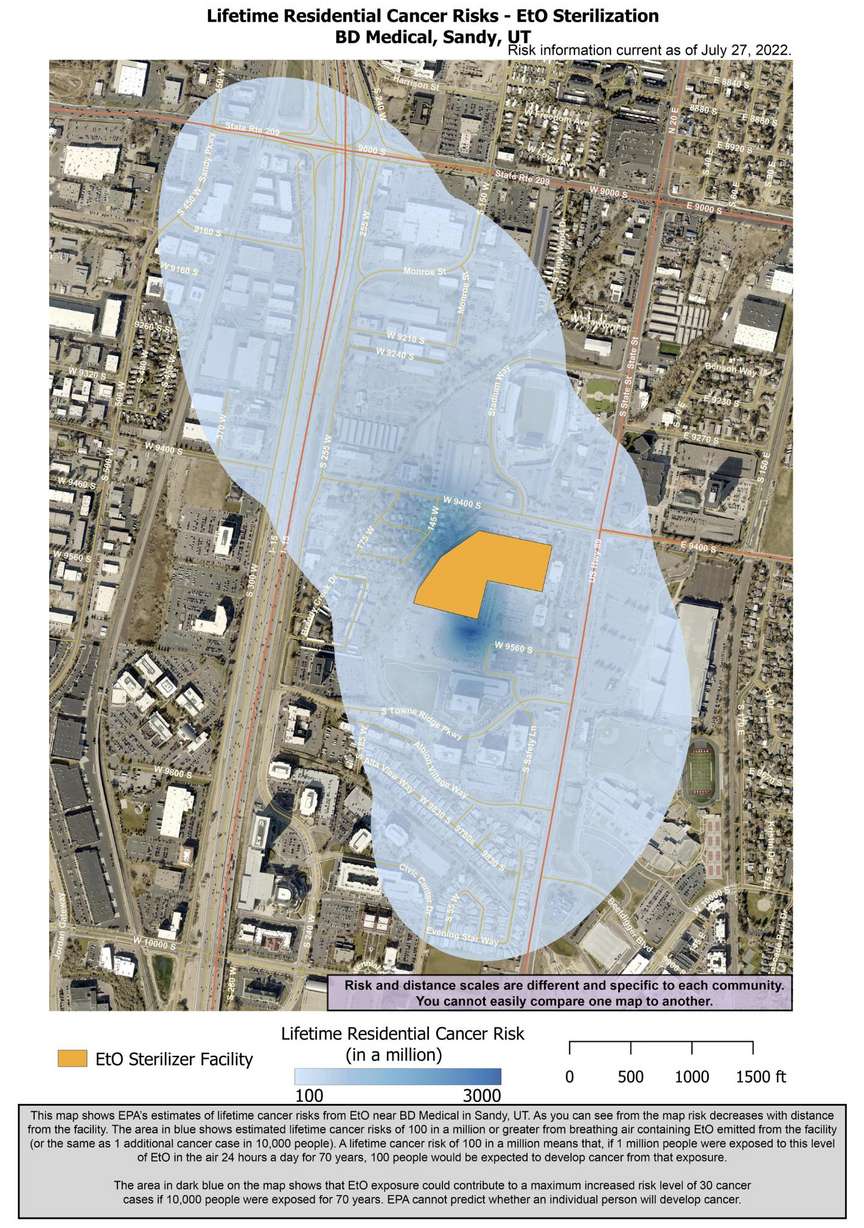
EPA officials say they used computer models to estimate the risk of cancers due to emissions from a BD Medical facility located at 9450 S. State in Sandy, just south of America First Field, formerly known as Rio Tinto Stadium. The Utah Division of Air Quality said officials sampled ethylene oxide levels from eight locations near the facility, and said their findings were in line with the estimates the EPA used in its model.
The medical device manufacturing facility has been in operation since 2007 and uses ethylene oxide to sterilize IV catheters, valves and other devices.
Representatives from BD Medical said they attended the town hall, but were not given the chance to participate.
During the town hall, EPA officials presented a map showing the risk levels for cancer near the facility. The estimates are based on lifetime exposure to the chemical — which the agency counts as 24-hour exposure every day from birth to age 70. In the area closest to the facility, they estimate there will be close to 3,000 additional cancer cases per 1 million residents. Estimates drop to around 100 additional cases per 1 million residents for most of the remaining area close to the plant.
Kerry Hicks, air toxin coordinator for EPA Region 8, said there are just over 700 people living in the higher-risk area near the facility.
According to the EPA, BD Medical is compliant with current standards for emissions, but because the agency believes the chemical still presents a long-term risk, EPA is in the process of updating regulations to limit the amount of chemical that is released into the air.
The Sandy BD Medical facility isn't alone in drawing the EPA's concern. The agency is monitoring close to 100 sterilizers around the county — 23 of which they consider to pose an elevated risk, like the Sandy facility.
Hicks said it's best to limit the amount of gas released in the first place because it's difficult to mitigate once it's already in the air.
"Unfortunately, there are not many actions that you can personally take to reduce risk," he said. "This isn't a chemical that you can easily remove with home air filters or completely reduce your risk by staying inside. Spending less time near these facilities would reduce your risk, but again, the best solution is to reduce the amount of EtO coming out of the facility."
Hicks said BD Medical volunteered to upgrade its system to capture emissions before they leave the facility, and said the new system is scheduled to be in place and tested by March 2023. Troy Kirkpatrick, a spokesman for BD Medical, said the company expects the system to be operational by the end of December, but said it will take a couple of months to test that it is working properly.
BD Medical says the system is estimated to reduce residual emissions from its facility by 90-95%.
Kirkpatrick said the company doesn't believe its emissions pose an increased risk to residents in Sandy, but said BD Medical has volunteered to upgrade the emissions capture system in anticipation of a change in EPA regulations and to reassure residents.
He also said that the amount of EtO emitted by BD Medical is relatively small compared to the amount of ambient EtO that can exist in the air in many places.
While the EPA is working to revise its guidelines, the state is also monitoring the emissions and looking at its own solutions. The Utah Department of Health and Human Services plans to begin a statistical review of the BD Medical site sometime in 2023 to determine if there is a higher rate of ethylene oxide-associated cancers in the area, compared to the rest of the state.
"Based on the results of our report findings, we will provide some public health recommendations for the community, our partners and stakeholders," said Alejandra Maldonado, state toxicologist.
Because cancer cases cannot be tied to a single source, researchers will have to compare cancer rates in that neighborhood to those in the rest of the state, which means it could be some time before definitive results are available.
In the meantime, the EPA isn't making any recommendations to residents or those who work near the facility, it is just making the public aware of its concerns and letting residents decide what level of risk they're willing to live with.
"When we think about risk in these terms, it doesn't necessarily really easily translate to ... 'Am I personally at risk?'" Beal said. "If you want to think about your risk in those terms, there are three things that you really need to consider. One is: How close are you to the facility? ... The second is how much EtO is coming out of the facility and then the third is how long have you been breathing in the EtO near the facility — both in terms of the years that you have spent in your neighborhood, but also in the number of hours each day that you might spend close to the facility."
Beal said the EPA is primarily focused on the second point, but residents will have to consider their proximity and time near the plant on their own.
If residents have further questions or would like to leave a public comment with the EPA, they can email eto@epa.gov. For news and to sign up to receive notifications and updates, visit www.epa.gov/eto.