'%3e%3cpath%20d='M34.1406%205.85938C30.3906%202.10547%2025.3047%200%2020%200C14.6953%200%209.60938%202.10547%205.85938%205.85938C2.10938%209.61328%200%2014.6953%200%2020C0%2025.3047%202.10547%2030.3906%205.85938%2034.1406C9.61328%2037.8906%2014.6953%2040%2020%2040C25.3047%2040%2030.3906%2037.8945%2034.1406%2034.1406C37.8906%2030.3906%2040%2025.3047%2040%2020C40%2014.6953%2037.8945%209.60938%2034.1406%205.85938ZM37.0117%2023.543H31.1602V13.5391H27.6328V19.9414C28.1211%2020.6914%2028.3711%2021.582%2028.3711%2022.5625V22.625C28.3711%2023.668%2028.1172%2024.6055%2027.6328%2025.4297V26.6094H36.082C33.4883%2032.9375%2027.2891%2037.3789%2020.0039%2037.3789C10.3711%2037.3789%202.62109%2029.6289%202.62109%2020C2.62109%2010.3711%2010.3711%202.62109%2020%202.62109C29.6289%202.62109%2037.3789%2010.3711%2037.3789%2020C37.3789%2021.1484%2037.2617%2022.2656%2037.0508%2023.3477C37.0391%2023.4141%2037.0234%2023.4766%2037.0117%2023.543Z'%20fill='white'/%3e%3cpath%20d='M22.3086%2018.5352C20.4336%2018.125%2019.9531%2017.8398%2019.9766%2017.1836V17.1406C19.9766%2016.6992%2020.3477%2016.2148%2021.4023%2016.2148C22.582%2016.2148%2023.8867%2016.6797%2025.0781%2017.4766L26.8516%2015.0195C25.4453%2013.8906%2023.707%2013.3398%2021.5547%2013.3398C18.5195%2013.3398%2016.4375%2015%2016.4063%2017.4766V17.5352C16.3633%2020.2617%2018.5859%2020.9805%2021.293%2021.6016C23.0391%2021.9766%2023.5703%2022.3164%2023.5703%2022.9609L23.5469%2022.9766C23.5469%2023.3906%2023.2578%2023.7031%2022.7852%2023.8359C22.5742%2023.9062%2022.1289%2023.9727%2021.5156%2023.9727C20.7617%2023.9727%2019.7539%2023.8633%2018.6328%2023.4844C18.0898%2023.2891%2017.4727%2023.0039%2016.8047%2022.6133L20.1406%2026.625C20.2813%2026.6602%2021.0977%2026.8516%2021.7734%2026.8516C25.0039%2026.8516%2027.0859%2025.2461%2027.1094%2022.6328V22.5703C27.1602%2020.1133%2025.2148%2019.1719%2022.3086%2018.5352Z'%20fill='white'/%3e%3cpath%20d='M5.24219%2013.5664V26.6133H8.75391V23.7578L10.2969%2021.9531L14.2031%2026.6133H18.3867L12.3555%2019.5195L17.4023%2013.5664H13.4531L8.75391%2019.0586V13.5664H5.24219Z'%20fill='white'/%3e%3c/g%3e%3cdefs%3e%3cclipPath%20id='clip0_97_2430'%3e%3crect%20width='40'%20height='40'%20fill='white'/%3e%3c/clipPath%3e%3c/defs%3e%3c/svg%3e)


Estimated read time: 7-8 minutes
This archived news story is available only for your personal, non-commercial use. Information in the story may be outdated or superseded by additional information. Reading or replaying the story in its archived form does not constitute a republication of the story.
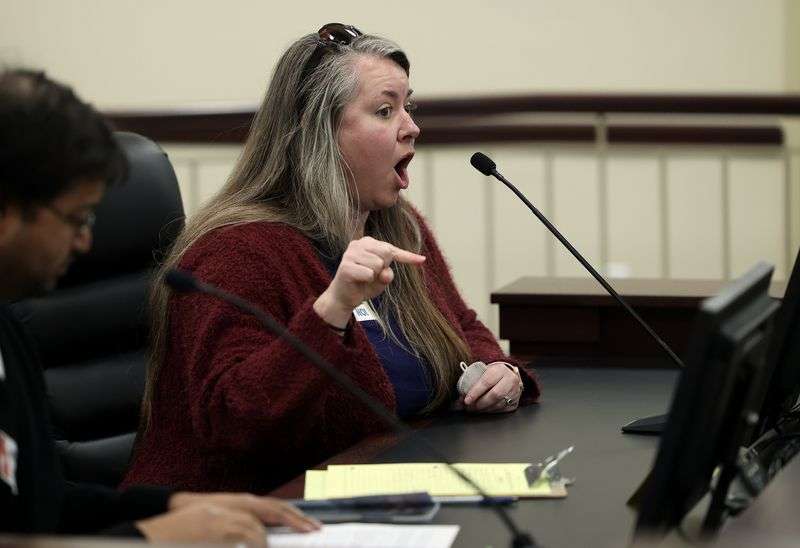
SALT LAKE CITY — A Utah bill to create a permanent digital driver's license program faces an uncertain future after dozens of constituents flocked to a House committee hearing on Monday to voice their frustration with digital IDs — many citing unfounded fears of a United Nations takeover or concentration camps.
One woman invoked the New Testament's Book of Revelation when she called digital driver's licenses "moving one step closer to the mark of the beast."
In the end, the committee adjourned without recommending the bill, which previously passed the Senate unanimously. The House can resurrect discussion of the bill at any time, though it has no public plans to do so.
The scene was reminiscent of a similar demonstration last month, when people spoke out during a committee hearing about a workers' compensation bill for firefighters they incorrectly believed would have authorized the National Guard to arrest the unvaccinated.
Controversial bills often draw the ire of the public, but both bills in question are seemingly innocuous — not hot-button issues like guns or abortion that would be expected to spark outrage.
This pair of bills and their public response seem to represent a new phenomenon taking place on Capitol Hill this year. Not only are people latching onto bills that might not otherwise spark the same level of outrage, they seem to have been tipped off to the bills by a handful of websites and organizations that stoke fear with speculation and misinformation.
SB88, which was up for debate in the House Public Utilities, Energy and Technology Committee on Monday, would expand Utah's existing pilot program for digital IDs and would require that the Driver License Division take steps to ensure the privacy of those who use the program.
A blog post published on the Utah Freedom Coalition's website last August claims that digital driver's licenses could include vaccine records, credit scores, financial records, background checks, sex offender status and even personal dietary preferences. Many commenters echoed similar fears and worried about potential hacks that could make such information public.
Rather than storing personal information in the driver's license app itself, the app would generate a one-time QR code that would link to the state's database, according to Ryan Williams, quality assurance manager with the Driver's License Division.
"When you present that QR code, you're not presenting your information. You can't share the QR code with anybody," he said. "If I lose my physical license and it's picked up by somebody, they have all of that information in their hand."
Digital licenses would only include information currently included on physical licenses, but commenters said they were concerned that more information could be added down the line.
Sen. Lincoln Fillmore, R-South Jordan, who is sponsoring SB88, told the Deseret News that his bill doesn't include Social Security or vaccine information and said that if future legislation tried to expand the scope, "someone will get a chance to vote no if we ever approached that line."
"So I always try to look at the bill that's in front of me, and what the bill in front of me does," he said.
The Utah Freedom Coalition told the Deseret News via email that it is "grateful" the committee didn't advance the bill. The coalition denied organizing with community members to speak in opposition to the bill, but it published a similar blog post 24 hours before the hearing urging its readers to, "Please show up ... and make your voices heard."
The coalition declined to attribute their comments to any individual, saying, "There is no one person, this is by the people, of the people and for the people."
Utah Freedom Coalition and similar organizations don't have a monopoly on spreading dubious claims about driver's licenses at the Legislature. In a December episode of their podcast "The Common Cause," Utah Reps. Phil Lyman, R-Blanding, and Mike Petersen, R-North Logan, discussed the digital driver's license program — featuring a woman called "Salty Annie" who claimed "the U.N. has a foothold in Utah" and shared similarly misguided speculations.
Fillmore said he doesn't see anything unusual with the outcry around these bills, in part because there are "always a handful of bills ... that generate opposition from, you know, really impassioned people."
"It's just the ecosystem that we deal with up here in the Legislature," he said. "We are accountable to the public and we respond to the public, and man, the public can really exercise its voice.
Fillmore said he knows there are issues where a vocal minority can dominate public comments, but doesn't think lawmakers should discount groups who vehemently oppose or support legislation simply because they are in the minority.
"This is the kind of bill where I think lots of people support it without passion, and fewer people oppose it with great passion," he said. "But, you know, intensity is really meaningful in politics and in legislation. ... In fact, our system is designed to make sure that — even if it's a minority position — that intensity is measured and available and can stop things from happening. I think that's one of the wonderful parts of this system."
Fillmore pointed to two amendments to the bill — one which specifies that the program is completely voluntary for citizens and another clarifying that the app would be incapable of digital tracking or "geotracking" — as evidence that lawmakers understand the fears and are taking action to clarify and reassure the public.
'Democracy in action'
While wading through misguided beliefs and fears can be difficult and frustrating, that's kind of the point, said Jim Tabery, professor of philosophy at the University of Utah.
"The whole principle behind public comment in a representative democracy is to create these spaces where members of the public can come before their elected representatives and share their perspectives on these things," he said. "I think what we're seeing play out right now is quite messy and it can be frustrating, I'm sure, for someone ... who sees much of it driven by abject misinformation. ... This is democracy in action."
Tabery said recent contentions have centered around issues where people feel their personal liberties are being infringed upon by an expanding government. These worries are especially prevalent in a state like Utah, where people generally value personal freedoms over government oversight.
In a democracy, people have to be able to accept it when their side doesn't win, Tabery said, but there is cause for concern when they begin to view matters of governance as an "existential war."
"What is particularly worrisome is when it sort of takes on this existential good versus evil quality and references to those kinds of things," he said.
Even when the stuff seems fringy, I think there's real value in taking that — if not the actual belief seriously — the anxiety from where the belief comes from seriously so that you can respond to it.
–Jim Tabery, professor of philosophy at the University of Utah
He believes that allowing for the public airing of grievances can act as a "pressure release valve" for anger, but acknowledged that there is a media ecosystem that thrives off of continuously riling people up.
"There is definitely a market for this kind of anxiety and this kind of fear," Tabery said. "People that incline in that direction, who are savvy enough to navigate that space are able to deliver a product that people want. ... If you're getting all your data points from the Utah Freedom Coalition and Defending Utah, you're going to get a particular view of what's going on in the world and where the threats lie."
Can the government be trusted with privacy?
Claims about the United Nations lack credibility, but genuine concerns with how Utah has handled privacy and technology shouldn't be ignored, according to a spokesman for the ACLU of Utah.
"We urge the state to approach the creation of a permanent digital driver's license program with caution to ensure that data collected by the state and outside vendors does not place the privacy of Utahns at risk. ... When the personal information of Utahns is on the line, the state must move cautiously to make protecting privacy their top concern," Jason Stevenson said in a statement.
He cited a state program from early on in the COVID-19 pandemic that was designed to prompt visitors to the state to fill out a "health declaration form." Some Utah residents reported receiving multiple texts while at home, despite living 70 miles away from the border.
Tabery said there is often some level of genuine concern among people who fall for misinformation, and the focus should be on educating, rather than belittling those who have been exploited by false claims.
"Even when the stuff seems fringy," he said, "I think there's real value in taking that — if not the actual belief seriously — the anxiety from where the belief comes from seriously so that you can respond to it."