Estimated read time: 5-6 minutes
This archived news story is available only for your personal, non-commercial use. Information in the story may be outdated or superseded by additional information. Reading or replaying the story in its archived form does not constitute a republication of the story.
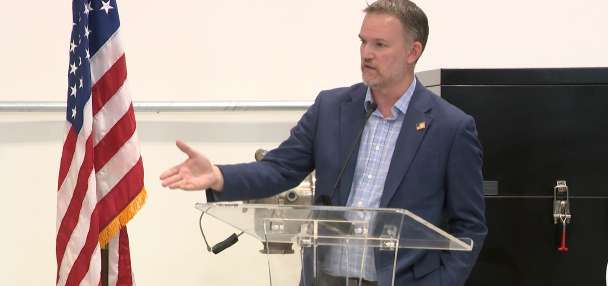
SALT LAKE CITY — Gov. Gary Herbert took a historical approach when describing where Utah’s current state of affairs is. He pointed to the transcontinental railroad — which was completed 150 years ago this year — as inspiration that what happens in Utah today can motivate the country during his annual State of the State address at the Utah Capitol Wednesday evening.
For Herbert, that means unifying political sides and working together with people with different backgrounds.
With that in mind, here are four takeaways from Herbert’s address.
Budget, budget, budget
It seems clear the state budget is going to be a factor during this year’s legislative session, especially since most of Herbert’s talking points Wednesday are heavily mentioned in his 2020 budget proposal released late 2018.
Among those budget boasts is a $1 billion surplus and how the state completed a $1 billion fundraising goal toward education in four years instead of five. He discussed areas to invest for the future, such as education and $100 million toward air quality air improvements.
“Your solutions to our challenges of growth will be limited if we don’t have sustainable revenue to support good policy,” he said, regarding Utah’s budget. “The more you know about the budget, the more effective you will be as a legislator because how we collect revenue and how we spend it is at the core of policy-making.”
In the Democratic response to Herbert’s address, Rep. Carol Spackman Moss, Minority Whip of the Utah House of Representatives, said she hoped the surplus would go toward schools, teachers and first responders.
The battle over Prop 3’s fate is real
Herbert didn’t spend too much time on Proposition 3 (the Medicaid expansion initiative) Wednesday, but he did give a push toward those looking to rework the proposition to fit the state’s budget. Indeed, a bill to rework it is on the legislative docket this year.
“The much needed Medicaid expansion passed by the voters needs to be implemented in a fiscally sustainable way,” Herbert said, adding that the initiative was a “hurdle” for Utah’s budget. “With some common-sense adjustments, I know that we can implement this program without delay.”
If untouched, Proposition 3 expands Medicaid to those earning less than 138 percent the federal poverty rate that's about $12,000. Under SB96, which passed through the Senate Health and Human Services Committee Tuesday, would lower that to those less than 100 percent.
Replacement for voter-approved Medicaid expansion passes first test in Senate
It's only the third day of the 2019 Legislature, but a controversial replacement for the voter-approved ballot initiative expanding Medicaid has already received initial Senate approval.However, not everyone in Utah’s Legislature is on board with that idea. In a response to the State of the State address, Utah House Minority Leader Brian King, D-Salt Lake City, rebuked both the Proposition 2 compromise regarding medical marijuana and the new attempt to adjust Proposition 3. Both initiatives passed in November, but Proposition 2 was reworked in a special legislative session in December.
“It’s simply anti-democratic, not what Utahns want. It is wrong,” King said.
Sen. Karen Mayne, Utah Senate Minority Leader, agreed.
“This past election, the majority of Utahns voted to expand Medicaid for the most vulnerable in our communities,” said Mayne, D-West Valley City. “Attaching strings or limiting the expansion goes against the expressed will of Utah voters. This shows a lack of compassion and disrespect for the people of the state we are elected to serve.”
It’s fairly safe to assume that debate won’t be resolved immediately.
Throwing the Hail Mary pass?
Going back to that $1 billion surplus, Herbert’s budget proposal includes a $225 million tax cut, which he said is the largest in state history. Instead, his budget proposal eyes sales tax reform.
“To paraphrase (Utah Senate) President Stuart Adams’ astute observation about the gutsiness of taking on tax reform: “You can’t catch a Hail Mary pass if it isn’t thrown,’” Herbert said.
He called to working on tax reform now instead of punting it for another time. He said the sales tax would be cut 64 percent from 4.85 to 1.75 under his plan and that tax would be extended to cover a broader base, such as taxing Lyft or Uber rides, or other services.

Herbert: Greatest challenge for Utah? Growth
Utah Gov. Gary Herbert detailed his desire for a $225 million sales tax cut and $1 billion for education.He pointed out reform is needed because the sales tax still lists items like buggy whips, which bring nearly no revenue for the state.
Moss agreed in improving the state tax system and helping the middle class but stopped short of supporting tax cuts as the only solution.
“That is not good policy during a time of economic prosperity,” she argued in response to Herbert's address.
Using history as inspiration for the future
This year, Utah celebrates the 150th anniversary of the transcontinental railroad, which was completed at Promontory Summit on May 10, 1869. Herbert drew from that monumental moment Wednesday night.
Blasting “polarization and dysfunction” in Washington, D.C., Herbert pointed toward how the transcontinental railroad — constructed greatly by America’s outcast minority groups of the era — once united the country.
“We can and we should do more to protect the nameless, the outcast and the vulnerable. Second, even in times of deep division and discord, even when some naysayers are betting against us, great things can be envisioned and can be accomplished,” he said. “Finally, although we come from diverse backgrounds and experience, we can work side-by-side, sunup-to-sundown, with the spirit of cooperation to lay a foundation for our future prosperity.”