Estimated read time: 6-7 minutes
This archived news story is available only for your personal, non-commercial use. Information in the story may be outdated or superseded by additional information. Reading or replaying the story in its archived form does not constitute a republication of the story.
Editor's note: This article is a part of a series reviewing Utah history for KSL.com's Historic section.SALT LAKE CITY — The old Wasatch Springs Plunge building stands rather unassuming on 300 West as the road bends into Beck Street. Its doors are blocked off and many of its windows are covered with cheap plywood.
Since it has been closed for 15 years, it’s hard to tell that this used to be a recreation and relaxation hub for more than a century, and it’s impossible to tell this was home to the original Children’s Museum of Utah. Its main feature these days appears to be a parking lot in the back that allows people to visit the two parks that neighbor the building to the north and south.
Nevertheless, there are signs that this business was once something special. There’s a National Register of Historic Places plaque proudly placed adjacent to the boarded doors, and the building’s Mission-Revival architecture is unique compared to other buildings in the city.
Now, a group of Utah residents want to restore this building back to its glory days, and they believe they are inching closer to that goal. Members of the Warm Springs Alliance met with Salt Lake City Mayor Jackie Biskupski on Dec. 18 to discuss the group’s proposal to revitalize the old Wasatch Springs Plunge building, which has been vacant since 2003.
They're a group that banded together in the summer of 2017 to oppose the development of a seven-story apartment building in that location.
"A lot of people remember swimming there," said Sylvia Nibley, the group’s chair. "With the Children's Museum, thousands of people kind of grew up there. We want to preserve the building and recognize that the building is on one of the most historic sites in the whole area."
Their proposal for the building includes restoring hot spring pools, a community space for events and a restaurant, Nibley said. The group envisions “a place where people from diverse communities can come together to enjoy the benefits of the mineral water, enjoy community events or just relax in a beautiful space,” according to a statement from the group.
“We've been gathering community input, gotten hundreds of comments, had thousands of conversations on the ground with people — neighbors and people all over the city — and have found there's a real desire for community space and for the hot springs to come back again," Nibley said. "We're feeling very hopeful after that meeting with the mayor."
Nothing is set in stone yet, and there are a few more hurdles before the building would reopen, but Matthew Rojas, spokesman for Biskupski, said the mayor is “intrigued” about the group’s concept and willingness to find funding for any potential project.
He added that next year’s budget may include funding for an engineering study to see how much it would cost to restore the building and to find the best use for it. That would come before the city would look at funding for the renovation. According to Nibley, that study could be conducted by mid-2019. She estimated renovation could cost anywhere from $12 million to $18 million to restore the building.
Crews would have to look at the building and springs to determine if they are sanitary enough for a pool, like the building used to house, Rojas said. That means it could be a while until it’s reopened, but there’s hope it will have new life.
“We’re really just trying to look at what the community wants,” he said. “It could be quite an extensive renovation of the building. … (There were) some concerns about the health of the springs and whether or not that health allowed for bringing back the pools.”
Neighbors and people all over the city have found there's a real desire for community space and for the hot springs to come back again. —Sylvia Nibley, Warm Springs Alliance Board Chair
The warm springs the building housed were actually used by Ute, Paiute and Shoshone tribes prior to the time Mormon settlers arrived in the Salt Lake Valley in 1847. After they arrived, the springs became a bathing area. By 1850, an adobe bathhouse was built over the springs to create the Warm Springs Bath House, according to a history compiled by Salt Lake City.
According to the Utah Division of State History, early pioneers praised the “warm sulfurous water for its curative and rejuvenating qualities.”
Sometime later, Brigham Young, then-president of The Church of Jesus Christ of Latter-day Saints, designated the building as a social hall, and it became one of the first places Utahns could go dancing, the city said. The current building was constructed in 1921, when the city took over control of the building.
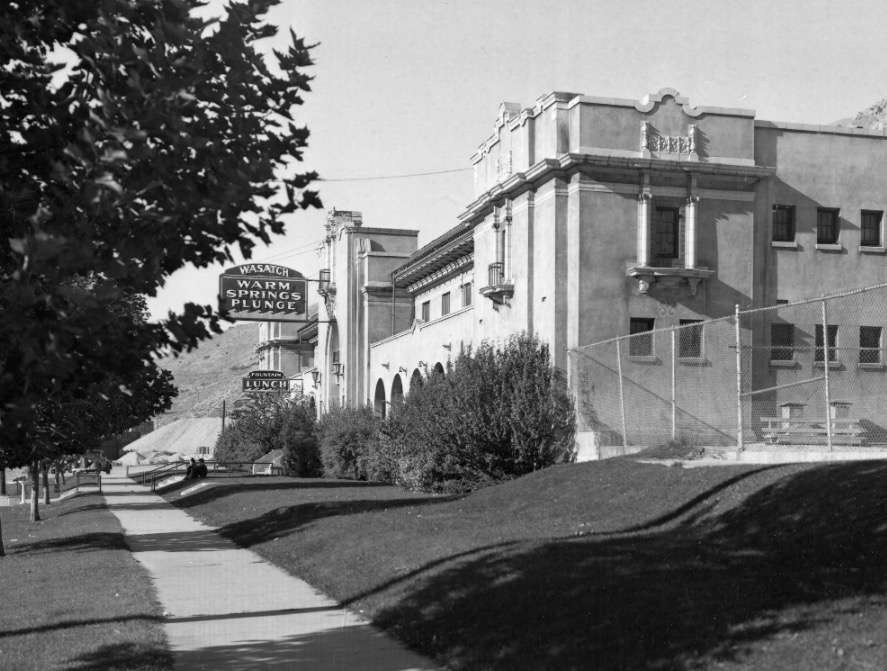
The Utah Division of State History noted the bathhouse building was designed by Cannon and Fetzer, a Utah architectural firm. That firm only lasted for a brief time but also designed the Park Building on the University of Utah campus. The city constructed new pools after problems arose with the warm springs water and the building. The building eventually closed as a community pool in the 1970s.
It reopened again in 1983 as The Children’s Museum of Utah, but the museum moved to the Gateway in 2003, leaving the building vacant.
Since then, there have been thoughts of reopening it. In 2006, a group of architects published a structure and feasibility assessment of the building. While it noted the building had deteriorated over time, the study found “the building still retains a high degree of historic and architectural integrity and easily maintains its continued eligibility for listing in the National Register of Historic Places.”
The study added the best use for the building could be as a recreation center. Nibley said the Warm Springs Alliance is open to ideas from the community about how the building would be used before it could reopen.
Meanwhile, Salt Lake City officials see a benefit in finding a way to use the building again. In fact, Rojas said the city has looked at other vacant historic buildings to repurpose in the future.
Those include the Utah Theatre on Main Street and the Fisher Mansion that sits near the banks of the Jordan River on 200 South.
“The city has for many, many years committed to preserving our historic buildings. They tell the story of Salt Lake City; they tell the story of Utah,” Rojas said. “It’s important that we have that connection to the past while also using them for the needs that exist today.
“Nobody wants to see these buildings deteriorate. Nobody wants to see them empty. They’re critical parts of who we are and who we have been.”