Estimated read time: 4-5 minutes
This archived news story is available only for your personal, non-commercial use. Information in the story may be outdated or superseded by additional information. Reading or replaying the story in its archived form does not constitute a republication of the story.
SALT LAKE CITY — It used to be so simple. There were five positions in basketball: point guard, shooting guard, small forward, power forward and center.
Those words basically described what the players actually did, too. Centers stayed in the middle; power forwards were powerful, strong players who stayed close to the top; small forwards were smaller power forwards; shooting guards stayed outside and shot the ball; and point guards initiated the offense, acting as the first point of attack.
In today's NBA, though, we've figured out that the labels don't really help. Look at the NBA Finals, for example. For the Cleveland Cavaliers, LeBron James (classically labeled a small forward) brings the ball up the court, initiates the offense and does everything. Everyone else exists to either give LeBron space to operate or to act as a secondary threat on his actions.
For the Warriors, it gets even more crazy. Steph Curry, ostensibly the point guard, is a better shooter than any shooting guard in NBA history. The Warriors regularly play without a center, with their biggest man being the 6-foot-7 Draymond Green. Kevin Durant might be the tallest player on the floor for most of the series, but he's doing at least 75 percent of his work from outside the paint.
So what does the NBA do now? Many subscribe to an idea Boston Celtics coach Brad Stevens put well in 2017.
"I don’t have the five positions anymore," Stevens told the Associated Press then. "It may be as simple as three positions now, where you’re either a ball-handler, a wing or a big."
As the Utah Jazz bring in prospects to Salt Lake City ahead of the NBA draft, that's the breakdown they've started to use on their roster sheets, though what Stevens calls "ball-handlers," the Jazz call "guards." Being that general is a little bit of an adjustment at times, though.
"In my thinking at times, I'm still looking at 'oh, that guy is 6-foot-2, so he's got to play point guard,' when he's really a pretty good shooting guard," Jazz vice president of player personnel Walt Perrin, who has over 30 years of experience as a scout, said. "So yeah, the thinking has to change. Players evolve, and so do scouts."
On Friday, the Jazz worked out Michigan's 6-foot-10, 210-pound Mo Wagner, who led the Wolverines to the national championship game this season. Wagner is a talented shooter and has a nice first step to the rim, but doesn't add the typical secondary skills that a traditional big man does. The players he's most similar to (according to Model 284's player similarity tool) are perimeter players, not big men.
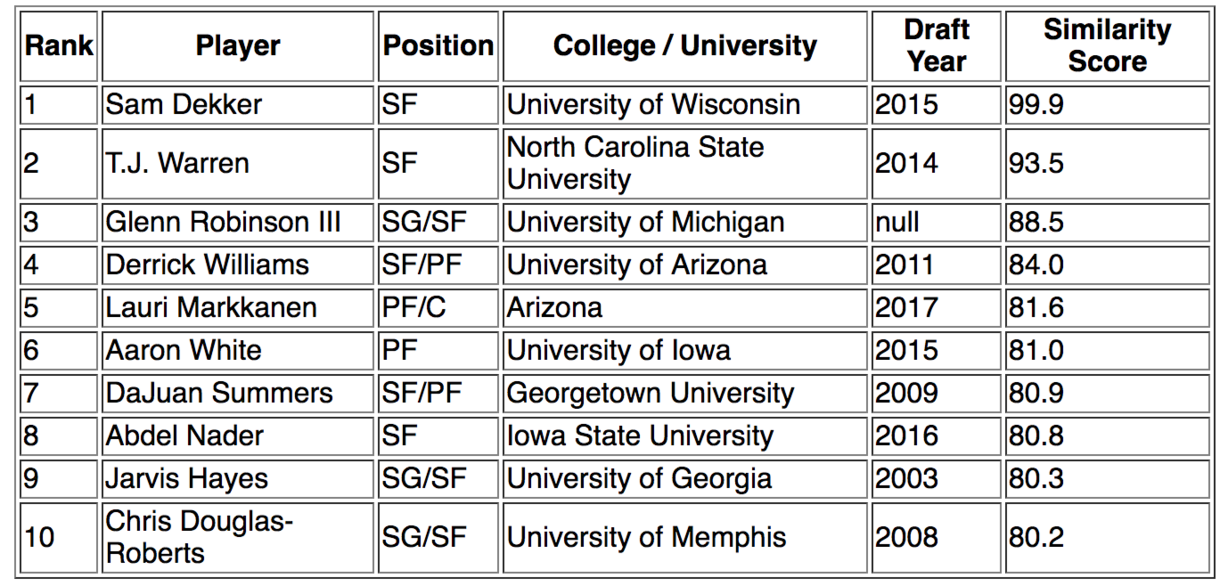
So Wagner isn't just blowing smoke when he dismisses questions about his NBA position.
"I think now in the NBA there's barely such a thing as the four and the five," Wagner said after his workout. "They're all the same. There are only bigs."
And some advanced analysts want to eliminate the notion of positions entirely, instead focusing on skill-prototypes that describe what players are capable of on the floor rather than their body types. Alex Chang at Fastbreak Data used machine learning analysis to examine the 547 players who played in the NBA from 2014 to 2017.
He found the data was best categorized (as determined by a method called silhouette scoring) into eight types of players: floor generals, combo guards, scoring wings, shooting wings, 3-and-D wings, versatile forwards, offensive centers and defensive centers. (Click to explore the image below.)
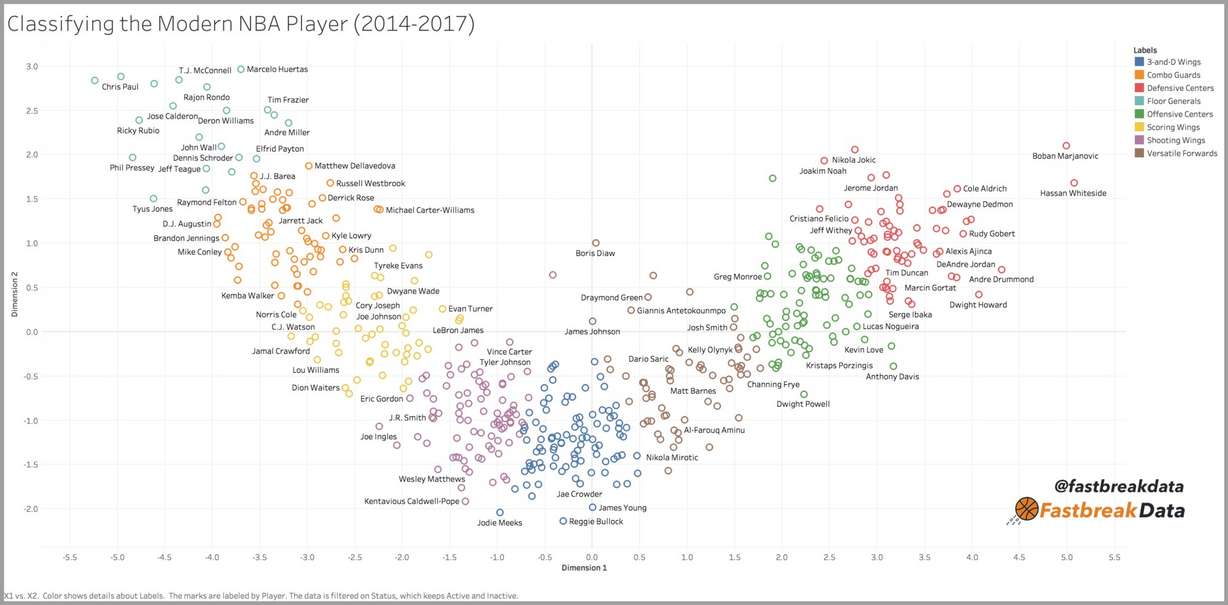
Even with Chang's clustering analysis, though, NBA players clearly fit more on a continuum than an eight-slot mailbox. Is Houston's Eric Gordon more of a scoring wing or a shooting wing? It's hard to say.
But this kind of analysis could be useful for teams who are making difficult decisions in the draft and free agency this offseason. Take the Jazz: It's pretty clear that they have their scoring guard (Donovan Mitchell) and defensive center (Rudy Gobert) of the future. They have answers at floor general (Ricky Rubio), shooting wing (Joe Ingles), and 3-and-D wings (Jae Crowder and Thabo Sefolosha) on the roster.
But the Jazz might need a better answer at versatile forward and combo guard than what they have on the squad. And should they keep their offensive center (Derrick Favors)? If they don't, they'll probably need to acquire another option.
Regardless of the answers to those questions, one thing is clear for all 30 NBA teams: the five positions of basketball, once the standard, are now obsolete.