Estimated read time: 3-4 minutes
This archived news story is available only for your personal, non-commercial use. Information in the story may be outdated or superseded by additional information. Reading or replaying the story in its archived form does not constitute a republication of the story.
SALT LAKE CITY — After a record-setting high in March, the Zions Bank Utah Consumer Attitude Index fell 15.4 points to register at 114.1 in April, the largest single-month drop since Zions Bank and Cicero Group began tracking Utah consumer attitudes in 2011. Despite the decline, year-over-year changes remain positive with the overall index up 1.5 points since April of last year.
In contrast, the national Consumer Confidence Index experienced a modest 1.7-point increase to register at 128.7 this month — 8.4 points higher than the same month last year.
Overall the Utah index has remained above 110 for the 23rd consecutive month, marking nearly two years of positive economic sentiment within the state, explained Chad Berbert, principal with Cicero Group. This month’s measure is significant given it comes during a period of increased interest rates, stock market volatility and significant global economic trade tensions — issues that can affect consumer sentiment broadly, he said.
Speaking at a monthly news conference, Berbert said data from the monthly survey indicated this month’s precipitous drop in the index was due in part to Utahns generally feeling more “normal” about the economy, compared to levels of significant positivity in previous months.
"For a number of months now, Utahns have been saying, 'It's going to get better, it's going to get better,'" he said. "This month we saw a reversion to the 'mean,' with people saying, 'The economy is going to stay the same.'"
"When it's been as goods as it's been, staying the same is still very positive," he added. "So our interpretation is that (attitudes) are not quite as exuberant or quite as positive, but they still feel very good."
An index of at least 110 is indicative of optimal economic activity, he said.
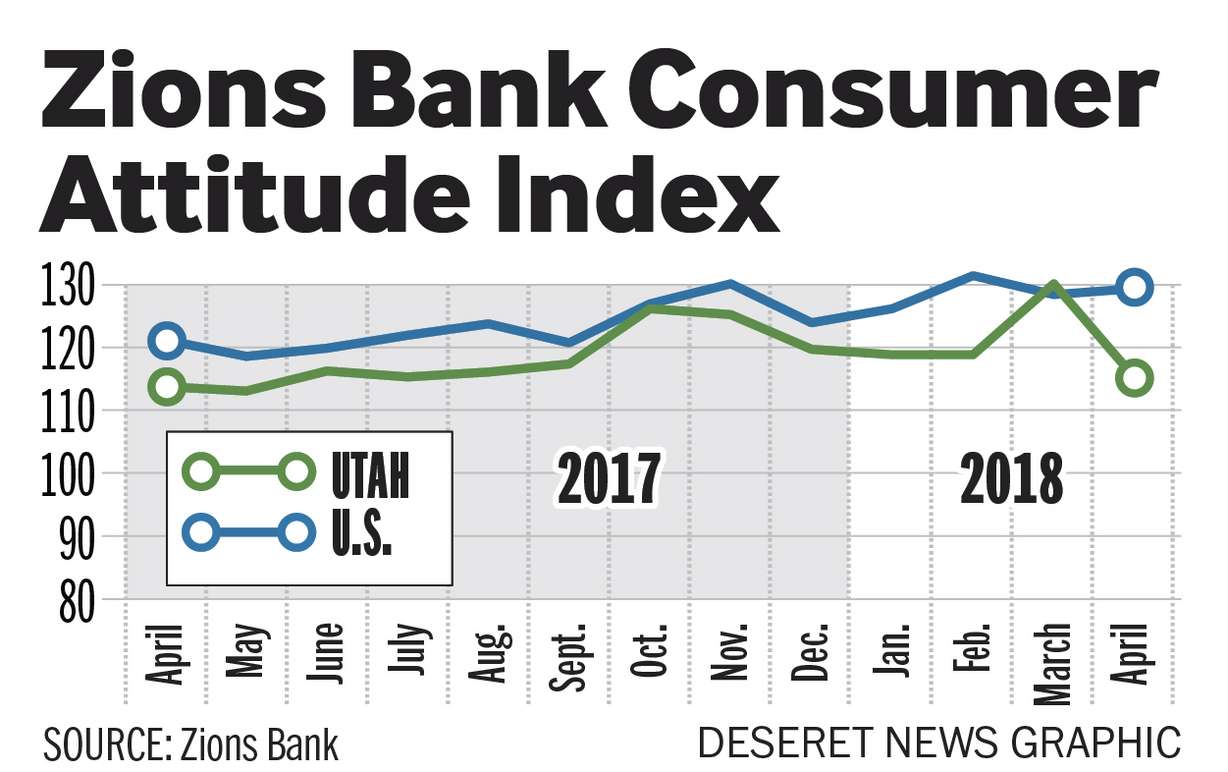
Specific areas where expectations decreased include in perceptions of future job availability, household income, and general business conditions, the report stated. More Utahns indicated that conditions will be “the same in the next six months” as opposed to better than they currently are, which suggests a general leveling out of expectations, Berbert reiterated.
In general, 58 percent of Utahns still feel that jobs are plentiful, the same as last month — 8 percentage points higher than April 2017, he said. Additionally, 55 percent consider business conditions to be good, he noted.
The Zions Bank Consumer Attitude Index is based on a representative sample of 500 Utah households. The monthly survey is conducted by Cicero Group and has a confidence level of plus or minus 4.38 percent.
Berbert said one month of tempered positivity is no reason to panic, but researchers will analyze the data closely in the coming months. He likened the overall index to how the stock market fluctuates from time to time but remains in a growth state long term.
Related story:

Utah consumer index hits all-time high
The Zions Bank Utah Consumer Attitude Index climbed 11.6 points to register at 129.5 in March, the highest level ever achieved by the index. Nationally, the Consumer Confidence Index declined 2.3 points to register at 127.7 for the month.He also noted that the high level of the national index could be attributed to how people nationally are especially positive about the economy 'right now,' whereas Utahns are confident in the state's economic outlook over the next year or so. He mentioned that job growth in the Beehive State is the highest in the nation, which explains why Utahns have remained so upbeat about their foreseeable future.
Even with increasing fuel costs as the summer driving season gets underway, he said Utahns are still confident the local economy will be able to sustain its strength for the time being.
There was a leveling out of expectations in April, said Randy Shumway, chairman and partner of Cicero Group.
“I do not think this is Utahns saying things are getting worse, rather it appears to be a recognition that the economy has been so strong it is hard to imagine it getting even better," he said. "Utah consumers are saying ‘things are good and we expect the economy to remain that way.’”