
Estimated read time: 4-5 minutes
This archived news story is available only for your personal, non-commercial use. Information in the story may be outdated or superseded by additional information. Reading or replaying the story in its archived form does not constitute a republication of the story.
SNYDERVILLE, Summit County — With dozens of animals killed on and around busy sections of I-80 each year, Summit County residents are teaming with state transportation experts to reduce the danger for wildlife and humans.
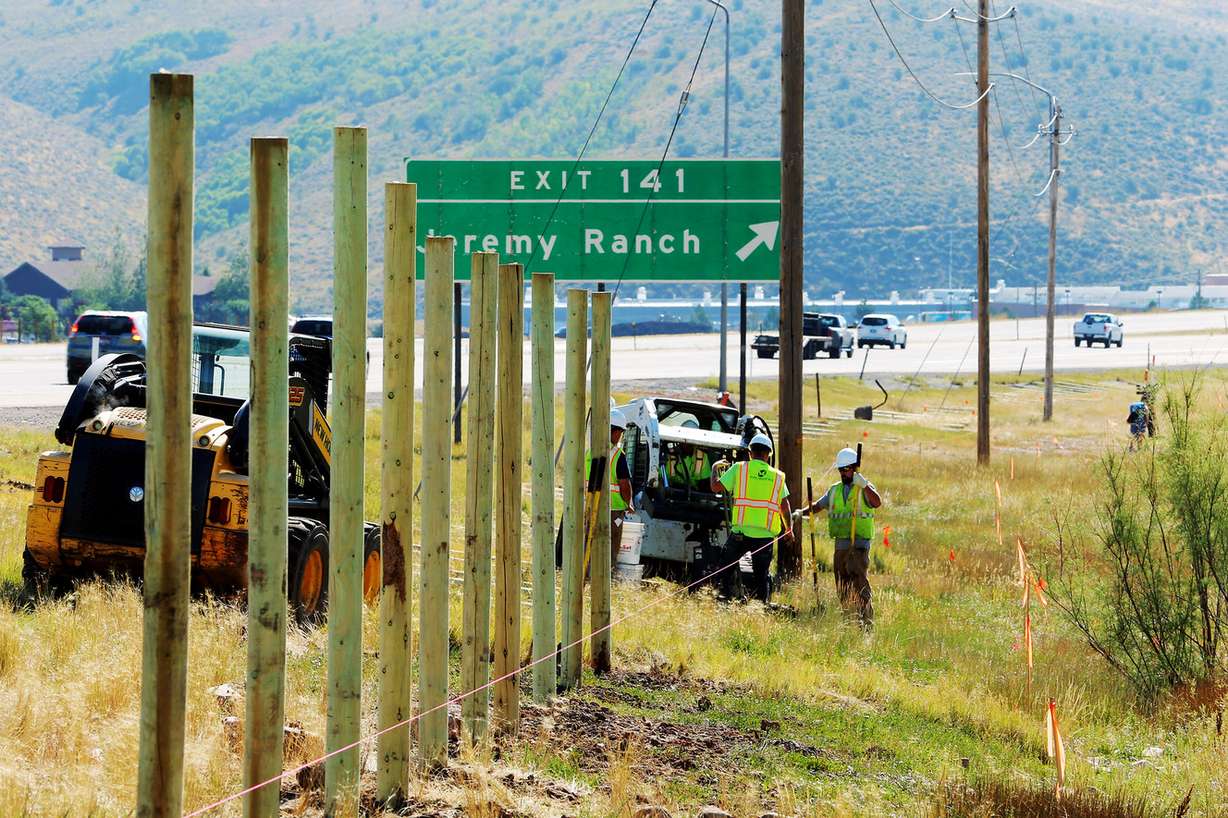
The Utah Department of Transportation announced Monday an effort to construct a wildlife barrier along eastbound I-80 near Jeremy Ranch. Crews are beginning install 1 mile of fencing to mirror the section constructed along westbound I-80 last fall.
In addition, the fence will be extended 1,400 feet on each side of the interstate as an extra layer of protection, explained UDOT project manager John Montoya.
"This is the first step of a bigger project that will include fencing along the way to Parleys Summit and the construction of a wildlife bridge intended to allow wildlife to pass over the freeway to the other without having them cross I-80 directly," Montoya said.
The area of interest is a migratory path for various wild animal species, including deer, elk, moose, bears and cougars, he noted.
"There have been collisions involving those larger animals, and it's usually not good for the animals, and it's usually not good for the person," Montoya said.
The fence will measure 8 feet high with galvanized steel mesh to prevent wildlife from going under or over the barrier, he noted, along with heavy, round posts installed every 10 feet to stop animals from pushing through it.
"It's a sturdy fence that's meant to keep wildlife on one side or the other," Montoya said.
UDOT has advanced a portion of funding from next year’s I-80 truck lane and wildlife improvements project to begin wildlife fence installation early — eight months ahead of the larger portion of the $400,000 project, he said.
The bridge is scheduled to be built in 2018 in coordination with the truck lane project, Montoya said.
UDOT has been working with residents and stakeholders to reduce collisions between vehicles and wildlife, he added.
Last year, 57 animals were killed on the highway, according to Save People Save Animals — a advocacy group comprised of Summit County residents who live near and around Jeremy Ranch. So far this year, 20 animals have been struck and killed.
"As residents of this community, we've moved into where the wildlife are," explained Erin Ferguson, spokeswoman for Save People Save Wildlife. "We put a freeway in where they were accustomed to crossing. Now they have no options."
Ferguson said people who use the highway or live nearby need to have respect for wildlife that migrate through the area on a regular basis. She noted that some residents moved to the semi-rural area in part because of the opportunity to live among native species of wild animals that have been there for years.
Ferguson added that people often lament the seemingly regular sight of roadkill along the freeway following collisions between vehicles and animals.
"To be commuting and see wildlife day after day — fox, cougar, bear, deer or elk — it's devastating," she said. "The irony is that Park City has the moose as its mascot. Something has to be done.
"About two years ago, following a study that showed the number of animals killed along the highway, residents banded together to collect funds to help UDOT build a barrier to alleviate the problem," Ferguson said. That initial effort eventually led to this most recent development, and the construction of the extended fence and overpass bridge, she added.
Ferguson said the group will continue its efforts to extend the fencing farther east from Jeremy Ranch to Kimball Junction, then from there to U.S. 40. But that project has not been fully planned or funded, she noted.
"In talking to people, there is such a wave of concern that just grows," Ferguson said. "(This project) can be a money-saver, increase safety and encompasses a lot of facets."
The long-term priority of the project is to reduce the potential hazards and danger presented by wildlife crossing the roadway, she said.
UDOT officials echoed that sentiment and offered to do what they can to eliminate life-threatnening interactions between vehicles and migratory animals.
"Our goal is to make this stretch of highway safer," Montoya said. "That's what we're doing here by adding the fencing and adding a crossing for wildlife. Overall, this (section) of road will be much safer in the next year and a half."