Estimated read time: 2-3 minutes
This archived news story is available only for your personal, non-commercial use. Information in the story may be outdated or superseded by additional information. Reading or replaying the story in its archived form does not constitute a republication of the story.
SALT LAKE CITY — Former Utah Attorney General Mark Shurtleff has asked a 3rd District judge to deny the state's motion to dismiss his claim for attorneys' fees in the abandoned criminal case against him.
In a court filing Monday, Shurtleff's lawyers argue Utah law does not require him to be a state employee at the time the charges were dropped. It only requires the charges to be filed in connection with his time in office for him to be eligible for reimbursement, they say.
"The state’s reading of the provision leads to absurd results that would be contrary to public policy — requiring an accused person to cling to office no matter what," Shurtleff's lawyers wrote.
Shurtelff sued the state for $1.1 million in fees and damages in March, claiming current Attorney General Sean Reyes thwarted his attempt to recoup the costs to defend himself.
The attorney general's office contends that Shurtleff isn't entitled to protection under the law because he was not an employee of the state when the felony charges were dropped last summer.
The state also argues that Shurtleff can't claim attorneys' fees because Judge Elizabeth Hruby-Mills dismissed the case against him based on the prosecution's motion instead of Shurtleff's motion. Her decision precluded the state from having to pay Shurtleff's attorneys' fees.
Related:
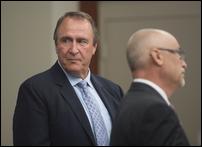
Shurtleff claims AG Sean Reyes thwarted his right to attorneys' fees in criminal case
Former Utah Attorney General Mark Shurtleff claims current Attorney General Sean Reyes thwarted his attempt to recoup attorneys' fees in the abandoned criminal case against him.But Shurtleff's lawyers say the state's motion to dismiss the charges was a "capitulation" to Shurtleff's own dismissal.
"By urging in its motion the very same arguments Mr. Shurtleff made in his own motion, the state evidenced an intent to accept Mr. Shurtleff’s arguments in favor of dismissal," Shurtleff's attorneys wrote.
State prosecutors dropped felony public corruption charges against Shurtleff last summer, citing a U.S. Supreme Court ruling regarding bribery, the inability to obtain key evidence from a federal investigation and concerns over whether he could get a fair trial.