Estimated read time: 3-4 minutes
This archived news story is available only for your personal, non-commercial use. Information in the story may be outdated or superseded by additional information. Reading or replaying the story in its archived form does not constitute a republication of the story.
SALT LAKE CITY — Dust storms. Soggy soil. Now the Utah State Prison relocation faces another challenge: mosquitos.
That's because the three proposed sites for the new facility are located in "the prime mosquito habitat in our entire state," according to Salt Lake City Mosquito Abatement District Director Ary Faraji, who presented at a Utah Administrative Services meeting Tuesday.
“If there was a mosquito heaven, that would be pretty close to it,” Faraji said.
The Legislature voted to move the state prison from Draper to an area west of Salt Lake City International Airport last year after fierce debate.
The chosen area is made up of marshy wetlands and farmland, according to Faraji, who said stormwater and snowmelt being channeled toward the Great Salt Lake usually gets intercepted and stored there.
"When you impound water, you go through cycles of flooding and dry-down and flooding and dry-down, which is exactly what produces mosquitos," he said. "We're basically taking the prison and putting it into a habitat that is historically and notoriously known for producing large numbers of mosquitos."
Officials are currently deciding between three parcels on the site to build the new complex. Utah Administrative Services operations officer Marilee Richins said in a statement that the mosquito issue affects the three parcels equally, so it’s unlikely to determine where they decide to put the new complex.
“Every site had its issues,” Richins said. “The mosquito issue was identified at this site before it was ever selected, and we will work collaboratively to address it.”
Brooke Adams, spokeswoman for the Utah Department of Corrections, said in a statement that the department “knew there would be challenges like this at our new location — or at any location, frankly — and definitely expect to be engaged in solving them.”
Adams added that the department is interested in adding a mosquito abatement program to the training and work opportunities the prison plans to offer to inmates.
At the meeting, Faraji presented data from the Salt Lake City Mosquito Abatement District’s traps to illustrate the problem.
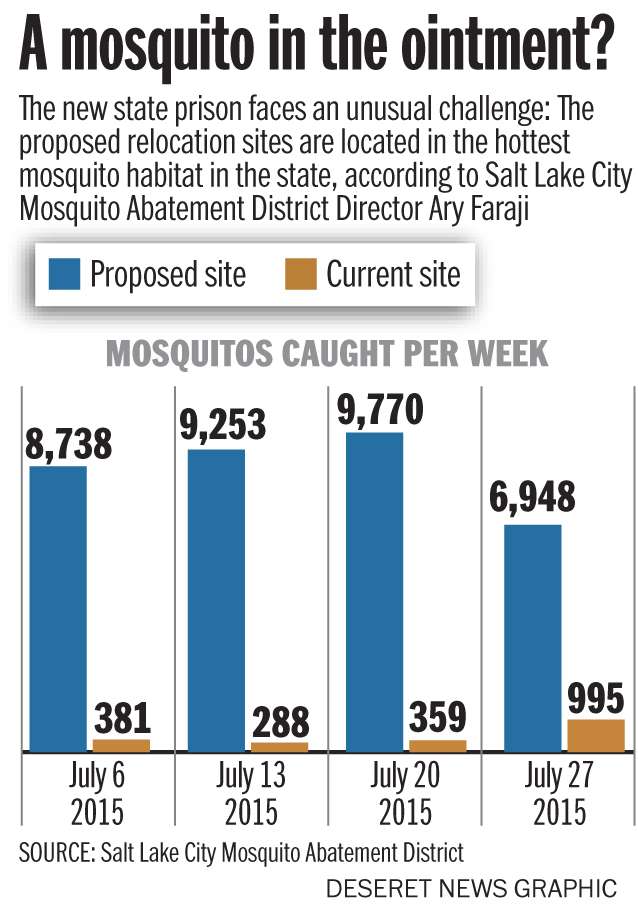
Over a particularly active week in August last year, mosquito traps in the prison’s current Draper location caught an average of 111 mosquitos, according to Faraji.
The traps closest to the proposed new prison site caught 12,744.
The 4,000-bed prison is expected to cost about $550 million to build.
Faraji said the influx of thousands of inmates and installment of bright lights around the complex will create a “perfect” attraction for even more blood-feeding insects.
In addition to mosquitos, experts are also concerned about deer flies — “big, vicious biters,” Faraji said — and biting midges, also known as no-see-ums or sand flies.
“Ironically, people assume that Utah is a very hot, dry state,” he said. “And it is — except for this northwest quadrant.”
Because the vast majority of the wetlands area is exempt from paying taxes into the mosquito abatement district, Faraji is hoping to annex the area into the district's tax boundary.
And he's asking the state for additional funding to ramp up mosquito control in that area. Faraji gave a "very conservative" estimate of $160,000 per year in addition to the district's $3.2 million budget to perform basic adult mosquito control, which consists largely of pesticide spraying.
He said it would be ideal if workers could also tackle juvenile mosquitos, which develop in standing water, but that takes additional manpower and resources and is significantly more expensive.
Contributing: Ladd Egan