'%3e%3cpath%20d='M34.1406%205.85938C30.3906%202.10547%2025.3047%200%2020%200C14.6953%200%209.60938%202.10547%205.85938%205.85938C2.10938%209.61328%200%2014.6953%200%2020C0%2025.3047%202.10547%2030.3906%205.85938%2034.1406C9.61328%2037.8906%2014.6953%2040%2020%2040C25.3047%2040%2030.3906%2037.8945%2034.1406%2034.1406C37.8906%2030.3906%2040%2025.3047%2040%2020C40%2014.6953%2037.8945%209.60938%2034.1406%205.85938ZM37.0117%2023.543H31.1602V13.5391H27.6328V19.9414C28.1211%2020.6914%2028.3711%2021.582%2028.3711%2022.5625V22.625C28.3711%2023.668%2028.1172%2024.6055%2027.6328%2025.4297V26.6094H36.082C33.4883%2032.9375%2027.2891%2037.3789%2020.0039%2037.3789C10.3711%2037.3789%202.62109%2029.6289%202.62109%2020C2.62109%2010.3711%2010.3711%202.62109%2020%202.62109C29.6289%202.62109%2037.3789%2010.3711%2037.3789%2020C37.3789%2021.1484%2037.2617%2022.2656%2037.0508%2023.3477C37.0391%2023.4141%2037.0234%2023.4766%2037.0117%2023.543Z'%20fill='white'/%3e%3cpath%20d='M22.3086%2018.5352C20.4336%2018.125%2019.9531%2017.8398%2019.9766%2017.1836V17.1406C19.9766%2016.6992%2020.3477%2016.2148%2021.4023%2016.2148C22.582%2016.2148%2023.8867%2016.6797%2025.0781%2017.4766L26.8516%2015.0195C25.4453%2013.8906%2023.707%2013.3398%2021.5547%2013.3398C18.5195%2013.3398%2016.4375%2015%2016.4063%2017.4766V17.5352C16.3633%2020.2617%2018.5859%2020.9805%2021.293%2021.6016C23.0391%2021.9766%2023.5703%2022.3164%2023.5703%2022.9609L23.5469%2022.9766C23.5469%2023.3906%2023.2578%2023.7031%2022.7852%2023.8359C22.5742%2023.9062%2022.1289%2023.9727%2021.5156%2023.9727C20.7617%2023.9727%2019.7539%2023.8633%2018.6328%2023.4844C18.0898%2023.2891%2017.4727%2023.0039%2016.8047%2022.6133L20.1406%2026.625C20.2813%2026.6602%2021.0977%2026.8516%2021.7734%2026.8516C25.0039%2026.8516%2027.0859%2025.2461%2027.1094%2022.6328V22.5703C27.1602%2020.1133%2025.2148%2019.1719%2022.3086%2018.5352Z'%20fill='white'/%3e%3cpath%20d='M5.24219%2013.5664V26.6133H8.75391V23.7578L10.2969%2021.9531L14.2031%2026.6133H18.3867L12.3555%2019.5195L17.4023%2013.5664H13.4531L8.75391%2019.0586V13.5664H5.24219Z'%20fill='white'/%3e%3c/g%3e%3cdefs%3e%3cclipPath%20id='clip0_97_2430'%3e%3crect%20width='40'%20height='40'%20fill='white'/%3e%3c/clipPath%3e%3c/defs%3e%3c/svg%3e)


Estimated read time: 2-3 minutes
This archived news story is available only for your personal, non-commercial use. Information in the story may be outdated or superseded by additional information. Reading or replaying the story in its archived form does not constitute a republication of the story.
SALT LAKE CITY — The wintertime air pollution season is over along the Wasatch Front, and state air quality regulators believe a slate of new regulations, more fuel-efficient cars and collective public actions are making a notable difference.
"The numbers show that pollution has decreased," said Bo Call, manager of air quality monitoring with the Utah Department of Environmental Quality. "The amount of pollution being emitted is going down, our cars are cleaner and we are generally emitting less."
The Wasatch Front did have a string of nasty temperature inversions this year, with monitors at the agency's Hawthorne site in Salt Lake City eclipsing the federal Clean Air standard nine times.
"If the temperature inversions last long enough, we get the really high values," Call said, noting that 2013 was a bad year, driven by freezing temperatures and snow cover.
"The numbers just went through the roof. We had not had a year that similarly bad since 2004."
Overall, emissions were reduced by 35 percent in the past decade. Department director Alan Matheson said there was "good" air quality — with PM2.5 levels below 12.5 micrograms per cubic meter — about 70 percent of the days in 2004. By comparison, 2015 hit that mark 88 percent of the time. Cache Valley, which historically has seen some of the state's worst temperature inversions, logged good air days 94 percent of the time.
"We always talk about the eight or nine days that are really bad and we don't talk about the ones that are good," Call said.
We always talk about the eight or nine days that are really bad and we don't talk about the ones that are good.
–Bo Call, DEQ
He said what he finds particularly encouraging is that on those days where Cache Valley did eclipse the federal standard of 35.5 micrograms per cubic meter, it was by only a small amount.
"They were barely inching over the standard. With a little more work, those numbers may not even go past 35.5."
Call said he believes the relatively new vehicle inspection and emissions program implemented in Cache Valley is having an impact, as motorists can no longer skip "deferred maintenance" issues with older vehicles.
"It is a force to get you to do something."
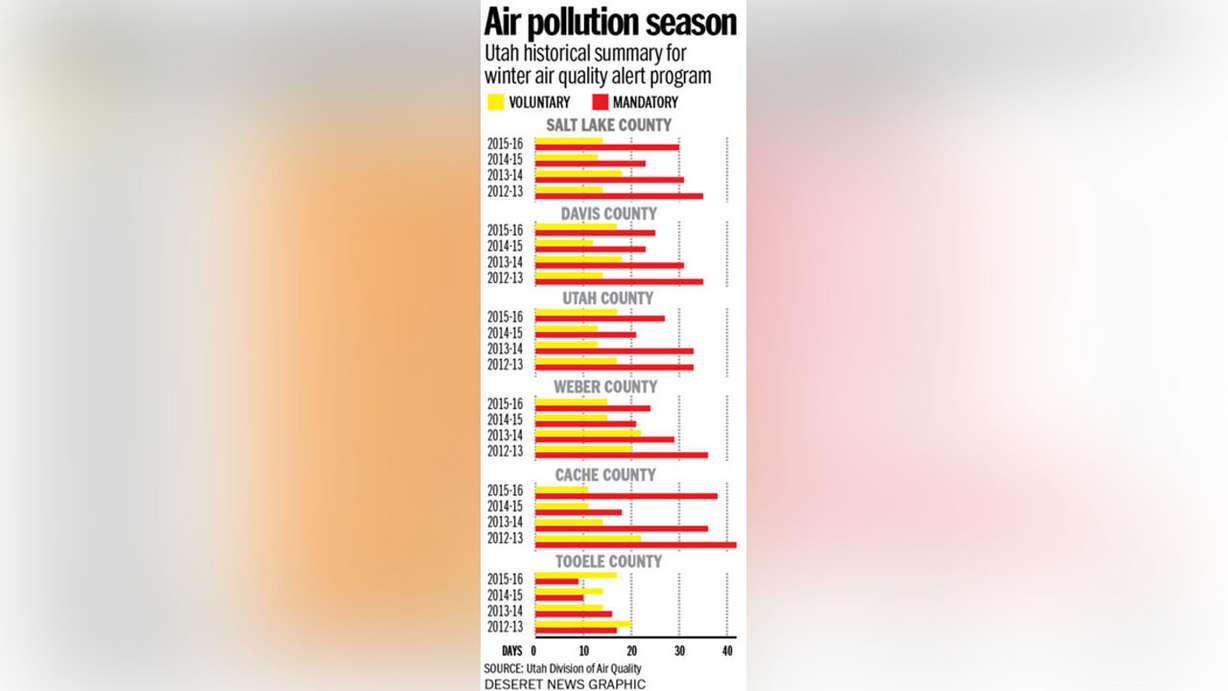
Air quality regulators are also calling voluntary action days earlier, hoping that carpooling, increased reliance on public transit and refraining from wood burning will help to decrease the volume of pollutants that ultimately get trapped by a temperature inversion.
"Instead of getting to the standard in three days, maybe it will take four, maybe five days instead," Call said. "The control measures that are in place are helping us to control that."