
Estimated read time: 14-15 minutes
This archived news story is available only for your personal, non-commercial use. Information in the story may be outdated or superseded by additional information. Reading or replaying the story in its archived form does not constitute a republication of the story.
WEST JORDAN — Tongues of flame started to lick up under the windscreen. A lot of heat hit Kirby Crump in the face. He struggled to yank the limp and bloodied pilot away from the yoke.
The pilot was stuck. A flash of anger overcame the heat in the cramped cockpit.
Crump recognized the immediate danger. The wrecked plane was on fire. No one was coming to his aid, at least not in time to make a difference. If he retreated, the pilot would burn to death.
It didn't matter. He was committed, even if it meant his life. At the rate the fire was growing, it would only take a few more moments for death to reach him.
Then, something hit him in the back.
Utah National Guard Staff Sgt. Robert Kelley had come back onto the wing for a third time, slapping Crump to let him know he was not alone.
Crump heaved with all his strength, knowing full well the force could leave the pilot paralyzed. At last, the tall man came loose from the mangled wreckage. Together, Crump and Kelley dragged him out and onto the grass.
Firefighters and police who were just arriving at the West Jordan Soccer Complex couldn't believe what they were seeing.
"He made that decision right there in that burning cockpit, when his forehead he felt was about to blister from the heat, that 'no, I'm going to stay here and get this guy out'," West Jordan Police Sgt. Dan Roberts said. "That is character."
Few people have heard Crump's story. When the news cameras showed up at the soccer fields that sunny Sunday, he stood off to the side. He'd have left altogether, but had to stay because yellow police tape was fluttering from his red pickup truck. Investigators had used it to help establish a perimeter around the crash site.
"You don't do this kind of thing because you're waiting for someone to step up and give you something," Crump said a little more than a year later.
His actions that day though have earned him a Carnegie Medal. It's a high honor reserved for civilians who risk or even lose their lives saving others.
It's an honor he almost refused.
Related:
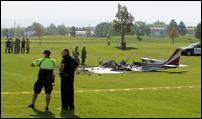
'Good Samaritans' rescue 3 passengers in West Jordan plane crash
A small plane crashed and went up in flames at a soccer complex near the South Valley Regional Airport Sunday morning, police say.The crash
Flying conditions were beautiful the morning of Aug. 10, 2014. Steven Sedlacek, his wife, Kathleen, and their adult daughter, Anna Looper, were planning to head home to Boise, Idaho, following a trip to Utah.
Steven, the pilot, taxied his Piper PA-32 onto runway 16 at the South Valley Regional Airport and opened up the throttle. The single-engine airplane accelerated, lifting off the ground.
That's when the problems started. Witnesses heard the engine sputter. The plane stopped climbing, barely making it over power lines at the southern edge of the airport. National Transportation Safety Board investigators later determined Sedlacek made an emergency call on the radio but stopped short of saying exactly what had gone wrong.
Crump was sitting in his truck, waiting for a traffic light to change at the intersection of Airport Road and the New Bingham Highway. He saw the plane off to his left as it began banking toward him, only about 100 feet above the ground.
Then, the Piper Lance straightened out and hung in the air, as if about to stall. Crump watched, noting how abnormal the plane appeared. He assumed the pilot had intended to circle the field and land but lacked the power to do so.
The plane rolled over to one side, then dropped from sight behind a building.
Crump's foot hit the accelerator. He ran the red light, crossing through the light morning traffic on state Route 48 onto Welby Park Drive. Another truck followed his path. He pulled to the side of the road once he had a clear view of the huge soccer complex to the south of the airport, expecting to see the aircraft nose-down in the field.
There was no sign of the plane.
The second driver didn't stop, continuing on toward 8200 South. Crump pursued him, making the turn onto 8200 South and catching up where that street makes a right-hand turn to become 4300 West.
Instead of making that turn, both Crump and the other driver drove up over the curb to the left. At full speed they weaved through a narrow gap between two trees, then raced down a small embankment and onto the soccer fields.
No more than 90 seconds had passed. When Crump stepped out of his truck, he saw the other driver dressed in military fatigues. Robert Kelley was already on the phone with 911.
He glanced into the cabin of the plane, seeing Steven Sedlacek. The impact had shattered Sedlacek's jaw, leaving his face and mouth a bloody mess.
"He's pretty banged up and in the fire. I'm pulling him out," Kelley said.
"Don't put yourself in any danger," the dispatcher warned.
"I'm not," he replied.
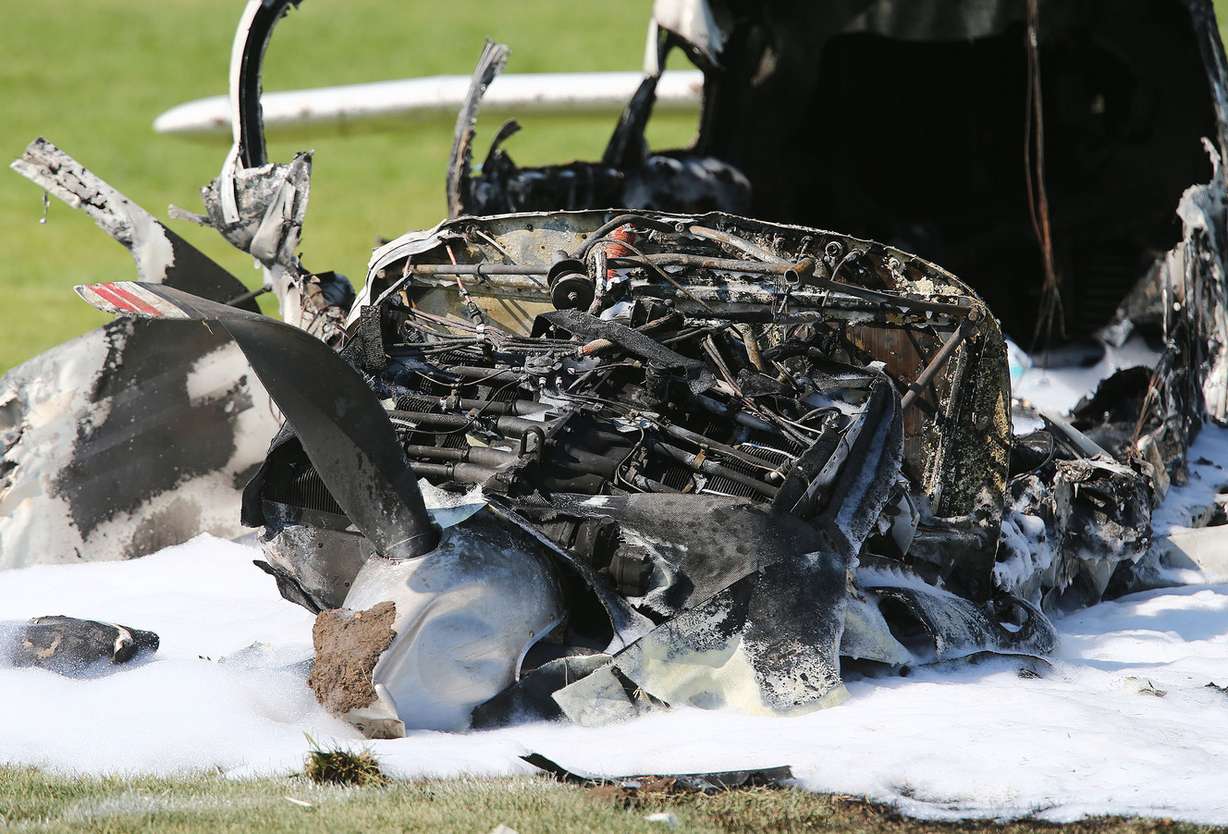
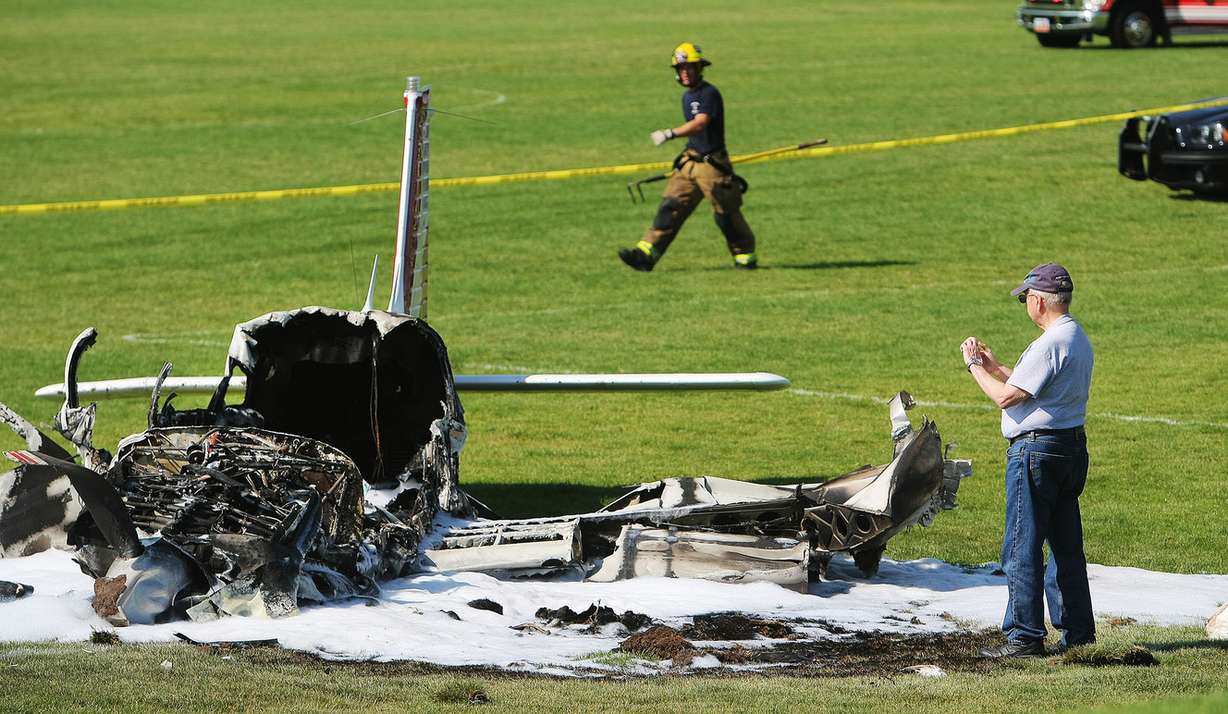
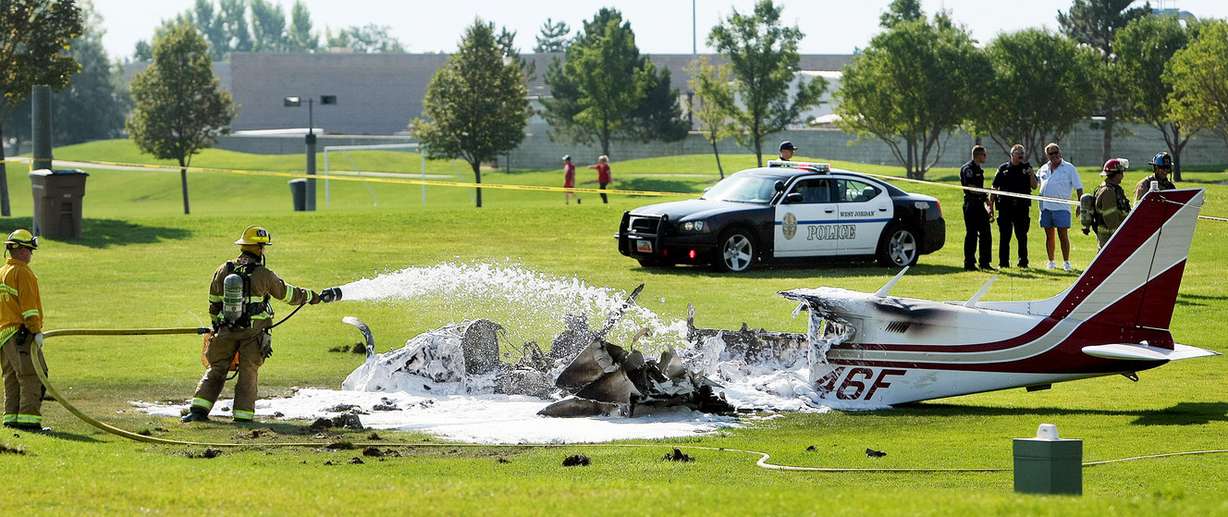
When the plane first hit the ground, its retractable landing gear had been extended. The force of the impact tore the wheel assemblies off their mounts and left deep gouges in the turf. The left wing had smashed into a lamppost and was torn away. The plane spun violently counterclockwise and skidded to a stop.
It had come to rest facing roughly east, behind a berm. Having just taken off for a cross-country flight, its tanks were full of fuel. A fire sparked in the engine almost immediately.
The rescue
Because of the damage and fire, Crump and Kelley had to approach from the right side. They opened the door to see a suitcase on top of Kathy Sedlacek.
Kelley handed his phone to Crump, tossed the suitcase aside and then undid the woman's seat belt. He carried her from the front right seat out onto the wing.
"I need to help them get these guys out, this plane is burning," Crump said.
The dispatcher, growing frustrated at the difficulty in getting an exact address, repeated her command to stay clear.
"I need you guys to not put yourself in danger, OK?"
"The address is 4200 West and about 80th South," Crump said. "We're right in the center of the soccer field at the south end of the Airport No. 2, and they need to get here quick. Thank you."
Crump, still holding the phone, climbed into the cabin. As he fumbled with Steven Sedlacek's three-point harness, a wave of heat rolled through the cockpit. It made him turn his head away. That's when he noticed Looper in the back seat.
Looper was badly injured but crawling forward in an effort to escape. Crump wanted to console her, to tell her help was coming, but he found himself drawn again to her unconscious father.
Kelley, meanwhile, returned to the wreckage and tried to find a door on the left side of the plane, only to realize it didn't have one. Instead he went to a rear door on the right side and opened it to retrieve Looper. The influx of air into the plane stoked flames that were beginning to enter the cabin. A second blast of heat hit Crump in the face.
"You probably need to get a Life Flight helicopter coming, too," he said to the dispatcher, his voice shaking. "There looks like there's at least three in there. We got two out now, but we've got one guy that's really trapped bad up against the controls."
She reassured him paramedics were on their way and asked if the injured were breathing.
"They're all conscious, but they're hurt really bad. We've got to get this guy out right now," Crump said.
"Moving him might make things worse. If you're putting any of you in danger, I don't want you to move him," she replied.
Crump didn't respond.
Reflecting on the experience later, Crump said his senses all seemed to focus in on the problem before him.
"Steve just begins to consume me," he said.
The second blast of heat had ignited an almost rage-like anger.
"I guess you might say I'm not going to let the plane win at this moment," Crump recalled. "It's not that the fire and the plane's going to blow apart and get us, it becomes a situation where you're just not going to leave him."
Sedlacek's left hand had fallen over the buckle of his harness during the crash, preventing Crump from seeing it. During a moment of lucidity though, he shifted. Upon finding the latch, Crump released it.
Luggage had wedged behind the left front seat, preventing it from sliding backward. With flames curling up onto the ceiling, he grabbed Sedlacek and started to pull.
"I can't use my feet or my knees, my legs. It's all upper body because my knee's in the other seat," Crump said. "He's got to come over that little console divide between the two seats, and my right leg's down in that foot well, just wrenched down in there with as much leverage as I can get."
Crump tugged and twisted, grunting so loudly the sound came across the open phone line to the 911 dispatcher. He felt Sedlacek's body literally tearing apart. Though he wouldn't admit it for months, Crump also felt his own abdomen splitting internally.
"As I'm pulling him out and I'm just wrenching on him, there's a moment there he just breaks loose of how he's jammed down in there. His legs are still a problem because he's 6-foot-6, he's just too big."
Flames were continuing to grow, entering the cabin from a gap between the firewall and the windscreen. Crump realized he was all alone and feared he was just moments away from being burned alive.
"The sergeant has taken Anna over behind my truck. He comes running back, comes jumping up on the plane and just plows right into my back. (He) grabs a hold of me and he's trying to get a piece of Steve, but I have to get Steve closer, further out toward that doorway. And at some moment there he's watching that fire."
Somehow, knowing Kelley was at his back refocused Crump.
"This is a good moment for the sergeant. He's wanting to get in there, but there's not enough space for him. But he's got such a good grip on me that if that flame comes blowing around there, he's going to pull me off that wing and we're going to have to leave Steve there."
Kelley found a gap at Crump's right shoulder and wedged himself in next to the door. Together, the two men combined their strength to at last get Sedlacek out of the plane.
Other witnesses, seeing a black plume of smoke rising from the wreckage, were starting to reach the crash site from elsewhere on the field.
Crump handed the phone back to Kelley, who stepped away to check on Kathy Sedlacek. Little more than five minutes had gone by since the two strangers had first seen the plane struggling from their places at the stoplight.
Although they both now feel they're out of danger, they're not.
"We're close enough I can hear that plane starting to flex," Crump said. "It's just a moment or two later and all the sudden you hear it crack, a big boil of fuel comes around, that fire comes around and seals the door right off. (It) blows right up over the plane."
Arriving paramedics were afraid to approach as flames jetted more than 10 feet into the air. The fuel tanks, they reasoned, could explode at any moment.
"The rescuers are yelling at them, 'Bring him back! Bring him back further!'" Roberts said. "Mr. Kelley and Mr. Crump both said, 'No, their injuries are too severe. You guys come up here.'"
Looper, too, was screaming, calling out her father's name under the belief he was still inside the plane. Crump went to reassure her, then pulled his truck forward to shield her from the fire.
The aftermath
While the three family members all survived, they were each badly injured. Two medical helicopters responded to the soccer complex, one each for the Sedlaceks. An ambulance transported Looper to the hospital.
Kelley, who had been on his way to Camp Williams when he followed Crump through the intersection, left to attend to his work. Crump remained behind, helping firefighters run hoses.
Reporters spoke with police, firefighters and even some other witnesses who had helped Kelley as he was removing the women from the plane. Crump, though, evaded notice. He did not volunteer himself for interviews.
"When he called me that afternoon, it was terribly emotional for him," Roberts recalled. "He was so distraught. He thought for sure Mr. Sedlacek was going to be paralyzed because he had pulled on him so hard."
Crump went to visit the Sedlaceks in the hospital. Months later, he traveled to their home in Idaho.
"After the accident, when I went to Boise to visit them, I had a lot of guilt from the accident," Crump said. "There's a couple of moments when I'm really torqueing on him bad and I'm inflicting so much pain that he moves back into semiconsciousness for a second or two and gives me a look like, 'What have I ever done to you?' It weighs heavy on me until I get to Boise, get a chance to see how well they're all doing. Really a shock to me."
Sedlacek was not paralyzed, though he'll never fly again.
"He's told me several times, 'Don't be carrying anything around. If you hadn't busted me up, if you hadn't done what you done, I might not be here today,'" Crump said.
Crump also had damage of his own. In the summer of 2015, he had to undergo surgery to repair the hernia caused by his exertion inside the plane. He hadn't told anyone else involved in the rescue about his injury.
The medal
Kelley, the Sedlaceks and West Jordan police and fire officials knew of Crump's heroism. Yet his reluctance to speak publicly about the experience led some to question his involvement. Kids in his own neighborhood didn't believe the story until he pointed out pictures proving he was there.
"I really haven't got that much attention," Crump said.
The city of West Jordan honored Kelley, Crump and three others a little over a month after the crash, on Sept. 24, 2014. Crump posed for some photos but declined media interviews.
When speaking about the crash, he continued to defer credit, placing it on Kelley.
"I'd had a statement that I wrote for the military to explain what the sergeant had done," he said.
Kelley, in turn, pressed Crump to send that information to the Carnegie Hero Fund Commission. The Pittsburgh-based organization had been trying to reach him.
"Just before I went and got my operation, they called me," Crump said. "I probably spent a couple hours on the phone with them trying to explain the accident, what we'd both done."
When the commission informed Crump he'd been awarded a Carnegie Medal though, he was irate. He did not want to accept it after learning Kelley was not receiving one as well.
Kelley, as it turned out, was ineligible because of his service in the Utah National Guard. Carnegie Medals are only awarded to civilians who, according to the foundation, voluntarily risk their lives to an "extraordinary degree while saving or attempting to save the life of another person." Emergency responders and members of the military are exempted.
Crump threatened to refuse the award, only relenting at Kelley's insistence.
The Carnegie Hero Fund Commission announced the award on Sept. 24, 2015, exactly a year after West Jordan honored Crump.
"I thanked them for it. I told them I was humbled and appreciated it," Crump said. "I think … what's taken some of the enthusiasm out of it for me is they had awarded 22 people and out of those 22, four people died in the process of rescuing someone."
He's growing more comfortable with the recognition as time passes. Still, Crump can't help but reflect on the confluence of circumstances that placed him inside that burning plane.
"Everyone else that participated in it deserves a lot of credit, but if you move the clock just a little bit here, the coincidence that we were over at the light, just move things around a little bit and it doesn't work," Crump said. Dave Cawley is a reporter and executive producer for KSL Newsradio. Contact him on Twitter: @ashergrey