
Estimated read time: 8-9 minutes
This archived news story is available only for your personal, non-commercial use. Information in the story may be outdated or superseded by additional information. Reading or replaying the story in its archived form does not constitute a republication of the story.
SALT LAKE CITY — Today's libraries aren't your grandmother's library. The role of libraries is changing to meet the new demands of the communities they serve.
With the Internet providing unprecedented access to information, libraries are no longer the only nexus between the masses and information.
Correspondingly, attendance at libraries across the nation is wavering. Utah has seen 8.5 percent fewer visitors to libraries per year from 2010 to 2014, according to Utah State Library statistical reports.
A study conducted by the Pew Research Center also found that attendance at libraries has wavered slightly from 2012 to 2015, but didn't call it a national trend.
Yet the study also found that the majority of those polled believe the closing of their local library would impact their communities, with 65 percent saying that it would have a major impact, and 24 percent saying it would have a minor impact.
"Libraries are really changing," said State Librarian Donna Jones Morris. "It seems like this is a time that libraries are refocusing what they do and moving into a digital age and a digital service."
One of the standards that all public libraries must meet is free Wi-Fi, according to Davis County Library assistant director Jerry Meyer. He often sees more people using their own devices on the Wi-Fi signal than the Internet computer terminals, but both generally provide faster Internet connections at the library than patrons have at home or work.
The number of "Internet terminals" for general use has increased by 18 percent in the past five years in Utah libraries, according to the Utah State Library Division.
Morris said the perception that librarians only investigate books to add to their libraries is no longer true; they are also constantly investigating where their primary population's tech needs and interests may be.
For example, more libraries are looking into more advanced technologies like 3-D printers. She referred to two middle school boys who recently took a 40-minute bus ride to the Park City Library on a Saturday morning to work with a 3-D printer there.
"The biggest challenge that libraries have is to keep track of where their community is with technology and to meet those needs," she said.
Currently, Utah's librarians are taking a serious look at the best 3-D printers to have in Utah libraries in a similar way that libraries tried to find the right ink/toner printers, according to Morris.
Another part of shifting community interest is a sharp demand for e-books and e-audiobooks.
Morris said that the amount of downloaded e-materials in the state by library patrons jumped to over 85,000 — a 41 percent increase from 2013 to 2014. These are downloads from a shared database, the Pioneer Online Library.
Cardholders either take tablets or e-readers to the library or access a library website to download copies of books.
The Davis County Library has integrated the OverDrive app, an application that allows libraries to access digital copies of e-books and e-audiobooks into their websites, to make it easier for patrons then access these materials from their devices.
"I'm a fanatical reader and I can finish a book at 10 p.m. on a Saturday night and I can go to the site and download another book and read any hour of any day," Meyer said.
When you get involved young, you're more likely to stay involved. We not only offer programs, but programs in an environment of literacy and learning.
–Lisa Sollis, Salt Lake County Library System
But Meyer said the app has limitations. Libraries have to buy copies or licenses of e-books or e-audiobooks that limit the number of downloads each library can have in a given amount of time. This means there are sometimes waiting lists for downloads.
Community centers
Libraries are also striving more to become community centers.
Morris said one reason that the Salt Lake City Library System built the large central library downtown was to create a large space where anyone can come together for any number of reasons.
"'Community center' is a term being used all over the country," Morris said."(Libraries) are becoming very individualized to meet the particular needs of their communities."
This community center focus of modern libraries satisfies a demand for a "third space," according to Meyer.
"This is a big trend in libraries. You have work, home but you need a space where you can go study or meet with people in a way you can't do at work or home," he said.
Meyer said that the libraries in Kaysville and Farmington were built with this community center need in mind.
"When you are able to design a building with these things in mind you get a nice increase in use and it sort of reinforces this idea of the library being a community center," he said. "They use it for a lot things. The books and other materials are the core thing, but they have a lot of other reasons to come here."
Morris points to the Viridian Event Center in West Jordan as a reflection of the investment libraries are making in meeting the demand for public meeting spaces. The Viridian Event Center is a combined library and event center that houses the West Jordan Library, along with a multi-purpose room and even an outdoor amphitheater.
The Viridian Event Center will host an "author's visit" with Brandon Mull, the author of "Fablehaven" and other books, on Oct 15. The center already hosted a Social Security Saving class, a rock and mineral workshop and a spinning and weaving with wool class.
On any given day in October, the master calendar for the Salt Lake County Library System has between a dozen or a few dozen events throughout its system.
Such programs by the libraries and other community organizations have become a major focal point for libraries. In-house programs offered within the Salt Lake County Library System has tripled since 2006 while total attendance at those programs has more than quadrupled, according to the Utah State Library Division.
These programs range from children's story time to intermediate Excel classes or question-and-answer sessions with authors, among many more.
Libraries are really changing. It seems like this is a time that libraries are refocusing what they do and moving into a digital age and a digital service.
–State Librarian Donna Jones Morris
"I think that the programing is indicative of a shift in libraries," Morris said. "There has always been some programming at libraries. But the amount of programming seems to be increasing because people want a place to come together."
Adult classes and programs vary widely at Utah libraries. That may be partly why attendance and the numbers of programs have increased sharply by over 50 percent from 2013 to 2014.
"It is a community based programing. It is whatever the clientele they serve needs," Morris said.
Some classes include career supplementing training, basic technology training, classes on varied hobbies and financial literacy.
"It's all about access to information, access to programs, access to training, access to technology, access to people," Salt Lake County Library System marketing and communications manager Liz Sollis said.
The information and a resources available at public libraries help people to achieve the life they want to live, Morris said.
Children's programs
Laura Seitz/Deseret News
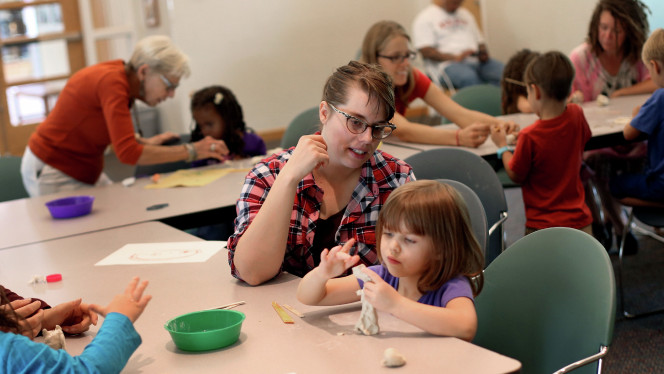
Pew found near unanimous consensus among those polled that libraries should offer free literacy programs to children and coordinate more closely with local schools to give resources to students.
Literacy and story time programs for children are a driving force behind public libraries in Utah. According to quickfacts.census.gov, nearly 40 percent of Utah's population in 2014 was under 18 years old.
"If you look at (Davis County Library) in terms of demographics, it's mostly families with children, young mothers with children specifically," Meyer said.
In Utah, the vast majority of in-house library program attendance is for children's programs. About 67 percent of all programs in the state in 2014 were for children with the attendance at children's programs increasing by 24 percent in the past five years, according to the state library division.
"When you get involved young, you're more likely to stay involved," Sollis said. "We not only offer programs, but programs in an environment of literacy and learning."
Just over half of all programs with Salt Lake County Library System are children's programs. But such programming then extends and increases usage all across the family.
"Moms want their kids to read and they might buy them a few books. But they can't buy thousands of books that are offered for free at the library," Meyer said. When children and adults attend classes or events at the library, they often see what else is offered there and check out more material.
Morris said children are more technologically adept than they ever have been. But having a community center is still a need that all children have and will have.
"They still need to come together in a group and learn to play well with others," Morris said. "You can be a phenomenal researcher by yourself. Usually to succeed in most jobs you still need to work and play well with others."
Yet the large number of children at Utah libraries has increased the demand for deliberately isolated and quiet study spaces, Meyer said. And like the libraries of yesterday, those are things librarians today still want to offer their patrons who need a peaceful oasis.