Estimated read time: 2-3 minutes
This archived news story is available only for your personal, non-commercial use. Information in the story may be outdated or superseded by additional information. Reading or replaying the story in its archived form does not constitute a republication of the story.
Washington Hawthorn
Within the next several weeks, trees in Northern Utah will begin going dormant. When this happens, broadleaved trees shed their leaves, and a great side effect of this process is that many trees have beautiful fall color. In fact, in some areas, tourist industries exist around this process. An example includes the New England and the Mid-Atlantic States, which are famous for the show that many of the regionally native forest trees put on during the autumn.
Many of these same trees including pin oak, red oak, red maple, sugar maple and sweet gum are cultivated in the landscape of many areas of the United States because of their brilliant fall color. Unfortunately, they generally do not perform well in Utah but are commonly planted. This is mainly due to our alkaline soil and arid climate. Fortunately, there are a few trees that are less commonly known with great fall color that grow quite well in many areas of the Intermountain West. One that is very useful, especially with today's smaller yards, is Washington hawthorn.
Washington hawthorn is native to the lower Midwest and upper south but is cold hardy in all parts of Utah. The species does have some presumed drawbacks that are actually not that bad. They include that the species has thorns and produces fruit. However, the thorns are not usually a problem due to how the tree is pruned by the grower. Additionally, the fruit is persistent, meaning that it has a tendency to stick to the tree and not drop to the ground, making it relatively clean. If the fruit does drop, it is in mid to late winter, where it falls into snow and rots before warm weather appears. Many bird species also eat the fruit.
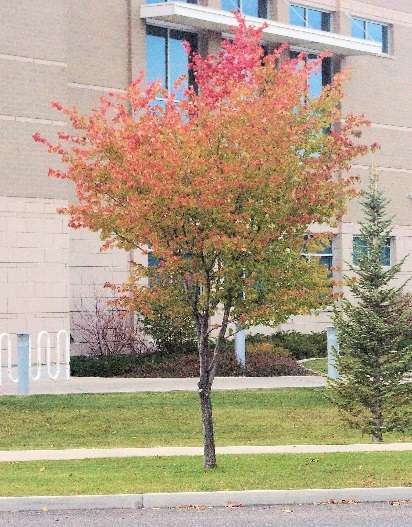
Washington hawthorn grows to 20 feet high and wide after 10 to 15 years. It has pretty, white spring flowers and tolerates alkaline and clay soil as long as it is not over watered and the soil is not compacted. It is also pest and disease resistant.
Other hawthorn species also perform very well in Utah. These include Russian, Lavalle, thornless cockspur and toba hawthorns. However, one species to be wary of is English hawthorn. It has beautiful red spring flowers but is susceptible to fire blight. It is commonly sold under the name Paul's scarlet.
Washington hawthorn in the fall (left) and its winter appearance (right). Note that the fruit sticks to the tree and has not fallen all over the ground. Both images Taun Beddes (public domain).