'%3e%3cpath%20d='M34.1406%205.85938C30.3906%202.10547%2025.3047%200%2020%200C14.6953%200%209.60938%202.10547%205.85938%205.85938C2.10938%209.61328%200%2014.6953%200%2020C0%2025.3047%202.10547%2030.3906%205.85938%2034.1406C9.61328%2037.8906%2014.6953%2040%2020%2040C25.3047%2040%2030.3906%2037.8945%2034.1406%2034.1406C37.8906%2030.3906%2040%2025.3047%2040%2020C40%2014.6953%2037.8945%209.60938%2034.1406%205.85938ZM37.0117%2023.543H31.1602V13.5391H27.6328V19.9414C28.1211%2020.6914%2028.3711%2021.582%2028.3711%2022.5625V22.625C28.3711%2023.668%2028.1172%2024.6055%2027.6328%2025.4297V26.6094H36.082C33.4883%2032.9375%2027.2891%2037.3789%2020.0039%2037.3789C10.3711%2037.3789%202.62109%2029.6289%202.62109%2020C2.62109%2010.3711%2010.3711%202.62109%2020%202.62109C29.6289%202.62109%2037.3789%2010.3711%2037.3789%2020C37.3789%2021.1484%2037.2617%2022.2656%2037.0508%2023.3477C37.0391%2023.4141%2037.0234%2023.4766%2037.0117%2023.543Z'%20fill='white'/%3e%3cpath%20d='M22.3086%2018.5352C20.4336%2018.125%2019.9531%2017.8398%2019.9766%2017.1836V17.1406C19.9766%2016.6992%2020.3477%2016.2148%2021.4023%2016.2148C22.582%2016.2148%2023.8867%2016.6797%2025.0781%2017.4766L26.8516%2015.0195C25.4453%2013.8906%2023.707%2013.3398%2021.5547%2013.3398C18.5195%2013.3398%2016.4375%2015%2016.4063%2017.4766V17.5352C16.3633%2020.2617%2018.5859%2020.9805%2021.293%2021.6016C23.0391%2021.9766%2023.5703%2022.3164%2023.5703%2022.9609L23.5469%2022.9766C23.5469%2023.3906%2023.2578%2023.7031%2022.7852%2023.8359C22.5742%2023.9062%2022.1289%2023.9727%2021.5156%2023.9727C20.7617%2023.9727%2019.7539%2023.8633%2018.6328%2023.4844C18.0898%2023.2891%2017.4727%2023.0039%2016.8047%2022.6133L20.1406%2026.625C20.2813%2026.6602%2021.0977%2026.8516%2021.7734%2026.8516C25.0039%2026.8516%2027.0859%2025.2461%2027.1094%2022.6328V22.5703C27.1602%2020.1133%2025.2148%2019.1719%2022.3086%2018.5352Z'%20fill='white'/%3e%3cpath%20d='M5.24219%2013.5664V26.6133H8.75391V23.7578L10.2969%2021.9531L14.2031%2026.6133H18.3867L12.3555%2019.5195L17.4023%2013.5664H13.4531L8.75391%2019.0586V13.5664H5.24219Z'%20fill='white'/%3e%3c/g%3e%3cdefs%3e%3cclipPath%20id='clip0_97_2430'%3e%3crect%20width='40'%20height='40'%20fill='white'/%3e%3c/clipPath%3e%3c/defs%3e%3c/svg%3e)



Estimated read time: 1-2 minutes
This archived news story is available only for your personal, non-commercial use. Information in the story may be outdated or superseded by additional information. Reading or replaying the story in its archived form does not constitute a republication of the story.
SALT LAKE CITY — If you're looking for a way to avoid the congestion on the roads you'll have a whole new option in less than a year in Salt Lake City.
Bike sharing has been phenomenally successful in other cities around the world. In the United States, the program has recently found success in Washington, D.C., and Denver.
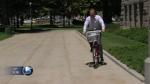
Bike Share SLC gets rolling next spring. Organizers tout it as convenient, affordable, and good for your health and the environment.
- The first successful bike share program in the United States was established in Denver in 2010.
- The largest bike share program in the U.S. currently is in Washington, D.C.
- The largest program in the U.S. will be in New York City. CitiBike is scheduled to launch this summer.
"If I'm in the south end of downtown and I've got a meeting in the north end of down town, or want to visit someone up there, instead of walking or spending 10 minutes waiting for a train to come, you grab a bike outside of your office and you ride uptown," said Salt Lake City Mayor Ralph Becker.
A membership costs from $5 for 24 hours, to $75 for a year. Ben Bolte, Bike Share SLC's project managers, says maps will be provided at each bike kiosk to assist riders in knowing where to drop off the bike when they are done.
The bike handles extremely well, providing a very comfortable ride, organizers say.
They are very comfortable, very stable. They're heavier than most bikes, so (they have) a low center of gravity.
–Mayor Ralph Becker
"They are very comfortable, very stable. They're heavier than most bikes, so (they have) a low center of gravity," Becker said.
Major sponsors include Select Health and Rio Tinto. Both stepped up to get the public-private partnership moving.
"My sense is that this will be very successful in Salt Lake City," Becker said.
A GPS will also track the bikes and tell the user how many calories they've burned and how much they've saved in gas and parking. Salt Lake will start off with ten stations and grow as more sponsors get involved.