Estimated read time: 1-2 minutes
This archived news story is available only for your personal, non-commercial use. Information in the story may be outdated or superseded by additional information. Reading or replaying the story in its archived form does not constitute a republication of the story.
SALT LAKE CITY — What's smaller than a cell and more numerous than the stars in the sky? Why the number of possible drugs that can have an effect on the human body, of course.
The American Chemical Society recently released a study in which they argue that the 67 million small molecule compounds that have already been discovered amount to less than one tenth of one percent of the possibilities out there. The total number could be as high as 1 novemdecillion, a one with 60 zeros trailing it or 10^60. According to the ACS, that's more than the number of stars in the entire universe, at least according to some estimates.
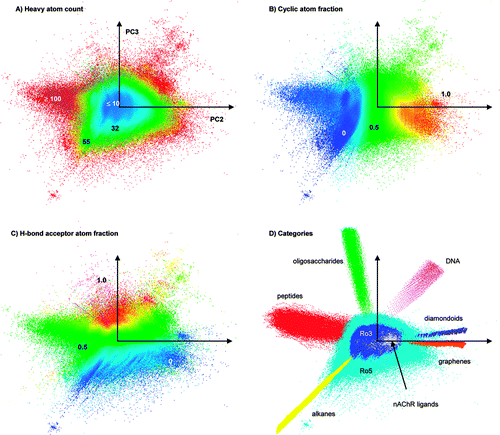
The ACS came to this conclusion by taking a voyage not into the space that holds the stars themselves, but into so-called chemical space. The researchers used computers and sophisticated algorithms to map out the possible combinations of atoms into small molecules, that is, molecules that can cross the cell membrane and interact with biological processes in a way useful - and sometimes dangerous - to living things.
The study, called "Exploring Chemical Space for Drug Discovery Using the Chemical Universe Database," sets out to identifying the resources available to comb through all of those possibilities in order to narrow in on a few compounds that could be of use to us, as opposed to the billions and billions that would probably kill us. Dut in doing so, it gives an exhaustive account of what's possible at all.
The researchers state, or perhaps understate, that "small molecule drugs are essential to the success of modern medicine." With a number like that to work from, it would have to be.