'%3e%3cpath%20d='M34.1406%205.85938C30.3906%202.10547%2025.3047%200%2020%200C14.6953%200%209.60938%202.10547%205.85938%205.85938C2.10938%209.61328%200%2014.6953%200%2020C0%2025.3047%202.10547%2030.3906%205.85938%2034.1406C9.61328%2037.8906%2014.6953%2040%2020%2040C25.3047%2040%2030.3906%2037.8945%2034.1406%2034.1406C37.8906%2030.3906%2040%2025.3047%2040%2020C40%2014.6953%2037.8945%209.60938%2034.1406%205.85938ZM37.0117%2023.543H31.1602V13.5391H27.6328V19.9414C28.1211%2020.6914%2028.3711%2021.582%2028.3711%2022.5625V22.625C28.3711%2023.668%2028.1172%2024.6055%2027.6328%2025.4297V26.6094H36.082C33.4883%2032.9375%2027.2891%2037.3789%2020.0039%2037.3789C10.3711%2037.3789%202.62109%2029.6289%202.62109%2020C2.62109%2010.3711%2010.3711%202.62109%2020%202.62109C29.6289%202.62109%2037.3789%2010.3711%2037.3789%2020C37.3789%2021.1484%2037.2617%2022.2656%2037.0508%2023.3477C37.0391%2023.4141%2037.0234%2023.4766%2037.0117%2023.543Z'%20fill='white'/%3e%3cpath%20d='M22.3086%2018.5352C20.4336%2018.125%2019.9531%2017.8398%2019.9766%2017.1836V17.1406C19.9766%2016.6992%2020.3477%2016.2148%2021.4023%2016.2148C22.582%2016.2148%2023.8867%2016.6797%2025.0781%2017.4766L26.8516%2015.0195C25.4453%2013.8906%2023.707%2013.3398%2021.5547%2013.3398C18.5195%2013.3398%2016.4375%2015%2016.4063%2017.4766V17.5352C16.3633%2020.2617%2018.5859%2020.9805%2021.293%2021.6016C23.0391%2021.9766%2023.5703%2022.3164%2023.5703%2022.9609L23.5469%2022.9766C23.5469%2023.3906%2023.2578%2023.7031%2022.7852%2023.8359C22.5742%2023.9062%2022.1289%2023.9727%2021.5156%2023.9727C20.7617%2023.9727%2019.7539%2023.8633%2018.6328%2023.4844C18.0898%2023.2891%2017.4727%2023.0039%2016.8047%2022.6133L20.1406%2026.625C20.2813%2026.6602%2021.0977%2026.8516%2021.7734%2026.8516C25.0039%2026.8516%2027.0859%2025.2461%2027.1094%2022.6328V22.5703C27.1602%2020.1133%2025.2148%2019.1719%2022.3086%2018.5352Z'%20fill='white'/%3e%3cpath%20d='M5.24219%2013.5664V26.6133H8.75391V23.7578L10.2969%2021.9531L14.2031%2026.6133H18.3867L12.3555%2019.5195L17.4023%2013.5664H13.4531L8.75391%2019.0586V13.5664H5.24219Z'%20fill='white'/%3e%3c/g%3e%3cdefs%3e%3cclipPath%20id='clip0_97_2430'%3e%3crect%20width='40'%20height='40'%20fill='white'/%3e%3c/clipPath%3e%3c/defs%3e%3c/svg%3e)



Estimated read time: 3-4 minutes
This archived news story is available only for your personal, non-commercial use. Information in the story may be outdated or superseded by additional information. Reading or replaying the story in its archived form does not constitute a republication of the story.
SALT LAKE CITY -- Agencies helping Utahns find work say they're seeing a steady increase in job openings around the state. Economic experts say if you're unemployed, now's probably a good time to look for work.
"If you're seeing job gains on the job boards, that would pretty much fit with what we thought and hoped would happen about this time," said Mark Knold, chief economist with the Utah Department of Workforce Services.
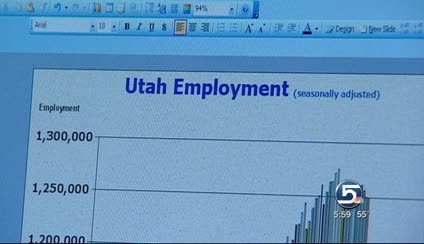
Knold says things are slowly improving. Jobs in Utah are growing at 1.5 percent, just shy of the ideal 3 percent rate.
Lori Thurston, assistant manager of the Salt Lake City office of LDS Employment Resource Services, said she has observed a "continual rise in how many jobs are available, a lot more blue collar than white collar."
"We have felt a lot of energy and enthusiasm lately," she said, which is a sharp contrast to conditions in 2010. "Last year, we heard a lot from job seekers, 'There are no jobs.'"
But that seemed to improve after the first of the year as job seekers renewed their searches and employers began to reassess their staffing needs.
"We saw a real surge, both in job seekers and employers," Thurston said.
Job outlook for new college grads
Meanwhile, one national report suggests that students who graduate from college this spring will have improved job prospects over the Class of 2010. Employers that responded to the association's fall survey plan to hire 13.5 percent more bachelor's degree graduates this year than the Class of 2010.
Dimitrina Bauman recently went back to school to get an associate's degree in accounting --her degree from Bulgaria doesn't offer her much here in America.
"It's hard," Bauman said. "It's just, we are in a hard economy situation." She said for one open position, there seems to be at least 100 people applying.
The National Association of Colleges and Employers' Job Outlook 2011 rates employment prospects as "good" compared to "fair" for 2010.
"We're seeing some positive movement. Hopefully that increases," said Mike Caldwell, director of the Westminster College's Resource Center.
Some 85 to 90 percent of Westminster College's 2010 graduates have found employment or have enrolled in graduate school, he said.
Caldwell attributes the high rate to the college's "strong internship program." Business students are required to perform internships but many students in the college's arts and science programs do as well.
"What we see nationally is that is students who complete internships are much more competitive in the job market. Strong academic preparation is important but employers also seek "strong practical application of what they've learned," Caldwell said.
Knold said a 13.5 percent increase may be overly optimistic but it should be read as a positive indicator nonetheless.
"It's going to take a lot of time to not only gain back the 80,000 jobs that we lost, but to employ people who have come into the labor force since then," he said.
New graduates may have a leg up on other job seekers because they can be paid lower starting salaries and they are more "pliable," meaning that employers won’t have to "untrain their bad habits. They get to create their habits."
Better days ahead?
Although these trends are optimistic, job creation activity is far below that of five years ago, Knold said. The state's unemployment rate — 7.7 percent — is still "very high."
"We're not seeing any job growth putting a downward pull on the unemployment rate," Knold said.
Others are more optimistic. "If we're persistent, one day the job (is) going to come," Bauman said.
Many of the jobs lost during the recession were in mainly male-dominated industries, like construction and manufacturing. Since those were the first to go, experts say they may be the last to rebound.
-----
Story written with contributions from Nkoyo Iyamba and Marjorie Cortez.