Estimated read time: 8-9 minutes
This archived news story is available only for your personal, non-commercial use. Information in the story may be outdated or superseded by additional information. Reading or replaying the story in its archived form does not constitute a republication of the story.
BYU's 34-10 loss at Florida State represented the most dolorous of growing pains for the 2010 Cougars, as for a second straight week, BYU set a low-water mark for the Bronco Mendenhall era.
In the previous week's loss at Air Force, BYU passed for 88 yards; the worst aerial effort since a 3-0 home loss to Utah in 2003.
Yesterday in Tallahassee, BYU's six yards of first quarter offense marked the lowest single-quarter yardage total of the Bronco era, while the 191 yards of total offense stand as the most anemic output since the 156 yards gained in the 2003 game mentioned above.
Averaging 15.7 points per game, BYU has scored 23 points or fewer in three consecutive games for the first time since Gary Crowton's final season in 2004.
After five straight years ranking in the top 25 in total offense, and after being ranked in the top 25 in scoring offense in four of the last five seasons, the Cougars' offense is currently ranked 100th or worse in four of five main NCAA stat categories (the rush offense is ranked 67th).
Defensively, BYU is 98th in yards allowed and 119th (out of 120 teams) in rush yards allowed.
Times are tough, at 1-2 on the season and with one of the nation's most potent attacks rolling into Provo next week. Nevada is ranked in the top five in rushing offense, total offense and scoring offense; UNR is also is the top ten in pass efficiency. Wolfpack QB Colin Kaepernick is second nationally in total offense.
*******
BYU has been here before; the Cougars are 1-2 for a fourth time in Mendenhall's six seasons, yet have consistently righted the ship in years past.
2005: 1-3 start; 5-3 finish
2006: 1-2 start; 10-0 finish
2007: 1-2 start; 10-0 finish
*******
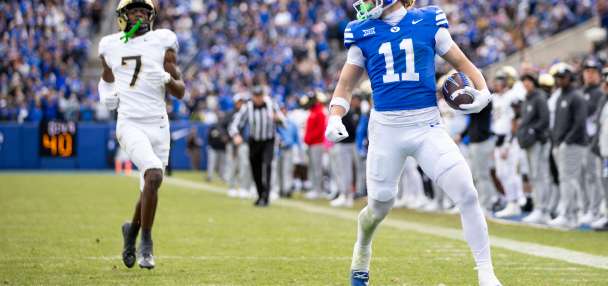
The FSU setback did feature the first touchdown pass for freshman Jake Heaps (pictured above, with ball in midair), who became only the fourth BYU freshman to throw a touchdown pass in his first season out of high school (Jim McMahon, 1 in 1977; Kevin Feterik, 1 in 1996; Drew Miller, 3 in 1997).
While head coach Bronco Mendenhall declined to name Heaps a starter for next week, the expectation is that sooner rather than later, the coaches plan to turn things over to the freshman to lead the execution of what could be considered BYU's "core offense."
*******
Which brings us to the crux of today's analysis: what we have witnessed so far doesn't look like the "core offense" as we have known it for the last five seasons.
Rather than focusing exclusively on the quarterback situation, let us briefly note that the first two years of the Bronco Mendenhall era featured John Beck running the offense as a junior and senior, then a redshirt sophomore in Max Hall taking over for the next three seasons.
In season six, BYU turned to an atypical, option-style QB combined with a true freshman straight out of high school, neither of whom was deemed prepared enough to be named a clear-cut starter. Things were not going to look like they did with Beck and Hall, at least not from the start.
*******
The debate over the wisdom of BYU's QB platoon system will continue, but I am choosing today to emphasize two particular areas of strength for BYU in the last five seasons, and prominent areas of weakness so far in 2010: third-down conversion efficiency and tight end production. Not surprisingly, the two are related.
*******
BYU led the nation in 3rd down conversion percentage in 2009 (56%), and finished first or second nationally in that particular category in three of the last four seasons.
Through three games this season, BYU is converting on 32.6% of third downs, which ranks 99th (interestingly, Nevada is #1 at 67.6%.
--
The sample size is small (only 25% of the regular season is complete), but some notable trends have emerged.
BYU is 15/46 on third downs; 8/13 rushing (62%), and 7/33 passing (21%).
In 2009, BYU was 94/168 on third downs; 33/60 rushing (55%), and 61/108 passing (56%).
Clearly, BYU was as effective running as it was throwing for first downs last season, and whereas BYU's rushing third downs have proven relatively productive in 2010, the inability to pass for first downs stands as a striking weakness.
You might assume that BYU's down-and-distance scenarios have been much more problematic this year than last, so let's see if that is the case:
3rd and 3 or shorter--
2009: 47 times in 168 attempts (28% of all third downs)
2010: 11 times in 46 attempts (24% of all third downs)
-
3rd and 4 to 3rd and 7--
2009: 60 times in 168 attempts (36% of all third downs)
2010: 18 times in 46 attempts (39%) of all third downs)
-
3rd and 8 or longer--
2009: 61 times in 168 attempts (36% of all third downs)
2010: 17 times in 46 attempts (37% of all third downs)
-
"Desperation" third downs; 3rd and 11 or longer--
2009: 37 times in 168 attempts (22% of all third downs)
2010: six times in 46 attempts (13% of all third downs)
--
As you can see, BYU's third down scenarios are tracking on last season's pace for the most part. The disparity comes in the team's inability to convert, particularly through the air.
*******
BYU passed on 64% of its third downs in 2009, converting on 56% of those attempts (61 of 108)
BYU has passed on 72% of its third downs in 2010, converting on only 21% of those pass attempts (7 of 33).
In short, the 2010 Cougars are throwing the ball very poorly (115th in pass efficiency), yet are throwing the ball more frequently on third down than a 2009 team that had the fifth best pass completion percentage in BYU history.
--
Note: Saturday at FSU, BYU called pass plays on 14 of 15 third down attempts (including its last 12), completing passes on only three of 14 attempts.
3rd and 1: 0/1 passing
3rd and 4: 1/1 rushing, 1/2 passing
3rd and 5: 1/3 passing
3rd and 6: 1/3 passing
3rd and 10: 0/2 passing
3rd and 11: 0/1 passing
3rd and 13: 0/1 passing
3rd and 14: 0/1 passing
--
Note: BYU's average third down distance v. Florida State was 3rd and 7; the Seminoles actually averaged 3rd and 8, yet ran on 6 of 13 third down attempts.
--
BYU completed two of nine passes on 3rd and 6 or shorter at FSU (22%). In 2009, BYU completed 38 of 59 pass attempts on 3rd and 6 or shorter (64%).
*******
One of the reasons BYU was so successful when choosing to throw on third down in 2009 was the fact that Dennis Pitta and Andrew George were the primary targets, and the lack of tight end production is a glaring positional black hole.
*******
In 2009, Pitta and George were targeted on 40 of 108 third down pass attempts (37%), including sacks--
Caught by Pitta: 17
Caught by George: 11
Intended for Pitta, incomplete: 7
Intended for George, incomplete: 3
Intended for Pitta, intercepted: 1
Caught by Pitta, short: 1
--
In 2010, TEs have been targeted on only two of 33 third down pass attempts (6%), including sacks--
Intended for Muehlmann, incomplete: 1
Intended for Wilson, incomplete: 1
--
In 2009, 28 of BYU's 61 third down receptions (46%) were caught by either Pitta or George, while 28 of 40 Pitta/Gerge "targets" resulted in first downs (70%).
In 2010, zero of BYU's seven third down receptions have gone to tight ends, while zero of two TE "targets" have resulted in first downs.
--
While the Cougars have five tight ends on the active roster (at least three of whom were high-profile TE recruits) BYU plainly doesn't feel it has the tight ends to play "BYU Football" right now--as evidenced by WR O'Neill Chambers being flexed out as a "Y" receiver at Florida State.
During camp, Offensive Coordinator/inside receivers coach Robert Anae had this to say about his tights ends:
"We've got plenty of talent. You can assure your readers that we've got plenty of talent at that spot to do well this year. It's going to be one of those things where you've got to take the 'ups with the downs.' You close the gap on the 'downs' and increase the distance on the 'ups.'
On coaching five consecutive All-MWC First Team tight ends from 2005 through 2009, he said simply: "We try to put guys who have earned spots in the best position to play roles. That definitely was the case in the past, and we're looking for that as we speak."
--
BYU's 33 third down pass "targets," 2010:
Luke Ashworth: 8 (1 caught for first down)
Cody Hoffman: 6 (2 caught for first down)
J.J. DiLuigi: 5 (3 caught for first down)
McKay Jacobson: 3 (1 caught for first down)
Bryan Kariya: 3
O'Neill Chambers (as WR): 2
Mike Muehlmann: 1
Richard Wilson: 1
Sacks: 4
--
BYU has thrown to WRs 19 times in 33 passing third downs, resulting in four first downs. While WRs are supposed to be a strength of the 2010 team, and the nature of their routes would ostensibly put them in position to move the chains, the chances of a third down pass being completed to a wideout are currently very slim.
"True" TEs are not part of the present game plan.
That leaves J.J. DiLuigi, who has a very good first down-third-down-target rate of 60%, and is currently averaging 7.0 yards per rush and 14.4 yards per reception (compared to Harvey Unga's 5.2 and 7.6 yard averages in 2009, respectively).
--
BYU has run on 13 third down attempts, and converted eight, as follows:
Riley Nelson: 8 attempts; 5 conversions
DiLuigi: 3 attempts, 2 conversions
Kariya: 2 attempts, 1 conversion
Again, by the numbers, DiLuigi is the go-to-guy on third downs when going for it on the ground.
--
By down and distance, 2010 rushing third down attempts (not including sacks)--
3rd and 1: 3/4
3rd and 2: 1/1
3rd and 3: 0/1
3rd and 4: 3/4
3rd and 6: 0/1
3rd and 7: 0/1
3rd and 16-20: 1/1
--
By down and distance, 2010 passing third down attempts (including sacks)--
3rd and 1: 0/1
3rd and 2: 1/3
3rd and 3: 0/1
3rd and 4: 1/5
3rd and 5: 2/4
3rd and 6: 1/3
3rd and 7: 0/0
3rd and 8: 1/4
3rd and 9: 0/2
3rd and 10: 1/5
3rd and 11+: 0/5
*******
So, who is this BYU football team, where is it really strongest, and and what will the "BYU offense" ultimately look like in 2010?
Four weeks into the season, I don't think we have a very good idea yet; not surprising, but troubling.
*******