- A coalition of immigrant advocates gathered to voice support for temporary protected status programming amid the Trump administration's push to end it.
- The administration is targeting the programming as part of its crackdown on immigrants in the country.
- Some 1.3 million immigrants across the United States have temporary protected status, including around 16,000 in Utah.
SALT LAKE CITY — With the Trump administration's crackdown on immigrants hurtling forward, community advocates are bracing for a looming showdown in the U.S. Supreme Court that could bear on the future of more than a million immigrants, including some 16,000 in Utah.
Moves by President Donald Trump's administration to end programming granting certain immigrants from Haiti and Syria temporary protected status, or TPS, are the focus of scheduled arguments later this month before the Supreme Court. If the court sides with Trump, Linda Stone, of MomsRising in Utah, said TPS programs geared to Venezuelans, Salvadorans and others would also face dismantling, throwing the lives of those impacted into disarray.
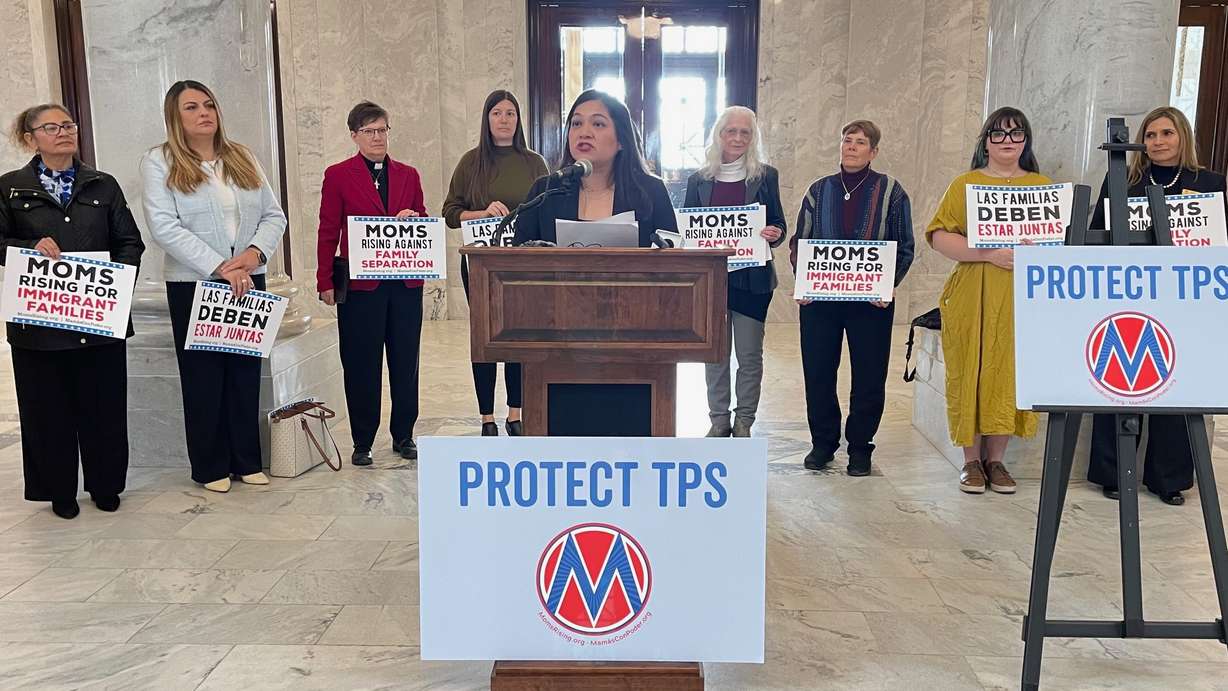
She spoke out on Friday to warn against the possibility and to voice support for TPS initiatives.
"Ending TPS would trigger the largest mass loss of legal status in U.S. history; we're talking 1.3 million people," she said at a press conference at the Utah Capitol in Salt Lake City, joined by other immigrant advocates, including Utah Sen. Luz Escamilla and Utah Rep. Angela Romero, Salt Lake City Democrats. "Families will be torn apart, communities destabilized, entire local economies disrupted."
In all, 1.3 million immigrants in the United States from 17 countries could be impacted if the Supreme Court sides with Trump, she said, including around 16,000 in Utah. The Utah figure includes around 7,000 people from Venezuela, the largest TPS bloc in the state, and 2,000 or so from El Salvador, the second-largest contingent.
"We're talking about parents separated from their children, workers removed from essential jobs, neighbors forced out of the communities they have helped build for years, often for more than a decade," said Stone. Her group, MomsRising, which advocates for immigrants from the perspective of women and mothers, is also planning press conferences in other cities around the country to speak out ahead of arguments in the case pertaining to TPS programs for Haitians and Syrians.
As part of Trump's multipronged crackdown on illegal immigration, his administration has pursued an end to many of the varied TPS programs in the country, some implemented under former President Joe Biden and others dating to the 1990s. TPS programs, geared to people from countries contending with armed conflicts, natural disasters and other dire situations, allow eligible immigrants to lawfully remain and work in the United States.
Trump administration officials, though, have argued that conditions in at least some TPS countries are no longer as dire as they once were, allowing for the initiatives to be scaled back.
In the looming case before the Supreme Court, the justices are to determine if the Trump administration has the authority to unilaterally end the TPS programs for Syrians and Haitians. If the court sides with Trump, those speaking at Friday's press conference say TPS programs for other countries — also under attack by Trump — would likely be next, essentially forcing TPS recipients to leave the country, find another mechanism that allows them to remain or face deportation.
U.S. officials created TPS programs "to protect people when conditions in their home countries make it unsafe to return. Sending people back under these conditions is not just reckless, it is inhumane," said Stone. "For many, it will be a death sentence."
Many of the speakers on Friday noted the fear many immigrants feel as Trump targets those in the country illegally. Short of a Supreme Court decision curtailing Trump's ability to dismantle TPS programs, others called for action by U.S. lawmakers to salvage TPS initiatives or protect those who would be affected if the program is eliminated.
Mayra Molina, of the Venezuelan Alliance of Utah, which advocates for the state's Venezuelan community, touted a measure in Congress that would extend TPS programming for Venezuelans covered by it for 18 months. Many have fled the country due to repression from the socialist government there, and Molina maintains that instability and danger persist.
"How can we be expected to return to our country where our lives are at risk? We cannot. It is not safe. There is no stability. There is not security at all," Molina said. TPS programming, she went on, "is not just a policy. It's a difference between safety and fear, between stability and uncertainty, between keeping families together or tearing them apart."
Romero, likewise, pressed for U.S. lawmakers to address the issue. "This should not come down to a court decision when lawmakers have the authority to protect families and provide stability. Instead, we are watching inaction while millions of lives hang in the balance," she said.
Those speaking Friday focused on what they say are the many contributions of immigrants to the community. Salvadorans in the United States under TPS programs "are construction workers, caregivers, small business owners and essential workers," said Gladis Rodriguez, of the Salvadoran and Latino Community of Utah, an advocacy group focused on Salvadorans.
Escamilla warned that families could be separated and that people could be forced to return to dangerous situations in their home countries. Immigrants, she said, are part of the "fabric" of Utah.
"All of these families that we are now talking about here in Utah are families that we spend time with. We go to church with them. We worship with them. Our kids go to school with them. We go to their businesses," she said.
Read more:

Voces de Utah
Looking for more news from Utah's Latino community? Visit our Voces de Utah section for more stories, events and features.Romero offered a strong critique of the Trump administration and stressed immigrants' contributions to the U.S. economy and workforce.
"This administration is destroying our country. I want to emphasize that — they're destroying our country because they are not supporting our immigrant community. Our immigrant communities are the ones that keep this country alive," she said.

Related stories
Most recent Politics stories
Related topics
 Tim Vandenack