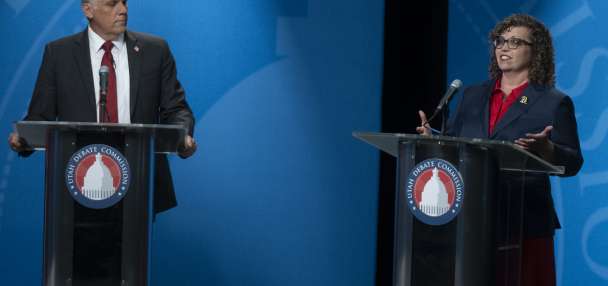
- Blake Moore and Karianne Lisonbee had few policy disagreements during a GOP debate for Utah's 2nd Congressional District.
- Lisonbee attacked Moore's role in supporting Proposition 4.
- Moore said he disagreed with judge's recent ruling on redistricting.
SALT LAKE CITY — Few policy disagreements emerged during a debate between 2nd Congressional District candidates Blake Moore and Karianne Lisonbee Monday.
Instead, Lisonbee used the topic of redistricting to attack Moore for his support of Proposition 4 in 2018, blaming the incumbent congressman in part for the initiative that led to Utah's new congressional map with a Democratic district.
Moore pointed to his leadership post in the U.S. House of Representatives and his support for making permanent the tax cuts first passed in 2017 as he pitched himself to voters in Utah's 2nd Congressional District.
Lisonbee, a state representative from Syracuse, called out Moore over his support of Proposition 4, but said she thinks gerrymandering is bad regardless of which party does it. Referring to comments Moore made recently in an interview with the KSL and Deseret News editorial boards during which he suggested governors band together to reach a detente on mid-cycle redistricting, Lisonbee said, "I truly can't tell whether he's naive or gaslight(ing) the public" to suggest Democratic governors would stand down.
She said Moore "gifted ... a congressional seat to the Democrats in Utah."
Moore said he disagrees with the decision by Utah 3rd District Judge Dianna Gibson to enact a new map after she ruled lawmakers did not comply with Proposition 4, saying she should have returned the issue to the Legislature to remedy. He said he has held a consistent stance on being opposed to partisan gerrymandering, but said he supports a proposed constitutional amendment to reassert lawmakers' power to draw maps.
"Republicans can win on candidates and policy," he added. "We don't need to manipulate too much to do it."
After a back-and-forth redistricting fight in red and blue states, both candidates said they support reestablishing traditional norms of redrawing political boundaries only once every decade.
Monday's hourlong debate, which was hosted at the PBS Utah studios on the University of Utah's campus, touched on various global issues from foreign policy to artificial intelligence regulation. The candidates also spent a significant amount of time on issues much closer to home for voters who live in the northern Utah district, such as the future of the Great Salt Lake and a large proposed data center in the district.
President Donald Trump has asked Congress for $1 billion to support the lake, and each candidate was asked how they would work to ensure Congress approved that funding. Moore touted his ongoing efforts in the House, while Lisonbee said she has some reservations about how that money would be used.
"Is that more deficit spending that is going to drive up prices for everyday Utahns?" she asked. "I'm not saying I'm not grateful for any resources that can go to the Great Salt Lake."
"I want to truly understand what we're going to do with the $1 billion, with a finite resource," she told reporters after the debate.
Moore said he recently spoke with Russell Vought, Trump's budget director, about the request for lake funding, and his team is working with Utah Rep. Celeste Maloy, who chairs the spending subcommittee on the environment.
"Our teams are working together to make sure that that subcommittee that will usher in some of the funding, it's clearly articulated, it talks about how the impact will be and it makes sure Utah has the opportunity to use it the best way possible," he said.
Both candidates also raised concerns about the process surrounding the massive data center proposed in Box Elder County, which was met with swift and fierce pushback from many Utahns.
Lisonbee said there are "too many unanswered questions" about the potential impacts to water and other things to say whether she can support the proposal in its current form.
"Those impacts don't go away just because we give tax incentives," she said. "I am not supportive at this point until questions are answered."
Moore called water needs "paramount."
"There's opportunities to do things in a more bite-sized approach, where you don't have to bite off so much," he said. "I mean, that land scale of this was enormous. I think that was what gave people a lot of pause, and so there is smart ways to be able to address this."
The primary election is June 23, and ballots will be sent out beginning this week.
The winner of the Republican primary will go on to face Democrat Peter Crosby, Independent American Party candidate Carlton Bowen and Libertarian Daniel Cottam in November.