Estimated read time: 2-3 minutes
This archived news story is available only for your personal, non-commercial use. Information in the story may be outdated or superseded by additional information. Reading or replaying the story in its archived form does not constitute a republication of the story.
Dr. Kim Mulvihill Reporting Millions of women have suffered through the discomfort of benign uterine fibroid tumors. And while drastic steps like hysterectomy were once the only solution, a much less invasive treatment is catching on.
Treatment usually means surgery to remove the fibroids, but another option is embolization, and a new study could turn skeptics into believers.
The procedure uses a catheter to release tiny particles about the size of grains of sand into the arteries that send blood to the fibroid. The particles block off the blood flow, starving the fibroids so they shrink and die.
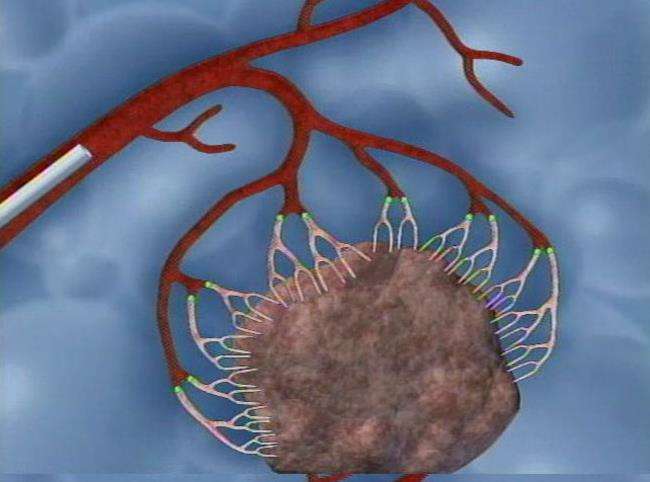
Some doctors have been slow to embrace the procedure, but new research says women who opt for embolization do just about as well as those who have surgery.
The good news is that today women with fibroids have choices, but they come with tradeoffs. Compared to surgery, embolization has a shorter hospital stay and a quicker recovery. But on the downside, in this study, 20 percent of women who underwent embolization continued to have symptoms and ended up needing a repeat embolization or a hysterectomy.
Common Questions
1. How common are fibroids, and do they always need to be treated?
Uterine fibroids are common, they occur in up to half of all women. Many fibroids remain small and cause no symptoms at all, yet others grow as large as a cantaloupe. Uterine fibroids are benign, not cancer, but they can cause pain, pressure, heavy menstrual bleeding, even infertility.
2. Is this newer procedure preferable for women who want to get pregnant?
We don't know enough about pregnancy after embolization to recommend the procedure for women who wish to preserve their fertility. The current thinking is that for women who want to get pregnant, a myomectomy, that's surgery to remove just the fibroids, is the best treatment option.
3. Do you sense any sort of "turf" struggle between gynecologists and radiologists about who can best treat these patients?
As new advances occur in medicine, we've seen many situations where care has shifted from one specialist to another. Open heart surgery to angioplasty for example. And yes, I think there has been a shift of care in this situation. But the goal certainly remains the same, doing what's best for the individual patient.