'%3e%3cpath%20d='M34.1406%205.85938C30.3906%202.10547%2025.3047%200%2020%200C14.6953%200%209.60938%202.10547%205.85938%205.85938C2.10938%209.61328%200%2014.6953%200%2020C0%2025.3047%202.10547%2030.3906%205.85938%2034.1406C9.61328%2037.8906%2014.6953%2040%2020%2040C25.3047%2040%2030.3906%2037.8945%2034.1406%2034.1406C37.8906%2030.3906%2040%2025.3047%2040%2020C40%2014.6953%2037.8945%209.60938%2034.1406%205.85938ZM37.0117%2023.543H31.1602V13.5391H27.6328V19.9414C28.1211%2020.6914%2028.3711%2021.582%2028.3711%2022.5625V22.625C28.3711%2023.668%2028.1172%2024.6055%2027.6328%2025.4297V26.6094H36.082C33.4883%2032.9375%2027.2891%2037.3789%2020.0039%2037.3789C10.3711%2037.3789%202.62109%2029.6289%202.62109%2020C2.62109%2010.3711%2010.3711%202.62109%2020%202.62109C29.6289%202.62109%2037.3789%2010.3711%2037.3789%2020C37.3789%2021.1484%2037.2617%2022.2656%2037.0508%2023.3477C37.0391%2023.4141%2037.0234%2023.4766%2037.0117%2023.543Z'%20fill='white'/%3e%3cpath%20d='M22.3086%2018.5352C20.4336%2018.125%2019.9531%2017.8398%2019.9766%2017.1836V17.1406C19.9766%2016.6992%2020.3477%2016.2148%2021.4023%2016.2148C22.582%2016.2148%2023.8867%2016.6797%2025.0781%2017.4766L26.8516%2015.0195C25.4453%2013.8906%2023.707%2013.3398%2021.5547%2013.3398C18.5195%2013.3398%2016.4375%2015%2016.4063%2017.4766V17.5352C16.3633%2020.2617%2018.5859%2020.9805%2021.293%2021.6016C23.0391%2021.9766%2023.5703%2022.3164%2023.5703%2022.9609L23.5469%2022.9766C23.5469%2023.3906%2023.2578%2023.7031%2022.7852%2023.8359C22.5742%2023.9062%2022.1289%2023.9727%2021.5156%2023.9727C20.7617%2023.9727%2019.7539%2023.8633%2018.6328%2023.4844C18.0898%2023.2891%2017.4727%2023.0039%2016.8047%2022.6133L20.1406%2026.625C20.2813%2026.6602%2021.0977%2026.8516%2021.7734%2026.8516C25.0039%2026.8516%2027.0859%2025.2461%2027.1094%2022.6328V22.5703C27.1602%2020.1133%2025.2148%2019.1719%2022.3086%2018.5352Z'%20fill='white'/%3e%3cpath%20d='M5.24219%2013.5664V26.6133H8.75391V23.7578L10.2969%2021.9531L14.2031%2026.6133H18.3867L12.3555%2019.5195L17.4023%2013.5664H13.4531L8.75391%2019.0586V13.5664H5.24219Z'%20fill='white'/%3e%3c/g%3e%3cdefs%3e%3cclipPath%20id='clip0_97_2430'%3e%3crect%20width='40'%20height='40'%20fill='white'/%3e%3c/clipPath%3e%3c/defs%3e%3c/svg%3e)



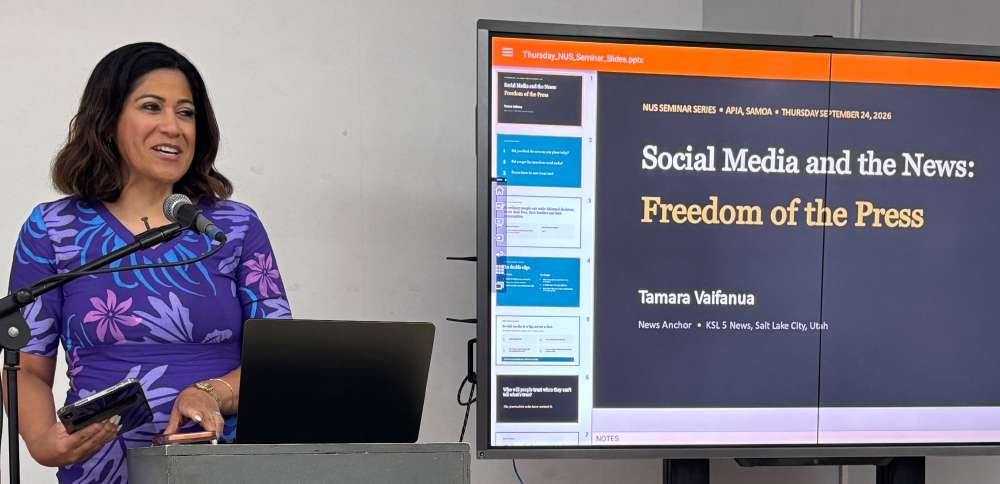
- KSL anchor Tamara Vaifanua traveled to Samoa last month to teach journalism.
- Vaifanua shared skills and discussed responsible use of social media and artificial intelligence.
- Her visit highlighted journalism's challenges and the U.S.-Samoa partnership's personal significance.
APIA, Samoa — KSL 5 News anchor Tamara Vaifanua traveled 5,000 miles to the South Pacific nation of Samoa the week of Sept. 21-25, not just to report, but to teach.
Vaifanua was invited through the U.S. Department of State's Speaker Program to spend the week meeting with journalists and training journalism students at the National University of Samoa.
"For me, it was personal," Vaifanua said. "My mother grew up here."
For a week, Vaifanua traded her anchor desk for a classroom, teaching broadcast writing and on-camera skills to students at the university. Many of the students read from a teleprompter for the first time. Vaifanua said she also talked with students about using social media and artificial intelligence responsibly, so their reporting stays accurate. "Every one of them leaned in," she said.
Tiperia Leautuolo Tuatagaloa, a National University of Samoa student, told Vaifanua she hopes to become a journalist who is "very passionate about their work," uncovering stories that make a difference while also being "a sympathetic storyteller to people who want to share their stories."
Vaifanua also met with working journalists in Samoa, many of whom she said are facing real challenges, from limited access to information to difficult reporting conditions. She encouraged them to always strive to seek the truth and get the story right.
"Sometimes difficult questions, or reporting, isn't easy," said Francis Vaigalepa, a TV1 Samoa anchor. "But that's the responsibility we have as journalists. What keeps me going is knowing that good journalism can help keep people accountable, inform our community, and give a voice to those who may not be heard."
The trip, Vaifanua said, was made possible by the partnership between the U.S. and Samoa. While there, she sat down with Matthew Younger, the U.S. Chargé d'Affaires to Samoa.
"You bring an American perspective of the importance of a free press, but I think you are deeply tied to the traditions here in Samoa," Younger told Vaifanua. "Those people-to-people ties, those are irreplaceable. There's a great Samoan diaspora in the United States and that is one of the real strengths of our relationship."
That partnership, Vaifanua said, also opened the door to something personal: a visit to Church College of Pesega. The school sits on land donated by her great-great-grandfather, AhMu, to The Church of Jesus Christ of Latter-day Saints. Generations later, Vaifanua's mother, Laila Skipps, went to school there.
At an assembly for Pesega students, Vaifanua spoke about her own winding path into journalism, including early mistakes on live television and the fear of leaving a comfortable job for something new. She encouraged students who don't yet know their own path to stay curious.
"You don't have to have it all figured out today," she told them.
That experience at Pesega, paired with the opportunity to sit with her NUS students, Vaifanua called a career highlight.
"Looking around that table at faces hungry for this work, I saw a reflection of myself," she said.