'%3e%3cpath%20d='M34.1406%205.85938C30.3906%202.10547%2025.3047%200%2020%200C14.6953%200%209.60938%202.10547%205.85938%205.85938C2.10938%209.61328%200%2014.6953%200%2020C0%2025.3047%202.10547%2030.3906%205.85938%2034.1406C9.61328%2037.8906%2014.6953%2040%2020%2040C25.3047%2040%2030.3906%2037.8945%2034.1406%2034.1406C37.8906%2030.3906%2040%2025.3047%2040%2020C40%2014.6953%2037.8945%209.60938%2034.1406%205.85938ZM37.0117%2023.543H31.1602V13.5391H27.6328V19.9414C28.1211%2020.6914%2028.3711%2021.582%2028.3711%2022.5625V22.625C28.3711%2023.668%2028.1172%2024.6055%2027.6328%2025.4297V26.6094H36.082C33.4883%2032.9375%2027.2891%2037.3789%2020.0039%2037.3789C10.3711%2037.3789%202.62109%2029.6289%202.62109%2020C2.62109%2010.3711%2010.3711%202.62109%2020%202.62109C29.6289%202.62109%2037.3789%2010.3711%2037.3789%2020C37.3789%2021.1484%2037.2617%2022.2656%2037.0508%2023.3477C37.0391%2023.4141%2037.0234%2023.4766%2037.0117%2023.543Z'%20fill='white'/%3e%3cpath%20d='M22.3086%2018.5352C20.4336%2018.125%2019.9531%2017.8398%2019.9766%2017.1836V17.1406C19.9766%2016.6992%2020.3477%2016.2148%2021.4023%2016.2148C22.582%2016.2148%2023.8867%2016.6797%2025.0781%2017.4766L26.8516%2015.0195C25.4453%2013.8906%2023.707%2013.3398%2021.5547%2013.3398C18.5195%2013.3398%2016.4375%2015%2016.4063%2017.4766V17.5352C16.3633%2020.2617%2018.5859%2020.9805%2021.293%2021.6016C23.0391%2021.9766%2023.5703%2022.3164%2023.5703%2022.9609L23.5469%2022.9766C23.5469%2023.3906%2023.2578%2023.7031%2022.7852%2023.8359C22.5742%2023.9062%2022.1289%2023.9727%2021.5156%2023.9727C20.7617%2023.9727%2019.7539%2023.8633%2018.6328%2023.4844C18.0898%2023.2891%2017.4727%2023.0039%2016.8047%2022.6133L20.1406%2026.625C20.2813%2026.6602%2021.0977%2026.8516%2021.7734%2026.8516C25.0039%2026.8516%2027.0859%2025.2461%2027.1094%2022.6328V22.5703C27.1602%2020.1133%2025.2148%2019.1719%2022.3086%2018.5352Z'%20fill='white'/%3e%3cpath%20d='M5.24219%2013.5664V26.6133H8.75391V23.7578L10.2969%2021.9531L14.2031%2026.6133H18.3867L12.3555%2019.5195L17.4023%2013.5664H13.4531L8.75391%2019.0586V13.5664H5.24219Z'%20fill='white'/%3e%3c/g%3e%3cdefs%3e%3cclipPath%20id='clip0_97_2430'%3e%3crect%20width='40'%20height='40'%20fill='white'/%3e%3c/clipPath%3e%3c/defs%3e%3c/svg%3e)



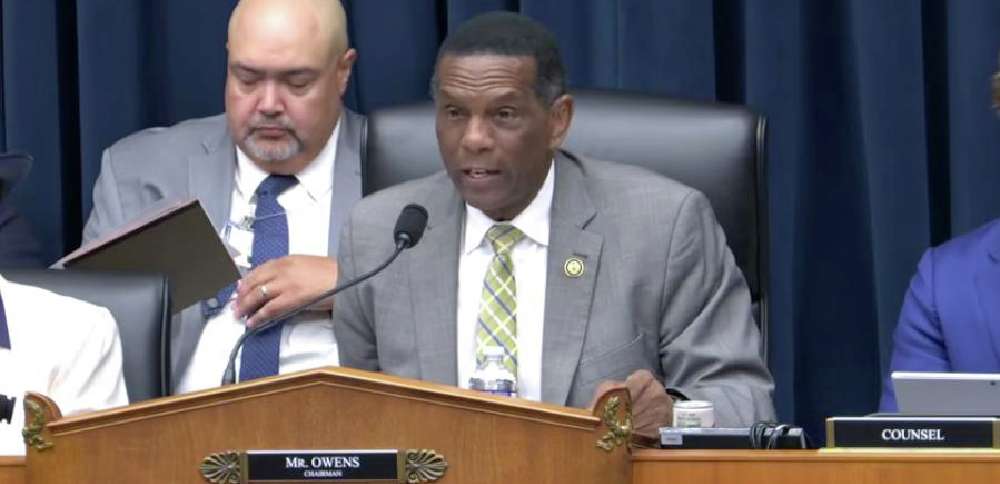
- Rep. Burgess Owens chaired a committee hearing on AI's impact on higher education.
- Experts discussed AI's potential benefits and challenges for college students' learning.
- Concerns include academic integrity, skill development, and balancing AI with traditional education.
SALT LAKE CITY — Utah Rep. Burgess Owens asked several education experts about the impacts artificial technology will have on college students during a committee hearing in Washington on Wednesday.
Owens, who chairs the House Higher Education and Workforce Development Subcommittee, spoke of the potential benefits of using AI in education but said academic institutions should ensure students learn the skills necessary to succeed in an increasingly AI-driven workforce, without sacrificing other learning.
The challenges presented by the new technology are "significant," he said.
"If students can produce polished work without genuine learning, the value of a credential is diminished for employers, institutions and students," Owens said in his prepared remarks. "Academic integrity frameworks built for a previous era are under significant strain, and institutions are still working out how to respond. Concerns about bias, data privacy and cybersecurity remain unresolved. And many educators are rightly asking what widespread use of AI could mean for foundational skills like writing, critical thinking and problem solving."
The committee heard from several witnesses who work in education, including Florida State University associate vice president and chief information officer Jonathan Fozard, who said AI is "quickly becoming a defining capability." He said universities should focus on teaching students how to use technology responsibly to prepare them for the workforce.
"Higher education must prepare students not only to use AI, but to understand it, question it, improve it, secure it and apply it in ways that serve people and strengthen our nation," he said.
But he said technology should serve to help teachers and students, not to replace them, when asked by Owens how universities can balance teaching AI without losing out on other learning.
"We don't view that AI will replace instruction or replace the classroom, but the partnership will prepare our students to be able to have exposure to the tools and the workforce and the platform that they will use in their future careers," he said.
Fozard said AI is "not magic," and shouldn't replace "human thought, critical thinking, ethical judgment or interpersonal communication."
"If students use AI as a shortcut, we risk weakening the very skills education is meant to build," he said.
Dave Duke, a top product officer for education company McGraw-Hill, said there is a growing gap between the AI skills desired by companies and what universities are teaching.
The problem, as he sees it, is that some students use AI constantly while unsupervised and have "learned to produce outputs without developing the capacity to evaluate them." On the other hand, he said many schools have restricted AI use and told students it is something to be avoided. Together, that leads to graduates "who are simultaneously over-reliant on AI and under-prepared to work with it professionally."
"The right answer is neither unrestricted use nor aggressive restriction," Duke said.
Michael Horn, an author and adjunct professor at Harvard Graduate School of Education, said universities may need to adapt to ensure that students are learning what they should.
"If AI can complete an assignment, perhaps the assignment itself is in need of change," he said, suggesting that tests or papers could be replaced by oral exams or presentations to "ensure that students are still doing the hard work of learning."