'%3e%3cpath%20d='M34.1406%205.85938C30.3906%202.10547%2025.3047%200%2020%200C14.6953%200%209.60938%202.10547%205.85938%205.85938C2.10938%209.61328%200%2014.6953%200%2020C0%2025.3047%202.10547%2030.3906%205.85938%2034.1406C9.61328%2037.8906%2014.6953%2040%2020%2040C25.3047%2040%2030.3906%2037.8945%2034.1406%2034.1406C37.8906%2030.3906%2040%2025.3047%2040%2020C40%2014.6953%2037.8945%209.60938%2034.1406%205.85938ZM37.0117%2023.543H31.1602V13.5391H27.6328V19.9414C28.1211%2020.6914%2028.3711%2021.582%2028.3711%2022.5625V22.625C28.3711%2023.668%2028.1172%2024.6055%2027.6328%2025.4297V26.6094H36.082C33.4883%2032.9375%2027.2891%2037.3789%2020.0039%2037.3789C10.3711%2037.3789%202.62109%2029.6289%202.62109%2020C2.62109%2010.3711%2010.3711%202.62109%2020%202.62109C29.6289%202.62109%2037.3789%2010.3711%2037.3789%2020C37.3789%2021.1484%2037.2617%2022.2656%2037.0508%2023.3477C37.0391%2023.4141%2037.0234%2023.4766%2037.0117%2023.543Z'%20fill='white'/%3e%3cpath%20d='M22.3086%2018.5352C20.4336%2018.125%2019.9531%2017.8398%2019.9766%2017.1836V17.1406C19.9766%2016.6992%2020.3477%2016.2148%2021.4023%2016.2148C22.582%2016.2148%2023.8867%2016.6797%2025.0781%2017.4766L26.8516%2015.0195C25.4453%2013.8906%2023.707%2013.3398%2021.5547%2013.3398C18.5195%2013.3398%2016.4375%2015%2016.4063%2017.4766V17.5352C16.3633%2020.2617%2018.5859%2020.9805%2021.293%2021.6016C23.0391%2021.9766%2023.5703%2022.3164%2023.5703%2022.9609L23.5469%2022.9766C23.5469%2023.3906%2023.2578%2023.7031%2022.7852%2023.8359C22.5742%2023.9062%2022.1289%2023.9727%2021.5156%2023.9727C20.7617%2023.9727%2019.7539%2023.8633%2018.6328%2023.4844C18.0898%2023.2891%2017.4727%2023.0039%2016.8047%2022.6133L20.1406%2026.625C20.2813%2026.6602%2021.0977%2026.8516%2021.7734%2026.8516C25.0039%2026.8516%2027.0859%2025.2461%2027.1094%2022.6328V22.5703C27.1602%2020.1133%2025.2148%2019.1719%2022.3086%2018.5352Z'%20fill='white'/%3e%3cpath%20d='M5.24219%2013.5664V26.6133H8.75391V23.7578L10.2969%2021.9531L14.2031%2026.6133H18.3867L12.3555%2019.5195L17.4023%2013.5664H13.4531L8.75391%2019.0586V13.5664H5.24219Z'%20fill='white'/%3e%3c/g%3e%3cdefs%3e%3cclipPath%20id='clip0_97_2430'%3e%3crect%20width='40'%20height='40'%20fill='white'/%3e%3c/clipPath%3e%3c/defs%3e%3c/svg%3e)


- State Rep. Karianne Lisonbee challenges Rep. Blake Moore ahead of the state GOP convention April 25.
- Moore touts his record in Congress and House GOP leadership role.
- Lisonbee runs on state legislative record and support from colleagues, including House Speaker Mike Schultz.
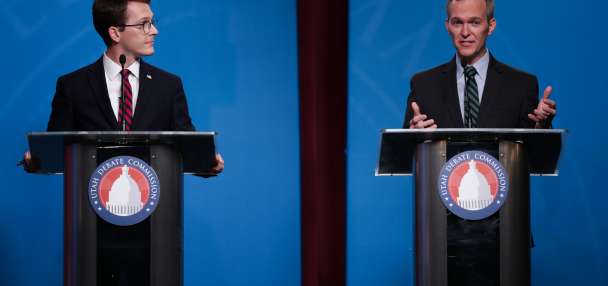
SALT LAKE CITY — With less than two weeks until the Utah Republican convention, a state lawmaker is trying to convince delegates to send her to a primary election against a three-term congressman who holds a top leadership position in the U.S. House.
Rep. Blake Moore is a rising star within the Republican Party — he occupies the leadership role formerly held by House Speaker Mike Johnson — and is looking to leverage his accomplishments and connections in Washington for another two years.
While Moore currently represents the 1st Congressional District, he's running this time in the 2nd Congressional District on the new map adopted by Judge Dianna Gibson, who threw out the previous map after a lawsuit accusing Republicans of gerrymandering.
But Moore's road to a fourth term is not smooth. He faces a notable intraparty challenge from Karianne Lisonbee, a state lawmaker who is critical of Moore for not living in the district where he's running — and for his role in the state's passage of the anti-gerrymandering initiative Proposition 4.
Lisonbee held multiple leadership positions in the Utah House of Representatives until her colleagues voted her out last year. Yet many of those same colleagues are endorsing her bid to unseat Moore.
Quin Monson, professor of political science at Brigham Young University, said Lisonbee "has the potential to be a formidable challenger." But, Monson added, she faces an uphill battle because challenging an incumbent with a history of being reelected "is a very difficult proposition."
"State legislators can mistake high profile in the state Legislature for a high profile with voters," Monson told KSL. "These are two very different things."
Prop 4 looms large
Moore has a reputation as a moderate Republican in the House, but that hasn't stopped him from climbing the GOP ranks and earning the support of President Donald Trump. He first ran for Congress in 2020, promising to extend the tax cuts passed during Trump's first term. Moore helped accomplish that last summer in the "One Big Beautiful Bill."
"We didn't just extend it for another few years; we made it permanent. It was a huge thing," Moore said. "This will give a long trajectory and confidence to the markets and to families to know that their child tax credit is not going away."
When Moore was elected to House GOP leadership in 2023, he became the first Utahn to hold the post. The congressman said his role gives Utah an "outsized voice" in Washington because he has a say in which committees the rest of Utah's delegation serves on.
"I can support my colleagues in a way that galvanizes our voice and awareness," he said.
Moore is also touting endorsements from the president, U.S. House speaker and Rep. Jim Jordan, of Ohio, founder of the conservative House Freedom Caucus.
But Lisonbee is hoping to capitalize on some frustrations among the Republican base in Utah, particularly over Proposition 4, which voters approved in 2018 to establish an independent commission to help draw congressional boundaries but was later weakened by the Legislature. Moore was one of the original backers of the initiative before he was elected to Congress.
Moore also faces notable criticism on that issue from a powerful politician, Utah House Speaker Mike Schultz, who slammed Moore's support for Proposition 4 and said he didn't do enough to bolster the recent GOP-led effort to overturn it.
In fact, Schultz, R-Hooper, has endorsed Lisonbee, citing Proposition 4 as the "biggest reason."
"I get it … people make mistakes and everything," the speaker said. "But when he decided not to get on board with the repeal of Prop 4 and work to try to resolve that, I was really disappointed with that."
Rep. Matt MacPherson, R-West Valley City, also took issue with Moore's support for Proposition 4 and was underwhelmed by the congressman's pushback on the court ruling last year that led to the adoption of Utah's new congressional map.
"Unintended consequences are kind of part of what we do, and we have to own those," MacPherson said. "You can't just pretend that they don't exist or say that this was an unforeseen circumstance. I think this was very much foreseen in this circumstance."
Moore did not sign the petition to repeal Proposition 4, which failed to qualify for the November ballot. But he criticized Gibson's decision to adopt a new congressional map rather than send the issue back to the Legislature.
Moore also said he supports a proposed constitutional amendment in Utah that would give state lawmakers power to repeal or amend ballot initiatives. The Utah Supreme Court in 2024 limited lawmakers' ability to amend initiatives in ways that go against their original intent.
"A challenger is going to disingenuously try to use it against me, but I took a principled position," Moore said of Proposition 4. "I'm a principles guy, and I will be able to credibly communicate how important it is to have a constitutional amendment so the state Legislature can address these types of ballot issues."
Who is Karianne Lisonbee?
Lisonbee became a state lawmaker in 2017 after serving on the Syracuse City Council. She was behind several notable bills, including Utah's 2020 trigger law, which banned elective abortions in the state and created a concealed carry permit for adults ages 18-20.
Within a few years of being elected, Lisonbee moved into House leadership, becoming majority assistant whip in November 2022. Two years later, she was elected majority whip.
But her tenure as whip was short-lived and rocky. She was widely viewed to have a difficult relationship with the Senate, according to multiple sources on Capitol Hill. After just one legislative session in that role, Lisonbee ran to become House majority leader after the previous one stepped down. But her House GOP colleagues rejected her bid, instead elevating Rep. Casey Snider, R-Paradise, to the No. 2 position.
A few months later, Lisonbee announced she would leave the Legislature at the end of her term.
"I was appointed to leadership once and elected to leadership three times by my colleagues," Lisonbee told KSL in response to questions about her time in leadership. "I'd be more concerned about my effectiveness as whip if senators were claiming that I was easy to work with because that would mean I wasn't doing my job."
MacPherson, the state representative who has served with Lisonbee since 2023, acknowledged the session prior to Lisonbee's failed leadership race was a "very difficult" one between the House and the Senate.
"I think all leadership was probably going to pay some sort of price for that," he said. "Whether it was her fault or anything to do with that, it's beyond me. I don't know. It was a difficult session. But I do know that from Karianne — I've never had anyone in the House that has ever worked harder for me to help my bills and my priorities pass."
Despite getting booted from legislative leadership, Lisonbee's congressional run is endorsed by a majority of her House GOP colleagues, including Schultz.
"She's probably one of the hardest-working people I've ever met in my life," said Schultz. "I'm a firm believer in hard work. I love people that jump in and work hard."
Schultz downplayed Lisonbee's loss in the leadership election, saying, "That happens." He said Lisonbee has been "on the right side of most of the issues."
Yet, Lisonbee's support in the Utah Senate is more sparse. Just five Republican senators have endorsed her bid to unseat Moore in Congress.
"Blake Moore is a proven leader for Utah," said Senate Majority Assistant Whip Mike McKell, R-Spanish Fork. "His election to House leadership in just his second term is almost unprecedented and gives our state a much stronger voice in Washington."
Senate President Stuart Adams, R-Layton, declined to comment on Lisonbee's run for Congress. He has endorsed Moore for another term.
But Sen. Dan McCay, R-Riverton, who endorsed Lisonbee, pointed to her record on conservative issues.
"Karianne and I have always worked hard on pro-life issues for the state of Utah, and I've always appreciated her hard work," McCay said.
"I have been a consistent champion for life, the Second Amendment, health freedom, fiscal conservatism, education, and the family in the Legislature and will continue to be a reliably conservative voice and vote in Congress," Lisonbee said. "The more the voters learn of my record and vision, the more excited they are to support me."
New congressional districts
Under the new and old maps, Moore lives in the 1st Congressional District. His house is in Salt Lake City. But after Gibson declared Proposition 4 to be the law and adopted a new map, it dramatically altered the district Moore represents. It is now a heavy favorite for Democrats, who haven't held a congressional seat in Utah in several years.
The other three districts — including the one Moore is running in — are strongly Republican.
Lisonbee, who lives within the new 2nd Congressional District boundaries in Syracuse, drew a distinction between herself and Moore.
"I am a better reflection of the residents who live in CD2. It's where I actually live," she said. "It's where I raised my six children. It's where I was an effective voice on a city council and a strong champion of conservative policy in the Legislature for a decade."
Federal and state laws don't require members of Congress to live within their districts. (Another Utah congressman, Rep. Mike Kennedy, lives in the 3rd District but is currently running in the 4th.)
But Moore said he moved into his current district following his first term in Congress.
"My family's doing amazing. My kids are enjoying sports, they're at school. I'm not going to disrupt that," Moore said, calling criticism of him living outside of the new district "grabbing at straws."
Moore grew up in Ogden, which is within the district he's now running for, and said he still represents northern Utah.
"You can't take the kid out of Ogden," he said.
However, the new district boundaries could prove more challenging for Moore in a primary election, according to Leah Murray, director of Weber State University's Olene S. Walker Institute of Politics and Public Service.
"I think Moore is the most vulnerable in the new district partisan setup," Murray said. "He is a moderate Republican, and these three districts are designed to be super right."
Still, Murray said she thinks Moore's status as an incumbent gives him a "very good chance" of winning a potential primary.
What's next?
Moore has gathered signatures to secure a spot on the June 23 primary ballot, even if he is unsuccessful at the Republican convention on April 25. But whether Lisonbee advances to the June primary will be entirely up to GOP delegates.
Republican Colton Hatch is also competing in the GOP convention next week.
The winner of the Republican primary will then move to the general election. Four Democrats — Peter Crosby, Tyler Farnsworth, Jarom Gillins and Ian Parrish — have filed to run and will compete for their party's nomination, also on April 25.
Two members of the Independent American Party, Carlton Bowen and Neil Hansen, have also filed to run for the seat.