Estimated read time: 5-6 minutes
- Michael Phelps visited the University of Utah's Huntsman Mental Health Institute as part of a visit to the state.
- Phelps emphasized the importance of mental health resources for athletes, citing his own struggles.
- He hopes for increased mental health support in future Olympics, including Utah's 2034 Winter Games.
SALT LAKE CITY — Swimmer Michael Phelps, considered one of the greatest ever Olympic athletes, said what inspired him during a visit to Utah on Wednesday was touring the Huntsman Mental Health Institute Crisis Care Center at the University of Utah.
"I speak a lot about my own mental health struggles, and I try to advocate for it as much as I possibly can. For me, lowering the stigma around mental health is something I'm very passionate about doing," Phelps told reporters ahead of appearing at the Governor's State of Sport Awards.
The walk-in center for emergency mental health conditions, part of the Huntsman Mental Health Institute and dedicated in 2021, addresses a need that, he said, goes unmet in too many people, including athletes who compete at the highest levels.
"I'm still kind of at a loss for words, just because of how incredible it is and the opportunities to help people again get the help and care they need. It's around the clock, 24/7. To me, every state should have this," Phelps said.
"I'm somebody who won't stop struggling with my own mental health journey. I think everybody needs a chance to be able to get the help and care they need and deserve," he said, adding that "it breaks my heart every single time" he reads about the nation's suicide rate.
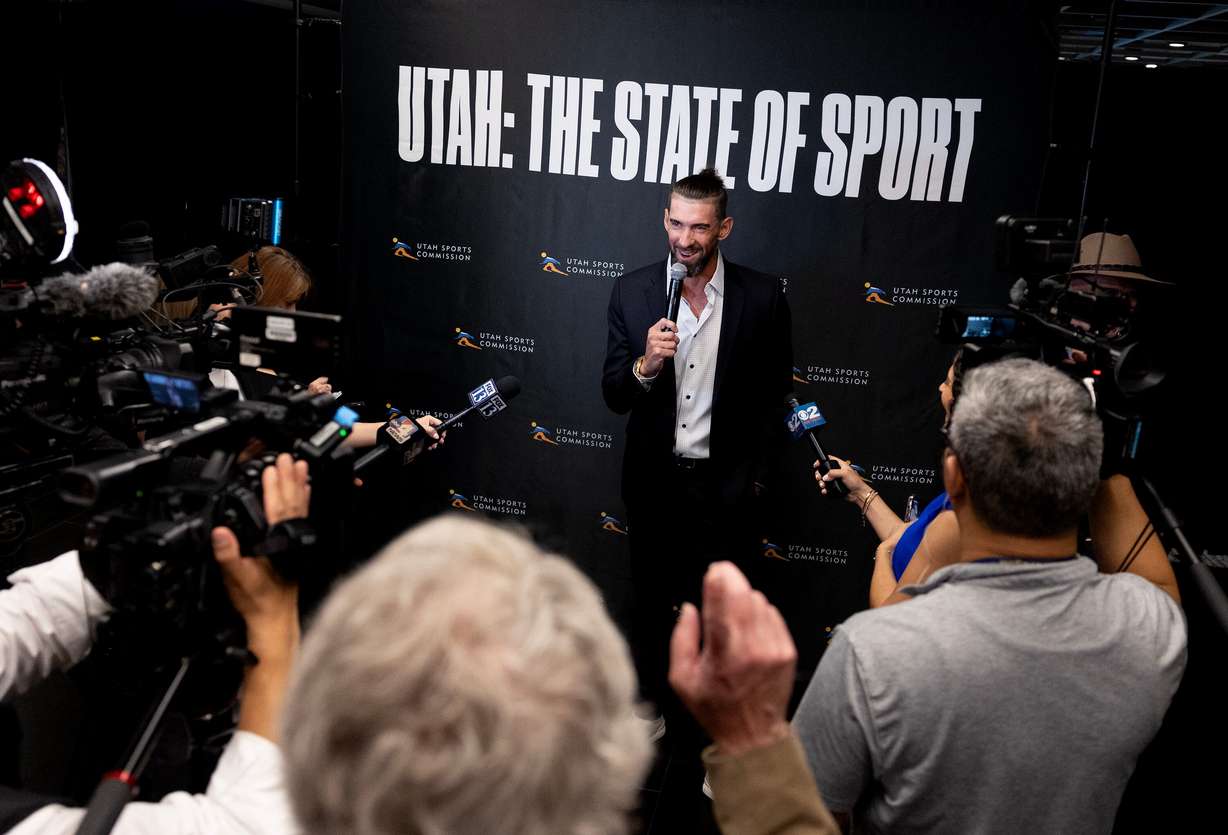
"So for me, today was inspirational," Phelps said, and "about what could be in the future."
Asked about what advice he would give organizers of Utah's 2034 Winter Games, the 40-year-old who started his Olympic career as the youngest Team USA male swimmer at the 2000 Summer Games in Sydney, Australia, cited the center.
What can be done to improve athlete mental health
"For me as an athlete, if I'd had something like that growing up, I think I would utilize it. I was always an athlete who always wanted answers to questions," Phelps said, calling the center "a forum you can go to, to get help."
After a fifth-place finish in Sydney, he went on to win a record 28 medals over four Summer Games, Athens in 2004, Beijing in 2008, London in 2012, and Rio de Janeiro in 2016. His haul includes 23 gold medals, more than twice as many as any other Olympic athlete.
But starting in 2004, Phelps has described falling into post-Olympics depressions, comparing it to "coming off a high" in an NBC Sports interview in 2024, being at "the edge of a cliff, like 'Cool now what? Oh, I guess I've got to wait four more years to have the chance to do it again.'"
Phelps said Wednesday that he "can speak from personal experiences. A lot, throughout my career, I felt like I was all alone. I do think the NGBs (national governing bodies of sports) are doing a little bit more than what they did throughout my career."
There's more to be done, he said, "to really make a massive impact, to help the athletes where they need it most." Phelps said he "hopes that's already a conversation" for the 2028 Summer Games in Los Angeles as well as Utah's 2034 Winter Games.
Last year, Huntsman Family Foundation CEO David Huntsman spoke about improving access to mental health care for athletes worldwide at the International Olympic Committee's first-ever Olympism 365 Summit in Switzerland.
That, Huntsman said during a panel discussion, "can be the legacy that we leave behind after the Closing Ceremonies are over with that continues to benefit people and society, and in our communities, long after the Games are over.
The Huntsman family's foundation, which announced a $150 million, 15-year gift to the University of Utah in November 2019 to establish the mental health institute, also contributed $20 million to the Utah Olympic organizing committee's Podium34 program.
Related:

Will supporting athlete mental health be the legacy of Utah's 2034 Winter Games?
For Huntsman Family Foundation CEO David Huntsman, hosting the 2034 Winter Games in Utah is an opportunity to improve the support available to athletes for their mental health.Phelps and another Olympic champion swimmer, Rowdy Gaines, spoke at the 14th annual awards ceremony honoring athletes, teams and events in the state, including the Olympians with Utah ties who made up nearly 30% of Team USA at the 2026 Winter Games in Milan-Cortina, Italy.
Jeff Robbins, president and CEO of the Utah Sports Commission that puts on the awards, told the Deseret News that he and David Huntsman met with Phelps about a year and a half ago to discuss athlete mental health.
Inviting Phelps to talk about the subject at the ceremony made sense, Robbins said, "with all we have going on with the Olympics, mental health, and sports" in Utah, labeled "the state of sport" by the commission.
A 'roller coaster of ups and downs'
"Keep dreaming," was Phelps' advice for Utah's Olympic athletes. "There were a lot of people that told me I'd never amount to anything, or wouldn't be able to do this, or accomplish this or that. The athletes now are proving all of those people wrong."
He said, "There's nothing better than competing and representing your country. The lows that athletes experience are going to be different for each of them, Phelps said, describing himself as "a deer in the headlights" after winning eight gold medals in 2008.
"I had no idea what to expect, doing something no one else has ever done before," he said. "It's situational. But I think every single athlete is going to ride that roller coaster of ups and downs, whether it's self-doubt, or this or that."