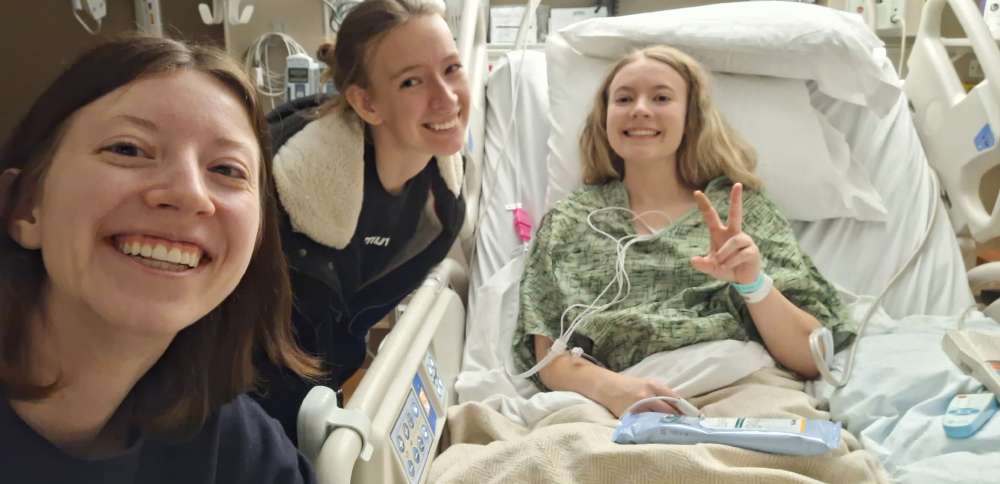
- Gretl Talbot, 18, identified her stroke symptoms using the FAST acronym on Feb. 21.
- She quickly received TNK medication, improving her condition after discovering a heart defect.
- Talbot shares her story to promote stroke awareness, emphasizing the BEFAST acronym for others.
SANTAQUIN — Gretl Talbot was getting ready to go ice skating on Feb. 21, when she noticed that she couldn't feel her hand.
"I was just in the back room with the door locked, and all of a sudden, my right hand just kind of went numb," she said. "In my head, I was joking like, 'Man, I must be having a stroke.' And then I was like, 'Wait, I actually can't move my hand.'"
Talbot is an 18-year-old senior at Payson High School, and she recently completed her certified nursing assistant training, during which she learned to recognize the signs of a stroke.
"I got up to check the mirror, and I checked my smile and went running through the acronym of FAST in my mind."
"FAST" stands for face, arms, speech and time, and Talbot explained that each of those was critical to getting the help she needed.
"I look at my face, and it's drooping, and I'm like, 'Yep, I'm having a stroke,'" Talbot recalled. "So I get to the door, and I unlock it and I open the door and I call to my sister, and I'm like 'Stroke!' but my speech is super slurred, and it takes about three calls for someone to come. They come and they get me out to the couch, and my sister calls the ambulance ... and they came within a minute."
Time really was of the essence in Talbot's situation because of a certain medication for strokes that can only be administered within the first few hours. And since Talbot recently turned 18, she had to make that quick decision herself.
"They were talking to me about the TNK (tenecteplase) medicine that busts down all of the clots," she recalled. "I had to make the decision, so I said. 'Yes.' So, they gave me the medicine, and pretty much as soon as they put the medicine in, things started improving from there."
Talbot spent a day in the ICU, and during her time there, doctors learned that the cause of her stroke was due to a hole in her heart she's had since she was born, which she was unaware of.
"At first, doctors were thinking that it could have been a mini stroke, but after I got an echo of my heart, they found a hole in my heart," Talbot recalled, adding, "25-30% of people actually have the hole in their heart because it's supposed to close once you take your first breath, but 25-33% of people's don't close. Doctors think that the clot just found a pathway through the hole in my heart to my brain."
Talbot, who is very physically active, said that she felt something was wrong with her heart for a while and had gone to doctors prior to her stroke with no answers. According to a GoFundMe* set up by her older sister, Talbot's "intelligence and strength may have just saved her smile."
Talbot said that although instances like hers appear rare among people her age, she hopes her story can help others. She also said she gained some additional knowledge from the nurses who cared for her that she'd like to pass along.
"My nurses said that there are two more letters to the acronym FAST, and it's BEFAST," Talbot said.
The acronym stands for balance loss, eyesight changes, facial drooping, arm weakness, speech difficulty and time to call 911.
"I want this to help bring about brain awareness and let others know about the BEFAST acronym, so that if someone has a stroke at a young age, they will be able to help save their own life, too," she said.
Talbot also said that in the fall she will be attending Southern Utah University with the goal of becoming a nurse or a physical therapist, adding that in recent weeks she has been helped greatly by people in those professions.
*KSL.com does not assure that the money deposited to the account will be applied for the benefit of the persons named as beneficiaries. If you are considering a deposit to the account, you should consult your own advisers and otherwise proceed at your own risk.

Photos
Most recent Utah County stories
Related topics
 Arianne Brown