'%3e%3cpath%20d='M34.1406%205.85938C30.3906%202.10547%2025.3047%200%2020%200C14.6953%200%209.60938%202.10547%205.85938%205.85938C2.10938%209.61328%200%2014.6953%200%2020C0%2025.3047%202.10547%2030.3906%205.85938%2034.1406C9.61328%2037.8906%2014.6953%2040%2020%2040C25.3047%2040%2030.3906%2037.8945%2034.1406%2034.1406C37.8906%2030.3906%2040%2025.3047%2040%2020C40%2014.6953%2037.8945%209.60938%2034.1406%205.85938ZM37.0117%2023.543H31.1602V13.5391H27.6328V19.9414C28.1211%2020.6914%2028.3711%2021.582%2028.3711%2022.5625V22.625C28.3711%2023.668%2028.1172%2024.6055%2027.6328%2025.4297V26.6094H36.082C33.4883%2032.9375%2027.2891%2037.3789%2020.0039%2037.3789C10.3711%2037.3789%202.62109%2029.6289%202.62109%2020C2.62109%2010.3711%2010.3711%202.62109%2020%202.62109C29.6289%202.62109%2037.3789%2010.3711%2037.3789%2020C37.3789%2021.1484%2037.2617%2022.2656%2037.0508%2023.3477C37.0391%2023.4141%2037.0234%2023.4766%2037.0117%2023.543Z'%20fill='white'/%3e%3cpath%20d='M22.3086%2018.5352C20.4336%2018.125%2019.9531%2017.8398%2019.9766%2017.1836V17.1406C19.9766%2016.6992%2020.3477%2016.2148%2021.4023%2016.2148C22.582%2016.2148%2023.8867%2016.6797%2025.0781%2017.4766L26.8516%2015.0195C25.4453%2013.8906%2023.707%2013.3398%2021.5547%2013.3398C18.5195%2013.3398%2016.4375%2015%2016.4063%2017.4766V17.5352C16.3633%2020.2617%2018.5859%2020.9805%2021.293%2021.6016C23.0391%2021.9766%2023.5703%2022.3164%2023.5703%2022.9609L23.5469%2022.9766C23.5469%2023.3906%2023.2578%2023.7031%2022.7852%2023.8359C22.5742%2023.9062%2022.1289%2023.9727%2021.5156%2023.9727C20.7617%2023.9727%2019.7539%2023.8633%2018.6328%2023.4844C18.0898%2023.2891%2017.4727%2023.0039%2016.8047%2022.6133L20.1406%2026.625C20.2813%2026.6602%2021.0977%2026.8516%2021.7734%2026.8516C25.0039%2026.8516%2027.0859%2025.2461%2027.1094%2022.6328V22.5703C27.1602%2020.1133%2025.2148%2019.1719%2022.3086%2018.5352Z'%20fill='white'/%3e%3cpath%20d='M5.24219%2013.5664V26.6133H8.75391V23.7578L10.2969%2021.9531L14.2031%2026.6133H18.3867L12.3555%2019.5195L17.4023%2013.5664H13.4531L8.75391%2019.0586V13.5664H5.24219Z'%20fill='white'/%3e%3c/g%3e%3cdefs%3e%3cclipPath%20id='clip0_97_2430'%3e%3crect%20width='40'%20height='40'%20fill='white'/%3e%3c/clipPath%3e%3c/defs%3e%3c/svg%3e)


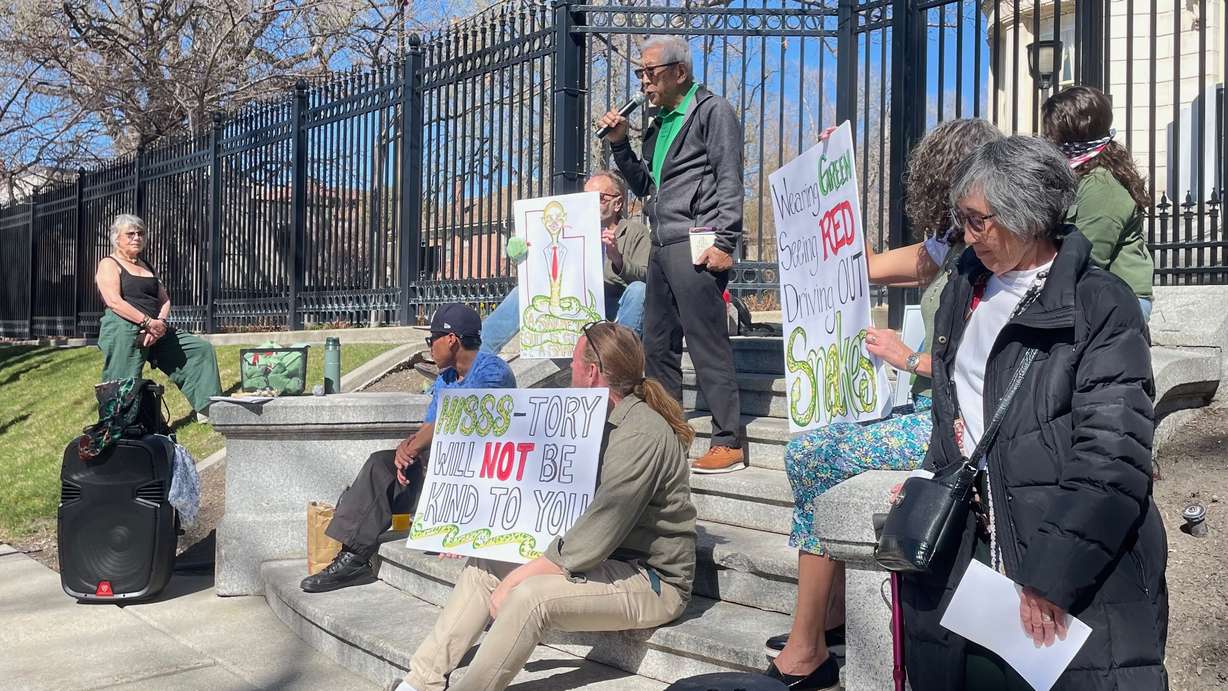
- Protesters gathered Tuesday to protest plans for an Immigration and Customs Enforcement detention facility in Salt Lake City.
- Simuiltaneously, Salt Lake Mayor Erin Mendenhall sent a letter to ICE officials voicing her concerns with the plans and asking for a meeting with ICE reps.
- ICE stressed the facility's role in "removing criminals from the streets," thereby making communities safer.
SALT LAKE CITY — As many of Utah's Republican leaders keep relatively quiet amid news an immigration detention facility is coming, foes are raising their voices and clamoring for those in power to do what they can to stop the plans.
"I don't think it's likely to sway the governor, but we at least have to try," said Christopher Nicholson, one of around 100 protesters who gathered Tuesday outside the gubernatorial mansion of Gov. Spencer Cox, a Republican, to sound off on the issue.
"It's just really inhumane. I don't want another one to open in Salt Lake City," he said.
The protesters spoke, sang and waved signs to passing traffic, echoing criticism about building an Immigration and Customs Enforcement facility that many Democratic leaders expressed late last week when the news first emerged. Salt Lake City Mayor Erin Mendenhall, meanwhile, repeated her concerns with the plans in a letter Tuesday to Todd Lyons, the head of ICE, and asked for a meeting with agency officials to discuss the varied issues.
"While we are seeking additional information about the ultimate intended use for this building, a large-scale detention facility is inappropriate for this location and does not have the support of Salt Lake City officials," Mendenhall said in the letter, which she publicly released. She cited concerns with the sewer infrastructure the facility would need and its appropriateness in an industrial area, among other things, and asked for a response by March 27.
According to property records, ICE last week purchased a 24.9-acre parcel containing a warehouse at 6020 W. 300 South. In a statement to KSL, ICE said it's planning a "very well-structured detention facility meeting our regular detention standards." Officials didn't state the timeline for development of the facility or how many people it would house.
The ICE statement noted the job-creation benefits of the facility, also saying it would bring in $238.7 million in tax revenue, though it didn't say over what time frame or state how it arrived at the number.
"These economic benefits don't even take into account that removing criminals from the streets makes communities safer for business owners and customers. ICE is targeting criminal illegal aliens including murderers, rapists, pedophiles, gang members and more," ICE said in the statement.
Mostly, though, the plans — at least publicly — have prompted strong backlash. Cox's office didn't respond to a query Tuesday seeking comment. Another demonstration against the plans is set for Wednesday at 6 p.m. at the site of the land that ICE bought at 6020 W. 300 South while the protesters on Tuesday reiterated much of the criticism that emerged last week.
Shelby Lofton, KSLThey worry ICE detainees would include U.S. citizens and immigrants in the country legally and that detainees would receive inhumane treatment. They likened the specter of an immigrant detention center to Topaz, the internment camp in Delta that housed Japanese Americans during World War II.
"Who are the people who will be held inside that facility? They're immigrants, asylum seekers, parents, workers, people who came here hoping for safety, opportunity or simply a better life," said Melissa Barbanell, a volunteer with Salt Lake Indivisible who spoke at the event. "This facility is not consistent with Utah's values, the values that Utah is both built on and the values that we represent ourselves as having to the rest of the world."
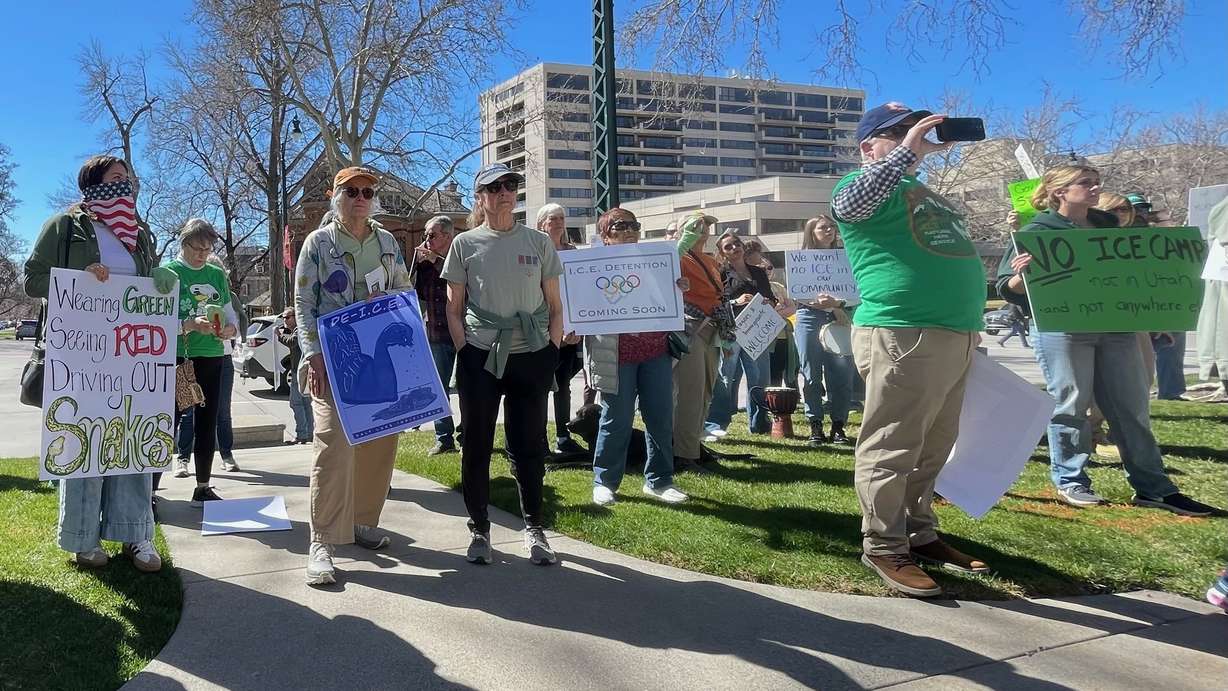
Floyd Mori, who also spoke at the event, lauded immigrants. "Immigrants are not a curse. Immigrants are the engine of what we call the market economy. ...The attitude of immigrants are what creates progress in this country," he said.
Some $45 billion is earmarked in the federal budget plan approved last July for immigration detention centers around the country in the coming years. Potential plans emerged for a facility in Salt Lake City last January, but the property owner ultimately said the land in question wouldn't be sold for such use.
'Troubling ramifications'
Among Mendenhall's concerns are the impact the facility would have on water and sewer infrastructure in the industrial area where it would be built and the repercussions the required modifications would have on others, including Union Pacific, the railway company.
"The area's utility system has been built specifically for warehouse use, not high-occupancy residential use, and there are downstream constraints. Our preliminary modeling shows that a large-scale detention facility would likely require sewer line, sewer force main and sewer lift station improvements to be made off-site," Mendenhall said in the letter.
Read more:

Voces de Utah
Looking for more news from Utah's Latino community? Visit our Voces de Utah section for more stories, events and features.Traffic to and from the facility would place "an enormous strain" on roads in the area and adversely impact rail lines as well. Moreover, the area, within the Utah Inland Port, is envisioned as a hub of economic development, which a detention facility would potentially threaten.
"If this facility were used as a large-scale detention center, it would have troubling ramifications for neighboring properties and a chilling effect on the potential of this area to thrive as an economic driver of the state," Mendenhall said.
Because the federal government is exempt from taxes, she added, local taxing entities would lose out on more than $1 million a year in property tax revenue.

Related stories
Most recent Politics stories
Related topics
 Tim Vandenack