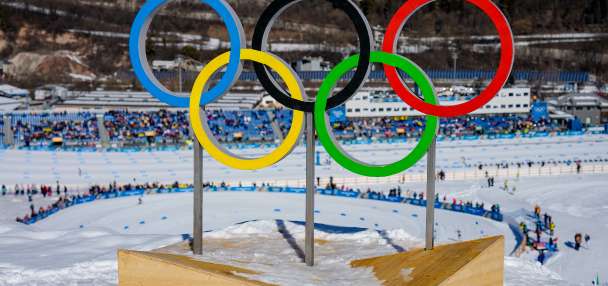
- The Olympic rings now have a sonic signature featuring heartbeats of athletes.
- Introduced at the 2026 Winter Games in Milan Cortina, Italy, it enhances brand recognition.
SALT LAKE CITY — The five Olympic rings are one of the most recognizable symbols in the world.
The set of interlocking blue, yellow, black, green and red rings meant to represent five parts of the world, Africa, Europe, Asia, Oceania and the Americas, was created by the founder of the modern Olympic movement, Pierre de Coubertin, and unveiled in 1913.
Now, there's a sound associated with those rings.
Heartbeats.
Hundreds of athletes, fans, coaches, volunteers and people behind the scenes had their heartbeats recorded for what the International Olympic Committee is calling the "first sonic signature for the Olympic rings."
Intended to enhance recognition of the Olympic brand, the resulting sound of many hearts beating together was introduced during the just-concluded 2026 Winter Games in Milan Cortina, Italy, including at stadiums and in digital content.
The inspiration came from "the idea that, when people watch events, like the Olympic Games, together, their heartbeats synchronize," the IOC said, describing the effect as the "heartbeat that unites the world."
A promotional video showcases how heart rates change both on and off the field as athletic performances are anticipated, executed and celebrated, slowing as "the world is holding its breath," pounding as medals are won.
Even the five Olympic rings pulsate with the beat of the hearts.
The athlete heartbeats recorded included Olympic champions Abhinav Bindra (shooting, India); Alistair Brownlee (triathlon, Great Britain); Allyson Felix (athletics, U.S.); Jessica Fox (canoe slalom, Australia); and Martin Fourcade (biathlon, France).
Together, the heartbeats collected formed what the IOC said is intended as a translation of "all the determination, joy and triumph of sport into a living soundtrack that embodies the emotion and universally human experience of the Olympics."
The addition of sound to the rings is part of the update to the digital identity for the Olympics. Known as "The Pulse," the identity visible across social media platforms also utilizes a motion symbol, graphics and a tone of voice.