'%3e%3cpath%20d='M34.1406%205.85938C30.3906%202.10547%2025.3047%200%2020%200C14.6953%200%209.60938%202.10547%205.85938%205.85938C2.10938%209.61328%200%2014.6953%200%2020C0%2025.3047%202.10547%2030.3906%205.85938%2034.1406C9.61328%2037.8906%2014.6953%2040%2020%2040C25.3047%2040%2030.3906%2037.8945%2034.1406%2034.1406C37.8906%2030.3906%2040%2025.3047%2040%2020C40%2014.6953%2037.8945%209.60938%2034.1406%205.85938ZM37.0117%2023.543H31.1602V13.5391H27.6328V19.9414C28.1211%2020.6914%2028.3711%2021.582%2028.3711%2022.5625V22.625C28.3711%2023.668%2028.1172%2024.6055%2027.6328%2025.4297V26.6094H36.082C33.4883%2032.9375%2027.2891%2037.3789%2020.0039%2037.3789C10.3711%2037.3789%202.62109%2029.6289%202.62109%2020C2.62109%2010.3711%2010.3711%202.62109%2020%202.62109C29.6289%202.62109%2037.3789%2010.3711%2037.3789%2020C37.3789%2021.1484%2037.2617%2022.2656%2037.0508%2023.3477C37.0391%2023.4141%2037.0234%2023.4766%2037.0117%2023.543Z'%20fill='white'/%3e%3cpath%20d='M22.3086%2018.5352C20.4336%2018.125%2019.9531%2017.8398%2019.9766%2017.1836V17.1406C19.9766%2016.6992%2020.3477%2016.2148%2021.4023%2016.2148C22.582%2016.2148%2023.8867%2016.6797%2025.0781%2017.4766L26.8516%2015.0195C25.4453%2013.8906%2023.707%2013.3398%2021.5547%2013.3398C18.5195%2013.3398%2016.4375%2015%2016.4063%2017.4766V17.5352C16.3633%2020.2617%2018.5859%2020.9805%2021.293%2021.6016C23.0391%2021.9766%2023.5703%2022.3164%2023.5703%2022.9609L23.5469%2022.9766C23.5469%2023.3906%2023.2578%2023.7031%2022.7852%2023.8359C22.5742%2023.9062%2022.1289%2023.9727%2021.5156%2023.9727C20.7617%2023.9727%2019.7539%2023.8633%2018.6328%2023.4844C18.0898%2023.2891%2017.4727%2023.0039%2016.8047%2022.6133L20.1406%2026.625C20.2813%2026.6602%2021.0977%2026.8516%2021.7734%2026.8516C25.0039%2026.8516%2027.0859%2025.2461%2027.1094%2022.6328V22.5703C27.1602%2020.1133%2025.2148%2019.1719%2022.3086%2018.5352Z'%20fill='white'/%3e%3cpath%20d='M5.24219%2013.5664V26.6133H8.75391V23.7578L10.2969%2021.9531L14.2031%2026.6133H18.3867L12.3555%2019.5195L17.4023%2013.5664H13.4531L8.75391%2019.0586V13.5664H5.24219Z'%20fill='white'/%3e%3c/g%3e%3cdefs%3e%3cclipPath%20id='clip0_97_2430'%3e%3crect%20width='40'%20height='40'%20fill='white'/%3e%3c/clipPath%3e%3c/defs%3e%3c/svg%3e)


- Salt Lake City's planning commission voted 5-2 to endorse city's plan to rezone Smith's Ballpark.
- The plan includes mixed-use development, while preserving some past stadium features.
- Neighborhood leaders remain concerned over green space reduction and other elements.
SALT LAKE CITY — A plan to rezone Smith's Ballpark to set up Salt Lake City's grand vision for the Salt Lake Bees' old stadium wasn't quite a home run with the city's planning commission — but it wasn't an out either.
Members of the advisory committee voted 5-2 on Wednesday to recommend the city's plan following a spirited presentation and debate over its objectives that lasted nearly two hours, agreeing it's time to move redevelopment along.
"Every year that we don't hit the go button on the next thing, there are negative ramifications for the neighborhood as (the ballpark is) sitting as it is," said Salt Lake City Planning Commission member Jeffrey Barrett, before the vote.
Reimaging Smith's Ballpark
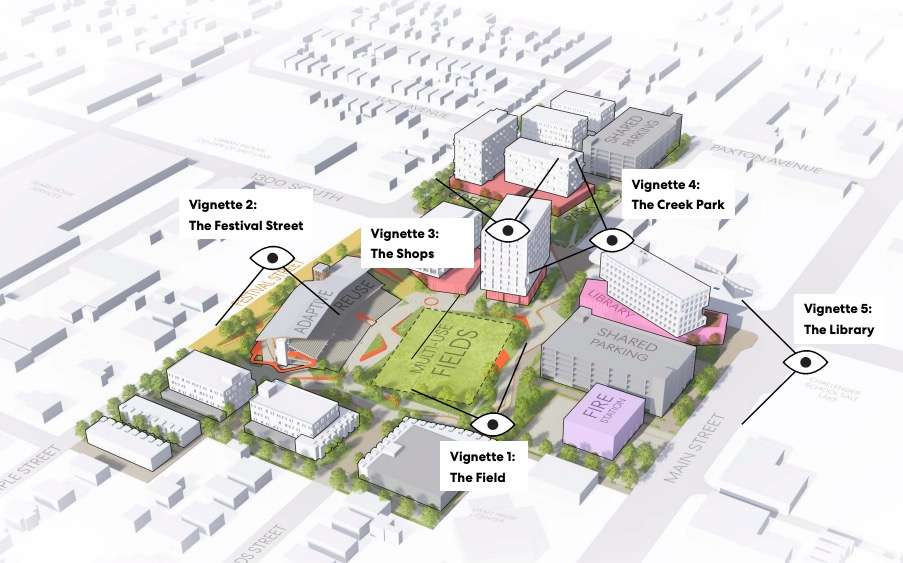
Salt Lake City's Community Reinvestment Agency signed off on a Smith's Ballpark redevelopment plan in December, solidifying its desire to adaptively reuse the old baseball stadium that's been mostly vacant since the Bees departed in September 2024.
It calls for some of the stadium to be demolished for mostly mixed-use development, along with new development on the parking lot across from 1300 South. The first-base bleachers would remain as part of a seating area and community venue. A section of the old playing surface would be part of that and general open space, while the city would daylight a buried section of Red Butte Creek in the area, too.
Getting to that vision requires new zoning, which the city is now seeking. It calls for a mix of mixed-use 5 and 11 (MU-5 and MU-11) zones across the project area. Most of it would be MU-11, which generally allows buildings up to 125 feet and up to 150 feet near the corner of 1300 South and West Temple.
"The overarching goal was to evolve this place into something that belongs to the community as much as it did to the team previously," said Hayden Callaway, project coordinator for the Reinvestment Agency.

A handful of Ballpark residents, including leaders of the Ballpark Community Council and Ballpark Action Team, still have concerns about some of the plan elements that tie to the proposed rezoning, however. While it would allow for more desperately-needed public space, they say cutting back on the old field would reduce total green space, potentially leading to more urban heat island issues.
They also believe the neighborhood section needs to remain home to some sort of community-driven activation or family-friendly activity area, as the departing stadium was.
"You have a one-in-a-lifetime opportunity to say to a neighbor, 'We heard you. We know what you need. You know what you need,'" said Fraser Nelson, co-chair of the Ballpark Action Team. "It is not more dense apartments that drown out the single-family homes. … We beg you to reduce our heat, to provide recreation for our children, to bring people to our neighborhood for events."
City planners say daylighting a section of the creek should help reduce some of the heating effects, as would more trees included in a promenade section and near the old playing surface. Some of the proposed building heights have also been trimmed after community feedback.
More housing, especially ownership opportunities, was also an issue that many residents had requested since the beginning of planning in 2023, said Makena Hawley, a project manager for the Reinvestment Agency.
"I think we agree with a lot of the things that the public has brought, but we're trying to mix it all together into this symbiotic relationship," she said.
A lengthy debate
Planning commissioners Amy Barry and Richard Leverett ultimately voted against recommending the request. While they said they understand the difficult task of distilling all the community ideas into a single plan for a project of this scale, they believe the plan "missed a mark" on meaningful green space and other elements.
"I don't think this design is adequate for connecting with the needs of the neighborhood. ... We have a balance that we're probably missing," Barry said, later calling it "kind of a disappointing end result."
The request might be premature because there are many moving pieces in the plan, and many of these potential projects appear to be years away from coming to fruition, Leverett added.
However, others on the commission said the plan brings use to a predominantly dormant area, and the new zoning offers more clarity for what's possible when projects do come together. Brian Scott, the commission's chairman, said he's also more accepting of leeway since it's coming from a Reinvestment Agency plan likely to stick.
It connects with other city plans for the area, which call for higher density near the old stadium, said Commissioner Lilah Rosenfield. It also appears to unlock more usable open space that has been gated off from the neighborhood in the past, Barrett noted.
That swayed the majority to support the measure as it continues through the rezoning process.
It's ultimately up to the Salt Lake City Council to approve or deny the final zoning. There's no timeline yet for when it will take up that discussion.