'%3e%3cpath%20d='M34.1406%205.85938C30.3906%202.10547%2025.3047%200%2020%200C14.6953%200%209.60938%202.10547%205.85938%205.85938C2.10938%209.61328%200%2014.6953%200%2020C0%2025.3047%202.10547%2030.3906%205.85938%2034.1406C9.61328%2037.8906%2014.6953%2040%2020%2040C25.3047%2040%2030.3906%2037.8945%2034.1406%2034.1406C37.8906%2030.3906%2040%2025.3047%2040%2020C40%2014.6953%2037.8945%209.60938%2034.1406%205.85938ZM37.0117%2023.543H31.1602V13.5391H27.6328V19.9414C28.1211%2020.6914%2028.3711%2021.582%2028.3711%2022.5625V22.625C28.3711%2023.668%2028.1172%2024.6055%2027.6328%2025.4297V26.6094H36.082C33.4883%2032.9375%2027.2891%2037.3789%2020.0039%2037.3789C10.3711%2037.3789%202.62109%2029.6289%202.62109%2020C2.62109%2010.3711%2010.3711%202.62109%2020%202.62109C29.6289%202.62109%2037.3789%2010.3711%2037.3789%2020C37.3789%2021.1484%2037.2617%2022.2656%2037.0508%2023.3477C37.0391%2023.4141%2037.0234%2023.4766%2037.0117%2023.543Z'%20fill='white'/%3e%3cpath%20d='M22.3086%2018.5352C20.4336%2018.125%2019.9531%2017.8398%2019.9766%2017.1836V17.1406C19.9766%2016.6992%2020.3477%2016.2148%2021.4023%2016.2148C22.582%2016.2148%2023.8867%2016.6797%2025.0781%2017.4766L26.8516%2015.0195C25.4453%2013.8906%2023.707%2013.3398%2021.5547%2013.3398C18.5195%2013.3398%2016.4375%2015%2016.4063%2017.4766V17.5352C16.3633%2020.2617%2018.5859%2020.9805%2021.293%2021.6016C23.0391%2021.9766%2023.5703%2022.3164%2023.5703%2022.9609L23.5469%2022.9766C23.5469%2023.3906%2023.2578%2023.7031%2022.7852%2023.8359C22.5742%2023.9062%2022.1289%2023.9727%2021.5156%2023.9727C20.7617%2023.9727%2019.7539%2023.8633%2018.6328%2023.4844C18.0898%2023.2891%2017.4727%2023.0039%2016.8047%2022.6133L20.1406%2026.625C20.2813%2026.6602%2021.0977%2026.8516%2021.7734%2026.8516C25.0039%2026.8516%2027.0859%2025.2461%2027.1094%2022.6328V22.5703C27.1602%2020.1133%2025.2148%2019.1719%2022.3086%2018.5352Z'%20fill='white'/%3e%3cpath%20d='M5.24219%2013.5664V26.6133H8.75391V23.7578L10.2969%2021.9531L14.2031%2026.6133H18.3867L12.3555%2019.5195L17.4023%2013.5664H13.4531L8.75391%2019.0586V13.5664H5.24219Z'%20fill='white'/%3e%3c/g%3e%3cdefs%3e%3cclipPath%20id='clip0_97_2430'%3e%3crect%20width='40'%20height='40'%20fill='white'/%3e%3c/clipPath%3e%3c/defs%3e%3c/svg%3e)



Estimated read time: 5-6 minutes
- Smith's Ballpark redevelopment may take five to 10 years, local developers say.
- Salt Lake City's timelines are unclear as it looks to finalize plans.
- Ballpark residents stress need for strong City Council representation amid redevelopment.
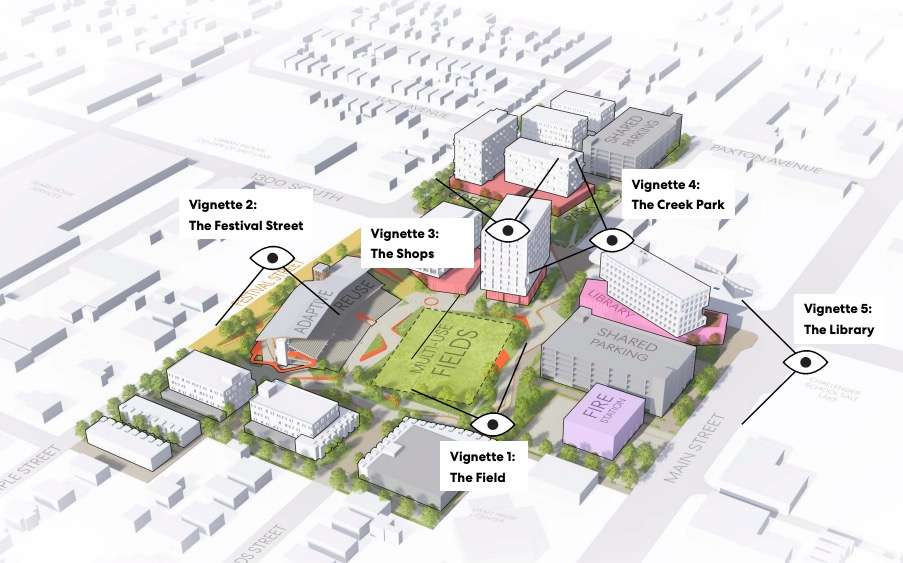
SALT LAKE CITY — Leaders of Utah's capital city are still exploring a way to finalize their ambitious redevelopment of Smith's Ballpark, but local developers say real change may still be five to 10 years away.
"These things take time," said Melissa Jensen, lead developer for Giv Group, pointing out that it took "many years" for other long-term projects like the city's 9th and 9th District to develop, during a panel discussion hosted by the Ballpark Action Team last week.
The uncertainty over the redevelopment time frame and new concerns about funding have raised questions again about how the ballpark will be utilized in the near term, while residents have voiced new concerns over project funding. It could also potentially spill over into next month's election, as leaders of two prominent neighborhood groups seek a seat on the Salt Lake City Council.
Why the wait?
Last week's meeting offered Ballpark residents a glimpse at the economics of redevelopment, as three experts offered insights on everything from the guarantees needed to get a project off the ground to current trends in the industry.
Based on where things are and the size of the city's plans for Smith's Ballpark, Salt Lake City's Ballpark Next could be a "10-year project," said Tessa Arneson, co-founder and CEO of the development group Maven, drawing a few gasps from the crowd.
Others see meaningful changes coming together a little sooner than that, whether that's shovels in the ground or having more detailed agreements in place. Ryan Kimball, a partner at Kimball Investment, said he could envision groundbreaking within three years, before two to three years of construction, while Jensen "optimistically" believes something "you can touch and feel" could potentially be in place within five years.
Some of the estimates might be "very conservative," but change also won't come overnight, said Tauni Barker, spokeswoman for the Salt Lake City Community Reinvestment Agency, which oversees the project. The agency, she told KSL.com, is still on track to send a request for proposals for the first phase of development in the first quarter of 2026, while the rezoning process will be underway about the same time.
Projects will ultimately go through architectural drawing and planning commission processes. She estimates that it might take two years before there's ground broken on new projects and two years of construction, based on how large the space is. It could be sooner than that, too, but economic trends, potential tariffs on building materials and interest rates could affect future timelines.
Dealing with numbers
Those regularly factor into new construction. Developers point out that not everything has to involve tall high-rises, but density helps financial numbers come together among many new projects. Sometimes it makes more sense to keep a building as is or find ways to adaptively reuse an old building for new uses, as is the plan with Smith's Ballpark.
"Bankers will only loan on something that makes sense for them, so I always think about them holding keys to the kingdom a bit," Arneson said, adding that Utah lawmakers still control "big levers" in the process.
Some projects are currently on hold because the numbers don't "pencil" with existing interest rates, she added.
Last week's meeting also sparked concerns from Ballpark residents about how much money the project would receive from donations.
The Larry H. and Gail Miller Family Foundation announced earlier this month that it's sending the city $5 million for the initial phase of the Ballpark Next process, which led to confusion after the organization announced plans to donate $22 million toward the project last year, and also offered to oversee a $100 million fundraising initiative for the neighborhood announced in 2023.
Miller Company officials clarified to KSL.com that the $5 million is part of the $22 million goal announced last year, and it plans to work with the neighborhood to raise more funds. They did not respond to KSL.com's request for clarification on how that fits within the $100 million goal.
Salt Lake City is thrilled about the initial donation and working with the new Gail Miller Utah Impact Fund, as it "remains focused on the established project goals outlined" in the community plan, said Andrew Wittenberg, a spokesman for the mayor's office.
It's unclear how any of that will affect the project timeline.
What happens to the Ballpark next?
Smith's Ballpark has been used as a community space a few times since the Bees and University of Utah baseball teams left, and it appears that will continue in the near term.
The Reinvestment Agency's agreement with Cornerstone Technologies over events expires at the end of February 2026, but the agency is expected to seek vendors again to run more events next year, Barker said. Anything beyond that is to be determined while the ballpark's future is planned out.
Salt Lake City has yet to finalize its Ballpark Next plan, as it seeks more guarantees that the city won't drastically alter the plan in the future. It's something that Salt Lake City Councilman Darin Mano wants to accomplish before leaving office. He's not seeking reelection in District 5, which includes the Ballpark neighborhood.
"I really want to leave it as solid as possible so we can ... give it the best chance of actually coming to fruition," said Mano, who also serves as chairman of the agency's board of directors.
The race to replace him includes Erika Carlsen, co-founder of the Ballpark Action Team, and Amy Hawkins, chairwoman of the Ballpark Community Council, two organizations dedicated to neighborhood events and issues, along with Vance Hansen, of Liberty Wells.
Given that the district includes more than just the Ballpark, as well as other key issues and historically low voter turnout rates, neighborhood residents aren't sure the stadium's future will decide November's race, but they say it would help to have a Ballpark resident on the City Council and agency board of directors.
"I think it's super important," said Fraser Nelson, chairman of the Ballpark Action Team. "We're going to need a very strong representative in the City Council, and it's nice that (two of the three candidates) are from Ballpark."