'%3e%3cpath%20d='M34.1406%205.85938C30.3906%202.10547%2025.3047%200%2020%200C14.6953%200%209.60938%202.10547%205.85938%205.85938C2.10938%209.61328%200%2014.6953%200%2020C0%2025.3047%202.10547%2030.3906%205.85938%2034.1406C9.61328%2037.8906%2014.6953%2040%2020%2040C25.3047%2040%2030.3906%2037.8945%2034.1406%2034.1406C37.8906%2030.3906%2040%2025.3047%2040%2020C40%2014.6953%2037.8945%209.60938%2034.1406%205.85938ZM37.0117%2023.543H31.1602V13.5391H27.6328V19.9414C28.1211%2020.6914%2028.3711%2021.582%2028.3711%2022.5625V22.625C28.3711%2023.668%2028.1172%2024.6055%2027.6328%2025.4297V26.6094H36.082C33.4883%2032.9375%2027.2891%2037.3789%2020.0039%2037.3789C10.3711%2037.3789%202.62109%2029.6289%202.62109%2020C2.62109%2010.3711%2010.3711%202.62109%2020%202.62109C29.6289%202.62109%2037.3789%2010.3711%2037.3789%2020C37.3789%2021.1484%2037.2617%2022.2656%2037.0508%2023.3477C37.0391%2023.4141%2037.0234%2023.4766%2037.0117%2023.543Z'%20fill='white'/%3e%3cpath%20d='M22.3086%2018.5352C20.4336%2018.125%2019.9531%2017.8398%2019.9766%2017.1836V17.1406C19.9766%2016.6992%2020.3477%2016.2148%2021.4023%2016.2148C22.582%2016.2148%2023.8867%2016.6797%2025.0781%2017.4766L26.8516%2015.0195C25.4453%2013.8906%2023.707%2013.3398%2021.5547%2013.3398C18.5195%2013.3398%2016.4375%2015%2016.4063%2017.4766V17.5352C16.3633%2020.2617%2018.5859%2020.9805%2021.293%2021.6016C23.0391%2021.9766%2023.5703%2022.3164%2023.5703%2022.9609L23.5469%2022.9766C23.5469%2023.3906%2023.2578%2023.7031%2022.7852%2023.8359C22.5742%2023.9062%2022.1289%2023.9727%2021.5156%2023.9727C20.7617%2023.9727%2019.7539%2023.8633%2018.6328%2023.4844C18.0898%2023.2891%2017.4727%2023.0039%2016.8047%2022.6133L20.1406%2026.625C20.2813%2026.6602%2021.0977%2026.8516%2021.7734%2026.8516C25.0039%2026.8516%2027.0859%2025.2461%2027.1094%2022.6328V22.5703C27.1602%2020.1133%2025.2148%2019.1719%2022.3086%2018.5352Z'%20fill='white'/%3e%3cpath%20d='M5.24219%2013.5664V26.6133H8.75391V23.7578L10.2969%2021.9531L14.2031%2026.6133H18.3867L12.3555%2019.5195L17.4023%2013.5664H13.4531L8.75391%2019.0586V13.5664H5.24219Z'%20fill='white'/%3e%3c/g%3e%3cdefs%3e%3cclipPath%20id='clip0_97_2430'%3e%3crect%20width='40'%20height='40'%20fill='white'/%3e%3c/clipPath%3e%3c/defs%3e%3c/svg%3e)




- Utah's population growth slowed to 1% from July 2024 to July 2025, the U.S. Census Bureau reports.
- Despite slowing, Utah was the fifth-fastest-growing state in percentage increase.
- Natural change drove Utah's growth, doubling net migration, affirming other trend reports.
SALT LAKE CITY — Utah's growth is slowing down, but it still remained one of the fastest-growing states in the nation last year.
Utah gained nearly 36,000 new residents between July 1, 2024, and July 1, 2025, representing a growth rate of 1%, according to U.S. Census Bureau data released on Tuesday. That's nearly a full percentage point below its growth rate in 2024, but still strong enough to remain one of the five fastest-growing states in the country.
The Beehive State was the fifth-fastest-growing state last year, trailing only South Carolina (1.5%), Idaho (1.4%), North Carolina (1.3%) and Texas (1.2%). Its numeric gain fell just shy of the Top 10 in that category, which was led by Texas's growth of 391,243 residents from mid-2024 to mid-2025.
Natural change, a measurement of the number of babies born over people dying in the state, was a top anchor for Utah's growth, the Census Bureau added. It more than doubled net migration, a measure of people moving into the state over those moving out, in 2025, matching previously released data from state population experts.
The Utah Population Committee estimated that the state added about 44,000 people last year, in a report it released in December. The two use different methodologies to track population trends, which is why they arrived at contrasting numbers, but both agreed that net migration has declined in the state.
Related:
Utah's growth experienced a 'significant shift' in 2025. These were the fastest-growing counties
Utah is still growing, but state demographers say its growth continues to moderate as the number of people moving in is starting to slow down.Last year was the first time since the COVID-19 pandemic that net migration didn't surpass natural growth. Rising housing costs could be a factor in the growth "moderation" that Utah is experiencing, as could other factors leading to fewer people moving in, state experts explained.
"This represents a return to Utah's historical growth patterns seen before the recent period of high levels of net migration," said Emily Harris, senior demographer at the University of Utah Kem C. Gardner Policy Institute.
Utah and Salt Lake counties accounted for more than half of all the growth in the state last year, the Utah Population Committee also reported last month. What the Census Bureau released on Tuesday shows only statewide growth, as the agency typically releases county- and city-level data in future reports.
Other national trends
What Utah is experiencing is not all that different from what other states are experiencing. The entire U.S. population grew by 0.5% last year, a half-percentage point behind the previous year. This is due to a slowdown in international migration into the country.
"With births and deaths remaining relatively stable compared to the prior year, the sharp decline in net international migration is the main reason for the slower growth rate we see today," said Christine Hartley, assistant division chief for estimates and projections for the Census Bureau, in a statement.
Net international migration plummeted from 2.7 million in 2024 to 1.3 million in 2025, and it's expected to drop to approximately 321,000 in 2026, federal demographers also reported on Tuesday. They add that the U.S. may reach negative net migration for the first time in over 50 years if the trends persist as projected.
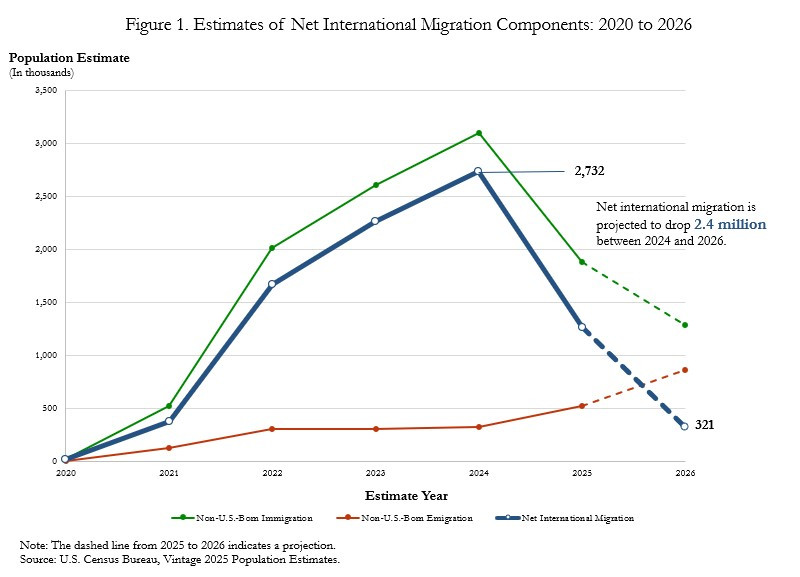
This is tied to a few things. The number of humanitarian migrants recorded in 2025 was the lowest since 2021, while the agency is also tracking Department of Homeland Security repatriation data to account for deportations conducted over the past year, among other datasets to track international migration.
However, experts also noted other trends from within the country. For example, while the South — led by South Carolina and Texas — topped the nation in growth again, although all four regions experienced gains.
The West and Northeast were the only regions that experienced net migration losses, as people moving to other regions, but each gained population through international migration and natural change.
California remains the nation's most populous state in the nation, but it lost an estimated 9,400 residents last year. Hawaii, New Mexico, Vermont and West Virginia were the only other states believed to have lost population in 2025.
U.S. Population Growth Leaders in 2025
- Texas: 391,243
- Florida: 196,680
- North Carolina: 145,907
- Georgia: 98,540
- South Carolina: 79,958
- Washington: 73,062
- Arizona: 67,394
- Tennessee: 63,785
- Virginia: 60,465
- New Jersey: 41,861
Percentage Growth Leaders
- South Carolina: 1.5%
- Idaho: 1.4%
- North Carolina: 1.3%
- Texas: 1.2%
- Utah: 1%
- Delaware: 0.9%
- Washington: 0.9%
- Arizona: 0.9%
- Nevada: 0.9%
- Tennessee: 0.9%
Source: Census Bureau