'%3e%3cpath%20d='M34.1406%205.85938C30.3906%202.10547%2025.3047%200%2020%200C14.6953%200%209.60938%202.10547%205.85938%205.85938C2.10938%209.61328%200%2014.6953%200%2020C0%2025.3047%202.10547%2030.3906%205.85938%2034.1406C9.61328%2037.8906%2014.6953%2040%2020%2040C25.3047%2040%2030.3906%2037.8945%2034.1406%2034.1406C37.8906%2030.3906%2040%2025.3047%2040%2020C40%2014.6953%2037.8945%209.60938%2034.1406%205.85938ZM37.0117%2023.543H31.1602V13.5391H27.6328V19.9414C28.1211%2020.6914%2028.3711%2021.582%2028.3711%2022.5625V22.625C28.3711%2023.668%2028.1172%2024.6055%2027.6328%2025.4297V26.6094H36.082C33.4883%2032.9375%2027.2891%2037.3789%2020.0039%2037.3789C10.3711%2037.3789%202.62109%2029.6289%202.62109%2020C2.62109%2010.3711%2010.3711%202.62109%2020%202.62109C29.6289%202.62109%2037.3789%2010.3711%2037.3789%2020C37.3789%2021.1484%2037.2617%2022.2656%2037.0508%2023.3477C37.0391%2023.4141%2037.0234%2023.4766%2037.0117%2023.543Z'%20fill='white'/%3e%3cpath%20d='M22.3086%2018.5352C20.4336%2018.125%2019.9531%2017.8398%2019.9766%2017.1836V17.1406C19.9766%2016.6992%2020.3477%2016.2148%2021.4023%2016.2148C22.582%2016.2148%2023.8867%2016.6797%2025.0781%2017.4766L26.8516%2015.0195C25.4453%2013.8906%2023.707%2013.3398%2021.5547%2013.3398C18.5195%2013.3398%2016.4375%2015%2016.4063%2017.4766V17.5352C16.3633%2020.2617%2018.5859%2020.9805%2021.293%2021.6016C23.0391%2021.9766%2023.5703%2022.3164%2023.5703%2022.9609L23.5469%2022.9766C23.5469%2023.3906%2023.2578%2023.7031%2022.7852%2023.8359C22.5742%2023.9062%2022.1289%2023.9727%2021.5156%2023.9727C20.7617%2023.9727%2019.7539%2023.8633%2018.6328%2023.4844C18.0898%2023.2891%2017.4727%2023.0039%2016.8047%2022.6133L20.1406%2026.625C20.2813%2026.6602%2021.0977%2026.8516%2021.7734%2026.8516C25.0039%2026.8516%2027.0859%2025.2461%2027.1094%2022.6328V22.5703C27.1602%2020.1133%2025.2148%2019.1719%2022.3086%2018.5352Z'%20fill='white'/%3e%3cpath%20d='M5.24219%2013.5664V26.6133H8.75391V23.7578L10.2969%2021.9531L14.2031%2026.6133H18.3867L12.3555%2019.5195L17.4023%2013.5664H13.4531L8.75391%2019.0586V13.5664H5.24219Z'%20fill='white'/%3e%3c/g%3e%3cdefs%3e%3cclipPath%20id='clip0_97_2430'%3e%3crect%20width='40'%20height='40'%20fill='white'/%3e%3c/clipPath%3e%3c/defs%3e%3c/svg%3e)



- Salt Lake City's planning commission supports rezoning for a 225-foot tower.
- Concerns arise over impacts on historic St. Mark's Cathedral during future construction.
- Developers promise to mitigate issues and allocate 20% units for affordable housing.
SALT LAKE CITY — Developers behind a proposed mixed-use tower east of downtown say they plan to find ways to mitigate impacts to a neighboring historic church as their project received support from Salt Lake City's planning commission.
Members of the Salt Lake City Planning Commission voted 7-1 on Wednesday to favorably recommend a request to rezone a large parcel at 265 E. 100 South in the Central City neighborhood from form-based mixed-use 8 (MU-8) to central business district (D-1). While D-1 zoning, the same used within Salt Lake's downtown core, has no height limits, the board also supported the city's proposed conditions that cap the project at 225 feet.
A future development agreement, which appears likely for the project, could also include construction mitigation language to protect the historic St. Mark's Cathedral, following concerns raised by residents and representatives of the neighboring church during the meeting.
A Central City tower?
Silverado Management requested the rezoning on behalf of Raven One, LLC, a part of the Cumming family that owns Snowbird, which owns the three-story commercial complex along 100 South. The complex is only half occupied, and the family determined that it would be better to redevelop the property rather than bring the aging building up to "technological standards" that businesses want in office spaces today, said Dave Hunter, founder of Silverado.
At the same time, developers see the parcel as one of the few areas where it can make a meaningful "impact" when it comes to the city's housing needs.
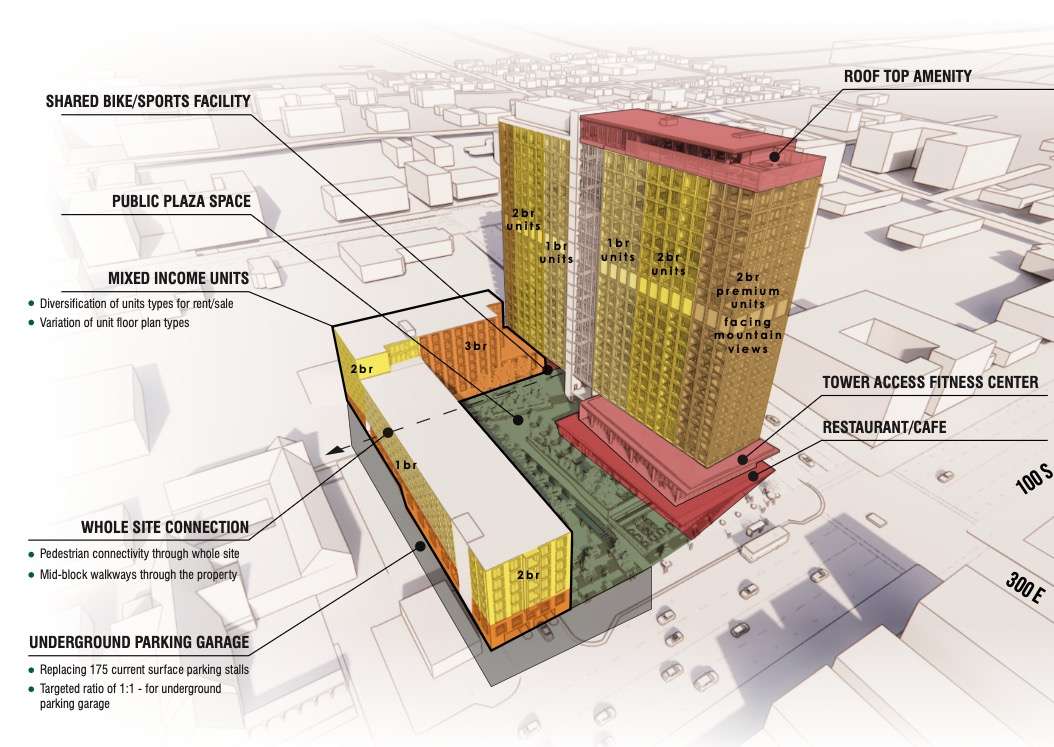
The proposal calls for 421 units, split between a high-rise tower and lower residential buildings, ranging from studio to three-bedroom units. It would also include 2,000 square feet for a ground-level restaurant with patio space, and another 1,000 square feet for a ground-level coffee shop, as well as additional space for shared residential amenities, according to a document submitted to the city.
"We feel this is one of the last contiguous 2.2-acre sites in the city," Hunter said.
Project debate
However, its proximity also generated worries about a shift of unlimited height in areas outside of the downtown core, and potential impacts on St. Mark's Cathedral and Hildegarde's Food Pantry, located next to the property on the block.
The cathedral was originally built in 1871, and parts of it were rebuilt after a fire ripped through it in the 1930s. It's listed on the National Register of Historic Places and has local landmark status, the latter of which offers stronger protections for its preservation.
Construction of this intensity and duration for buildings of this size … would have a potentially devastating impact on the cathedral.
–The Rev. Deacon Elizabeth Hunter
Church representatives and parishioners said they understand the project's need, but they're concerned about the height's impact on the church's solar generation and the vibrations that are expected as demolition and construction move forward.
"Construction of this intensity and duration for buildings of this size … would have a potentially devastating impact on the cathedral," said the Rev. Deacon Elizabeth Hunter. "The seismic risk to a building that's unreinforced masonry of brick and sandstone just cannot be contemplated."
Silverado worked around a similar issue when it built its Block 44 apartment complex next to the historic Oquirrh School, said Dave Hunter. He said the company will work with the "biggest contractors in the world that do this stuff on a full-time basis" to mitigate construction impacts, and potentially reimburse or relocate solar panels should there be any impacts there.
A few residents and businesses located near the project area brought up other issues they hope are addressed. Some pushed for commercial space to be broken up to supply more room for small businesses and organizations to move into, while others voiced issues with the rezoning of a property that just became MU-8 — capping height at 90 feet — through a new zoning process that began this month.
Justin Kani, chairman of the Central City Neighborhood Council, recommended that more family-sized units or a portion of the project be dedicated to condominiums to fit the growing needs of homeownership availability and family housing in the area.
But some came to Wednesday's meeting to support the plan for similar reasons.
"The only way out of the nationwide housing crisis that Salt Lake City suffers from, as well, is to build more housing for all incomes close to existing amenities and transportation," said resident Kyle Holland, adding that he believes the location could be perfect for that.
Approval with conditions
Exact project plans aren't reviewed by the planning commission as part of the rezoning process, but the city is proposing a development agreement that caps the building height at 225 feet and requires that the building owner work with existing commercial tenants "to mitigate displacement," said Salt Lake City senior planner Sara Javoronok.
Developers proposed other community benefits, setting aside 20% of units for affordable housing at 80% of the area's median income and 8% of all housing space for three-bedroom apartments, as well as ground-level commercial space for local businesses or organizations. Those could be bound into a development agreement that the Salt Lake City Council negotiates at a later stage, Javoronok said.
"The proposed zone allows for greater height and a broader range of uses," she said, noting that the proposed height limit would allow for better "transition" between the downtown core and Central City.
The commission ultimately voted in favor of the rezone with the conditions recommended by the city, but members pointed out that a future agreement could include measures tied to the cathedral.
It's up to the City Council to approve the rezone request and a development agreement. Both the city and the developer must sign the agreement before the rezoning is official, binding the project to the capped height and other conditions, said Salt Lake City planning director Nick Norris.