Estimated read time: 5-6 minutes
PROVO — What once looked like a deep and versatile running back room for BYU entering the 2025 season has instead turned into one of the team's most unpredictable position groups, marked by attrition, injuries, and unanswered eligibility questions.
Despite many challenges, BYU has managed to maintain a strong rushing attack. Ahead of the weekend games, the Cougars ranked 34th nationally in rushing yards per game and 43rd in rushing yards per carry, while also being third in the Big 12 in total rushing yards and second in the Big 12 in rushing yards per game.
The backs have showcased their resilience, adaptability and creativity. But how has BYU achieved these marks through five games, and are they doing so in a traditional way?
Committee in motion

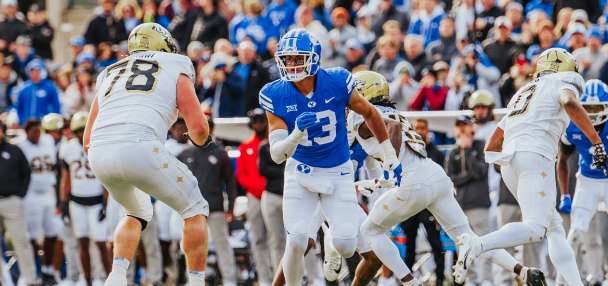
Through all the volatility, LJ Martin has been the bell cow back. The junior from El Paso has carried the brunt of the offensive workload, totaling 76 carries for 490 yards, averaging 6.4 yards per carry with three rushing touchdowns, all without losing a fumble.
While Martin has been the primary engine, BYU's running game has operated with a committee effort, as reflected in the list above. Quarterback Bear Bachmeier is the team's second-leading rusher, totaling 49 carries for 206 yards, averaging 4.2 yards per carry, with five rushing touchdowns.
Wide receivers are also sharing the load: Cody Hagen, Parker Kingston, and Dominique McKenzie have contributed on the ground, illustrating the versatility of BYU's skill players and the creativity of their offensive architect. Even punter Sam Vander Haar has chipped in with a well-timed fake field goal last week.
The preseason plan
At the beginning of the season, behind Martin, the plan was for Sione Moa and Pokai Haunga to provide a complementary one-two punch in the backfield.
Haunga, a dynamic and versatile athlete, was projected to be RB3 entering fall camp, but he is not playing this season for personal reasons. Moa, meanwhile, has struggled to stay healthy after missing much of the offseason and continuing to battle injuries throughout the year and his return is in question
Hinckley Ropati, one of the best running backs the past few years, was forecasted to obtain an extra year of eligibility but was denied by the NCAA, arguably representing the biggest setback to the running back room.
The scat back, Jovesa Damuni, who had been elevated on the depth chart, fumbled last week and was subsequently relegated down the depth chart, highlighting the limited margin for error in a seemingly thin backfield. His demotion has added extra focus on the running back rotation ahead of this week's matchup against Arizona, as BYU looks to find reliable contributors behind Martin.
The rest of the room has been a bit uncertain and unproven.
Enoch Nawahine, a veteran with experience, has battled through lingering injuries that have limited his availability but is finally seeing limited reps over the last two games. Preston Rex, who transitioned from defensive back to running back in hopes of bolstering the position, suffered a soft-tissue injury during fall camp and has yet to make a consistent impact.
He could, however, see his workload increase after being recently moved up the depth chart and listed as RB2 leading up to kickoff against Arizona. Logan Payne, a promising legacy player (son of former BYU punter Matt Payne), sustained a lower-extremity injury during fall camp and has not seen reps yet.
Offseason attrition definitely compounded the issue, as Cale Breslin, a highly productive true freshman out of Nevada, showed flashes of potential in his high school film but was injured during spring ball before the media or fans could fully evaluate his abilities. He entered the transfer portal after spring ball and ultimately ended up at Montana State.
Tip of the cap to the coaches
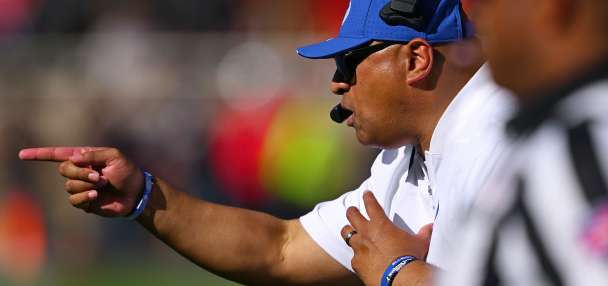
Given all of the above circumstances — injuries, attrition, eligibility setbacks, and unproven players — any coaching staff could have reasonable excuses for a struggling running game. But Aaron Roderick and his staff have found a way to continually produce on the ground.
Roderick predicted the productivity early in fall camp, knowing some of the adversities and potential stumbling blocks that lay ahead:
"Our run game is gonna be good. … I'm telling you, we're gonna be able to run the football," he stated.
A tip of the cap also goes to the coaching staff, like running backs coach Harvey Unga and the supporting group, including TJ Woods, Fesi Sitake, and Kevin Gilbride. The staff have ensured the offensive line, wide receivers, and tight ends are executing blocks at a high level, giving the runners of the ball, the lanes and opportunities to produce despite the volume of different personnel given that opportunity.
The question remains: Are they just one injury away from being in dire straits in the run game?
Forecast in Tucson: Ground game could decide it
Through the first five games, the Cougars have rushed 201 times for 1,170 yards, averaging 5.8 yards per carry with 14 touchdowns, a testament to a team that has successfully relied on a creative committee approach in a season defined by uncertainty and variability.
BYU has run the ball on 60% of its offensive plays this season, compared to just 40% through the air; and that balance may tilt even further toward the ground this week in Tucson. The forecast for Saturday's matchup at Arizona calls for stormy weather due to Hurricane Priscilla.
Ideally, BYU would like to limit Bachmeier's touches on the ground as the schedule becomes more physical over the next seven games. That means a true RB2 may need to emerge to keep the Cougars balanced and durable.
Complicating matters even more, Arizona has yet to allow a passing touchdown all season, making it one of the nation's stingiest secondaries. If BYU wants to find the end zone, it may need to tote the rock for touchdowns in Tucson and continue leaning on its resilient run game.
Does a true RB2 need to emerge behind LJ Martin, or will BYU continue to rely on a smattering of different rushers and creative usage to sustain its ground success? The creative and committee-driven ground game will be tried and tested in the next 7 weeks. Will it last the night?