'%3e%3cpath%20d='M34.1406%205.85938C30.3906%202.10547%2025.3047%200%2020%200C14.6953%200%209.60938%202.10547%205.85938%205.85938C2.10938%209.61328%200%2014.6953%200%2020C0%2025.3047%202.10547%2030.3906%205.85938%2034.1406C9.61328%2037.8906%2014.6953%2040%2020%2040C25.3047%2040%2030.3906%2037.8945%2034.1406%2034.1406C37.8906%2030.3906%2040%2025.3047%2040%2020C40%2014.6953%2037.8945%209.60938%2034.1406%205.85938ZM37.0117%2023.543H31.1602V13.5391H27.6328V19.9414C28.1211%2020.6914%2028.3711%2021.582%2028.3711%2022.5625V22.625C28.3711%2023.668%2028.1172%2024.6055%2027.6328%2025.4297V26.6094H36.082C33.4883%2032.9375%2027.2891%2037.3789%2020.0039%2037.3789C10.3711%2037.3789%202.62109%2029.6289%202.62109%2020C2.62109%2010.3711%2010.3711%202.62109%2020%202.62109C29.6289%202.62109%2037.3789%2010.3711%2037.3789%2020C37.3789%2021.1484%2037.2617%2022.2656%2037.0508%2023.3477C37.0391%2023.4141%2037.0234%2023.4766%2037.0117%2023.543Z'%20fill='white'/%3e%3cpath%20d='M22.3086%2018.5352C20.4336%2018.125%2019.9531%2017.8398%2019.9766%2017.1836V17.1406C19.9766%2016.6992%2020.3477%2016.2148%2021.4023%2016.2148C22.582%2016.2148%2023.8867%2016.6797%2025.0781%2017.4766L26.8516%2015.0195C25.4453%2013.8906%2023.707%2013.3398%2021.5547%2013.3398C18.5195%2013.3398%2016.4375%2015%2016.4063%2017.4766V17.5352C16.3633%2020.2617%2018.5859%2020.9805%2021.293%2021.6016C23.0391%2021.9766%2023.5703%2022.3164%2023.5703%2022.9609L23.5469%2022.9766C23.5469%2023.3906%2023.2578%2023.7031%2022.7852%2023.8359C22.5742%2023.9062%2022.1289%2023.9727%2021.5156%2023.9727C20.7617%2023.9727%2019.7539%2023.8633%2018.6328%2023.4844C18.0898%2023.2891%2017.4727%2023.0039%2016.8047%2022.6133L20.1406%2026.625C20.2813%2026.6602%2021.0977%2026.8516%2021.7734%2026.8516C25.0039%2026.8516%2027.0859%2025.2461%2027.1094%2022.6328V22.5703C27.1602%2020.1133%2025.2148%2019.1719%2022.3086%2018.5352Z'%20fill='white'/%3e%3cpath%20d='M5.24219%2013.5664V26.6133H8.75391V23.7578L10.2969%2021.9531L14.2031%2026.6133H18.3867L12.3555%2019.5195L17.4023%2013.5664H13.4531L8.75391%2019.0586V13.5664H5.24219Z'%20fill='white'/%3e%3c/g%3e%3cdefs%3e%3cclipPath%20id='clip0_97_2430'%3e%3crect%20width='40'%20height='40'%20fill='white'/%3e%3c/clipPath%3e%3c/defs%3e%3c/svg%3e)


This archived news story is available only for your personal, non-commercial use. Information in the story may be outdated or superseded by additional information. Reading or replaying the story in its archived form does not constitute a republication of the story.
- The U.S. plans to administer Gaza for a decade, the Washington Post reports.
- Gaza's population may relocate temporarily; aid includes $5,000 cash and rent subsidies.
- Israel's military actions impact aid access; 514,000 face famine, says IPC report.
WASHINGTON — A postwar plan for Gaza is circulating within President Donald Trump's administration that would see the U.S. administer the war-torn enclave for at least a decade, the relocation of Gaza's population and its rebuilding as a tourist resort and manufacturing hub, the Washington Post reported on Sunday.
The Washington Post said that according to a 38-page prospectus it had seen, Gaza's 2 million population would at least temporarily leave either through "voluntary" departures to another country or into restricted areas within the territory during reconstruction.
Reuters previously reported there is a proposal to build large-scale camps called "Humanitarian Transit Areas" inside — and possibly outside — Gaza to house the Palestinian population. That plan carried the name of the U.S.-backed Gaza Humanitarian Foundation, or GHF, a controversial U.S.-backed aid group.
Anyone who owns land would be offered a "digital token" in exchange for rights to redevelop their property, the Post reported, adding that each Palestinian who left would be provided with $5,000 in cash and subsidies to cover four years of rent. They would also be provided with a year of food, it added.
The Post said the plan is called the "Gaza Reconstitution, Economic Acceleration and Transformation Trust, or GREAT Trust," and was developed by the Gaza Humanitarian Foundation.
The Gaza Humanitarian Foundation coordinates with the Israeli military and uses private U.S. security and logistics companies to get food aid into Gaza. It is favored by the Trump administration and Israel to carry out humanitarian efforts in Gaza as opposed to the U.N.-led system which Israel says lets militants divert aid.
In early August, the U.N. said more than 1,000 people have been killed trying to receive aid in Gaza since the Gaza Humanitarian Foundation began operating in May 2025, most of them shot by Israeli forces operating near Gaza Humanitarian Foundation sites.
The White House and State Department did not immediately respond to a request for comment, but the plan to rebuild Gaza appears to fall in line with previous comments made by Trump.
On Feb. 4, Trump first publicly said that the U.S. should "take over" the war-battered enclave and rebuild it as "the Riviera of the Middle East" after resettling the Palestinian population elsewhere.
Trump's comments angered many Palestinians and humanitarian groups about the possible forced relocation from Gaza.
Israeli forces pounded the suburbs of Gaza City overnight from the air and ground, destroying homes and driving more families out of the area as Prime Minister Benjamin Netanyahu's security cabinet was set on Sunday to discuss a plan to seize the city.
The Israeli military has gradually escalated its operations around Gaza City over the past three weeks. On Friday it ended temporary pauses in the area that had allowed for aid deliveries, designating it a "dangerous combat zone."
On Sunday, the head of the World Food Program said Israel's designation would impact food access and put humanitarian aid workers in danger.
"It's going to limit the amount of food that they have access to," World Food Program executive director Cindy McCain said on CBS News' "Face the Nation" program.
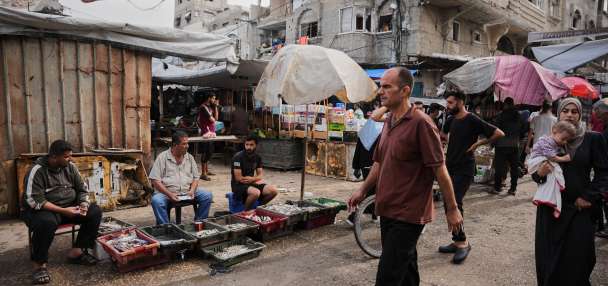
A report released earlier this month by the global hunger monitor, Integrated Food Security Phase Classification, said that approximately 514,000 people — nearly a quarter of Gaza's population — are facing famine conditions in Gaza City and surrounding areas.
Israel has dismissed the IPC's findings as false and biased, saying it had based its survey on partial data largely provided by Hamas, which did not take into account a recent influx of food.