Estimated read time: 4-5 minutes
This archived news story is available only for your personal, non-commercial use. Information in the story may be outdated or superseded by additional information. Reading or replaying the story in its archived form does not constitute a republication of the story.
- A majority of Utahns support the Salt Lake City downtown redevelopment project, despite a sales tax increase.
- The project includes renovating the Delta Center and creating a sports, entertainment, and culture district.
- Salt Lake City leaders emphasize the project's potential to boost the city's economy and services.
SALT LAKE CITY — A sales tax increase took effect in Salt Lake City on New Year's Day to help fund an ambitious project to remake the capital city's downtown, including renovating the Delta Center to accommodate NBA basketball and NHL hockey.
While Utahns aren't big on having to pay more on their purchases in the city or seeing public money subsidize a sports venue, per an earlier Deseret News/Hinckley Institute of Politics poll, a new survey shows broad support for the proposed downtown sports, entertainment, culture and convention district and arena modifications.
HarrisX found in a poll of 854 Utah adults conducted for the Deseret News and Hinckley Institute on Nov. 26-Dec. 5 that 63% favor establishing the zone, while 19% do not and 18% don't know. The survey has a margin of error of plus or minus 3.4 percentage points.
Salt Lake County residents' support of the plan matched that of Utahns statewide at 63%. Utah County and Davis County residents showed slightly higher support at 66% and 70%, respectively.
What city leaders say about the poll
Salt Lake City Mayor Erin Mendenhall is encouraged by the public's support for the downtown revitalization project, according to her spokesperson Andrew Wittenberg.
"This effort is about creating a space where everyone — families, visitors and residents alike — can come together to experience world-class entertainment, beautiful cultural spaces and public amenities that make a city truly come alive," he said.
A Deseret News/Hinckley Institute poll last August showed 54% of Utahns opposed the sales tax increase for the sports, entertainment culture and convention zone, while 38% favored it and 8% didn't know.
Salt Lake City Councilwoman Victoria Petro expressed disappointment about those survey results last year, adding there rarely are easy answers. The city, she said, is trying to make the best of opportunities "without stressing out our average constituent too much" as it endures a tough growth period.
But Petro found optimism in the new poll.
"This growing enthusiasm highlights the value of this initial investment by our community," she said. "It will significantly boost the city's general fund — enabling better services for residents and visitors alike — and further solidify downtown Salt Lake City as a premier destination for world-class sports, entertainment, events and more."
The survey found wide support — exceeding 60% — for the proposed zone across gender, age, education and income categories, the exceptions being those age 65 and older and rural Utahns. And even those groups hovered around 50% approval.
What's happening in downtown Salt Lake City?
Salt Lake City and Smith Entertainment Group, the owner of the Utah Jazz and Utah Hockey Club, signed a participation agreement last fall to redevelop a three-block area.
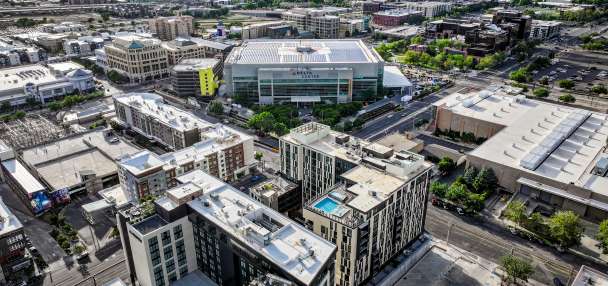
SEG has said it intends to put $3 billion into the project. The proposal includes reconfiguring the Delta Center entrance to face east, pedestrian plazas, building a residential tower and a hotel and providing retail and restaurant space between 300 West and North Temple. Parts of the Salt Palace Convention Center would be torn down, but city, county and company officials committed to keep adjacent Abravanel Hall, home of the Utah Symphony, intact.
The tax hike — going to 8.25% from 7.75% — is anticipated to generate $1.2 billion over the 30-year life of the participation agreement, $900 million of which would go to SEG. The increase does not apply to groceries or big-ticket items such as cars. The company estimates it will spend $525 million to remodel the 33-year-old Delta Center and $375 million on the other district improvements.
The agreement includes the creation of a community benefit fund from fees SEG would attach to ticket sales for basketball, hockey and other events, ranging from $1 to $3 per ticket depending on the ticket price, starting in July 2025. The city would use the money for affordable and family-sized housing, a Japantown streetscape project and public art, the latter two getting $5 million each.
The revitalization project still rests on land lease agreements tied to the participation agreement. Salt Lake City must approve a lease extension for the block where the Delta Center sits. The city and SEG also have to come to terms on a development agreement on building plans in the district outside the arena.
In addition, SEG and Salt Lake County must reach a land lease agreement for two blocks east of the Delta Center that includes the Salt Palace Convention Center and Abravanel Hall. The county owns and operates both facilities.
Other aspects of the project will go before city and county leaders as it develops over the next several years.
A Smith Entertainment Group spokesperson said the company had nothing new to share related to the downtown project.
Cost to taxpayers
Natalie Gochnour, an economist and director of the Kem C. Gardner Policy Institute, told the City Council last summer that 75% to 80% of the sales tax is paid by businesses and nonresidents of Salt Lake City.
She estimated that Salt Lake City households would on average pay about $120 to $150 a year in additional sales tax. But, she said, the amount really depends on how much people consume. Some might pay $1,000 more, while others only $20, she said.
Salt Lake City residents, she said, benefit for $3 out of every $4 that are invested from the sales tax increase.
"And what do they get for it?" Gochnour said earlier. "They get a vibrant, growing, thriving, dynamic city that has upward mobility."