'%3e%3cpath%20d='M34.1406%205.85938C30.3906%202.10547%2025.3047%200%2020%200C14.6953%200%209.60938%202.10547%205.85938%205.85938C2.10938%209.61328%200%2014.6953%200%2020C0%2025.3047%202.10547%2030.3906%205.85938%2034.1406C9.61328%2037.8906%2014.6953%2040%2020%2040C25.3047%2040%2030.3906%2037.8945%2034.1406%2034.1406C37.8906%2030.3906%2040%2025.3047%2040%2020C40%2014.6953%2037.8945%209.60938%2034.1406%205.85938ZM37.0117%2023.543H31.1602V13.5391H27.6328V19.9414C28.1211%2020.6914%2028.3711%2021.582%2028.3711%2022.5625V22.625C28.3711%2023.668%2028.1172%2024.6055%2027.6328%2025.4297V26.6094H36.082C33.4883%2032.9375%2027.2891%2037.3789%2020.0039%2037.3789C10.3711%2037.3789%202.62109%2029.6289%202.62109%2020C2.62109%2010.3711%2010.3711%202.62109%2020%202.62109C29.6289%202.62109%2037.3789%2010.3711%2037.3789%2020C37.3789%2021.1484%2037.2617%2022.2656%2037.0508%2023.3477C37.0391%2023.4141%2037.0234%2023.4766%2037.0117%2023.543Z'%20fill='white'/%3e%3cpath%20d='M22.3086%2018.5352C20.4336%2018.125%2019.9531%2017.8398%2019.9766%2017.1836V17.1406C19.9766%2016.6992%2020.3477%2016.2148%2021.4023%2016.2148C22.582%2016.2148%2023.8867%2016.6797%2025.0781%2017.4766L26.8516%2015.0195C25.4453%2013.8906%2023.707%2013.3398%2021.5547%2013.3398C18.5195%2013.3398%2016.4375%2015%2016.4063%2017.4766V17.5352C16.3633%2020.2617%2018.5859%2020.9805%2021.293%2021.6016C23.0391%2021.9766%2023.5703%2022.3164%2023.5703%2022.9609L23.5469%2022.9766C23.5469%2023.3906%2023.2578%2023.7031%2022.7852%2023.8359C22.5742%2023.9062%2022.1289%2023.9727%2021.5156%2023.9727C20.7617%2023.9727%2019.7539%2023.8633%2018.6328%2023.4844C18.0898%2023.2891%2017.4727%2023.0039%2016.8047%2022.6133L20.1406%2026.625C20.2813%2026.6602%2021.0977%2026.8516%2021.7734%2026.8516C25.0039%2026.8516%2027.0859%2025.2461%2027.1094%2022.6328V22.5703C27.1602%2020.1133%2025.2148%2019.1719%2022.3086%2018.5352Z'%20fill='white'/%3e%3cpath%20d='M5.24219%2013.5664V26.6133H8.75391V23.7578L10.2969%2021.9531L14.2031%2026.6133H18.3867L12.3555%2019.5195L17.4023%2013.5664H13.4531L8.75391%2019.0586V13.5664H5.24219Z'%20fill='white'/%3e%3c/g%3e%3cdefs%3e%3cclipPath%20id='clip0_97_2430'%3e%3crect%20width='40'%20height='40'%20fill='white'/%3e%3c/clipPath%3e%3c/defs%3e%3c/svg%3e)


Estimated read time: 2-3 minutes
This archived news story is available only for your personal, non-commercial use. Information in the story may be outdated or superseded by additional information. Reading or replaying the story in its archived form does not constitute a republication of the story.
BOCA CHICA, Texas — SpaceX launched its mega rocket Starship but lost both the booster and the spacecraft in a pair of explosions minutes into Saturday's test flight.
The rocket ship reached space following liftoff from South Texas, but communication suddenly was lost. SpaceX officials said it appears the ship's self-destruct system blew it up over the Gulf of Mexico.
The flight came to an end as the ship's engines were almost done firing to put it on an around-the-world path. The first test flight in April also ended in an explosion.
On Saturday, about three minutes into flight, the separated booster also exploded over the gulf. By then, though, its job was done.
Despite the failure, the approximately eight-minute flight lasted twice as long as April's test. At nearly 400 feet, Starship is the biggest and most powerful rocket ever built, with the goal of ferrying people to the moon and Mars.
"The real topping on the cake today, that successful liftoff," said SpaceX commentator John Insprucker.
Added commentator Kate Tice: "We got so much data, and that will all help us to improve for our next flight."
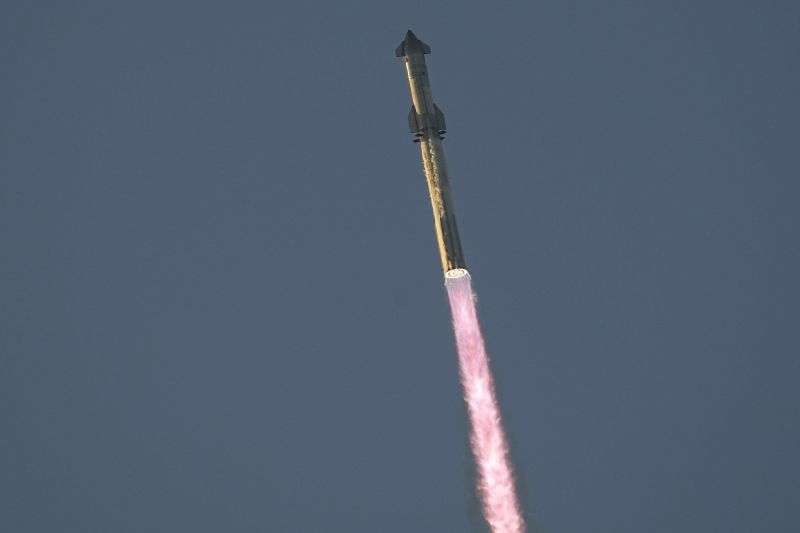
SpaceX founder Elon Musk watched from behind launch controllers at the southern tip of Texas near the Mexico border, near Boca Chica Beach. At company headquarters in Hawthorne, California, employees cheered as Starship finally soared at daybreak. The room grew quiet once it was clear that the spaceship had been destroyed and crashed into the gulf. The booster also ended up in the gulf.
SpaceX had been aiming for an altitude of 150 miles, just high enough to send the bullet-shaped spacecraft around the globe before ditching into the Pacific near Hawaii about 1½ hours after liftoff, short of a full orbit.
Following April's flight demo, SpaceX made dozens of improvements to the booster and its 33 engines as well as the launch pad. The Federal Aviation Administration cleared the rocket for flight on Wednesday, after confirming that all safety and environmental concerns had been met.
The Associated Press Health and Science Department receives support from the Howard Hughes Medical Institute's Science and Educational Media Group. The AP is solely responsible for all content.