Estimated read time: 6-7 minutes
This archived news story is available only for your personal, non-commercial use. Information in the story may be outdated or superseded by additional information. Reading or replaying the story in its archived form does not constitute a republication of the story.
LOGAN — So far this year, the Aggies offense has been much better than many anticipated before the season began.
Through six games, Utah State ranks 15th in the FBS and first in the Mountain West with 38.2 points per game, and ranks 23rd in the nation in offensive yards per game. Their up-tempo style of offense, built on big plays and passing the football, has been efficient this season.
Sure, the quarterback situation has been a little messy (probably not as messy as another school in the area), but both Cooper Legas and McCae Hillstead have emerged as competent offensive leaders that can make big plays against strong defenses.
The offensive line, though uncertain and inexperienced at times, has been better than anyone could have asked for this season.
The receivers have stepped up in a big way this season, making impressive grabs and producing consistently. Broc Lane has begun to emerge as a potential pass-catching tight end moving forward after getting a handful of targets and receptions in a majority of Utah State's contests this season.
But one important part of a spread-style offense, like Utah State's, that is often forgotten is the running backs. Turning a spread offense into a more two-dimensional team with a talented running back (or three, in the Aggies' case) is dangerous for opponents.
"When the running backs get it going, it honestly helps everybody," Aggies receiver Micah Davis said. "It brings in the backers a little bit, makes them play a little bit lower, and so, that way, we can run past defenders and get open deep."
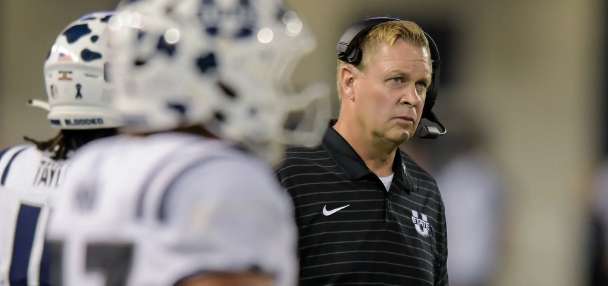
The Aggies have implemented a unique "running back by committee" style rushing attack this season, featuring three running backs. Head coach Blake Anderson, who also serves as the team's offensive coordinator, hasn't named a starter at running back since the beginning of the season, mentioning instead three different players who would share those responsibilities.
Here's a look at those players.
Robert Briggs Jr.
Briggs has been playing at Utah State the longest of the trio and is in his second year with Utah State. He played last year under seasoned vet Calvin Tyler Jr. and racked up 353 yards and a touchdown on 74 carries, all while trying to learn from Tyler.
A former three-star recruit, according to 247Sports.com, from Bellville, Texas, Briggs set a school record with his 100-meter dash time of 10.91 seconds his freshman season. Throughout his high school career, he tallied more than 6,300 all-purpose yards and scored 73 all-purpose touchdowns.
When it was time to decide where to go to school, Briggs said he loved the coaches at Utah State, loved their football facility, and loved the atmosphere and fans in Logan, adding that he felt "at home."
This season, Briggs has accumulated 211 total rushing yards and a touchdown on 40 carries, averaging 5.3 yards per carry. He was injured in the Aggies' home contest against Idaho State with a high ankle sprain, but said he is now back to 100%.
Davon Booth
Booth has led the Aggies running backs thus far in total yards (395), carries (62), and touchdowns (four), while averaging 6.4 yards per carry.
"Davon is a guy that has emerged solid in protection, catches the ball out of the backfield, and has shown his ability to make people miss and run physically," said Anderson, who added that the same could be said of the other two backs.
From North Las Vegas, Nevada, Booth is a former three-star recruit, according 247Sports.com. He was named the LA Times' Back of the Year as a senior at El Monte High after recording 2,935 yards on just 239 carries, averaging more than 12 yards per carry, and scored 36 rushing touchdowns that year alone.
Booth also tallied 627 receiving yards on just 22 receptions and scored a touchdown on half of his 22 receptions, which mirrored his junior season.
Booth chose to enroll at Cerritos College and played football there for two seasons, where as a sophomore he ran for nearly 1,500 yards and led his team to an 8-3 record. One large determining factor in Booth's decision to come to Utah State was the similarities he saw between his junior college coach and Anderson.
"I trust both of them with my career," Booth said.
He arrived at Utah State in January and has since made big strides.
"He doesn't even look like the same guy," Anderson said. "Very confident, body looks better, he's in better shape."
Rahsul Faison
Faison, like Booth, joined Utah State early this year. In high school, he ran for nearly 7,000 yards and averaged 9.5 yards per carry his senior season. He played his senior season at Salisbury High in Connecticut, not far from where the Aggies faced Connecticut this year.
"It was definitely fun (to play in Connecticut)," Faison said. "I got some family to come out and watch me play, so just seeing my family and being back on the East coast is definitely a good time."
Faison spent time at Marshall University before ultimately entering the transfer portal and ending up at Snow College in Ephraim. In his one year at Snow College, Faison ran for 355 yards on 88 carries and scored six touchdowns.
As a junior-college transfer, Faison was a two-star recruit, according to 247Sports.com. He joined the Aggies just a few months ago, making him one of the newest additions to the team.
"It was an easy switch," Faison said. "I didn't want to go too far.
"I like how coach Anderson handles a lot of his adversities, because I've been through a lot of adversity the last couple years, and I've seen how he responded to that and I wanted to be in that, surrounding that culture," Faison added.
This season, Faison has rushed for 259 total yards and a touchdown on just 34 carries through six games. He leads the trio of backs with 7.6 yards per carry.
Faison noted that the game day atmosphere was a pleasant surprise, saying, "I didn't realize it gets that loud and that packed."
'We've got three No. 1's'
The three running backs have ended up together at Utah State and have found great success. All three average more than 5 yards per carry and each has more than 30 carries on the season.
"We've got three No. 1's that are all ready to go, and it's taken all three to do what we're doing," Anderson said.
Having three backs of that caliber, however, begs the question: How do they feel about sharing the starting spot three ways?
"It's very competitive," said Briggs, who added that though it's competitive, the trio joke with each other often and that the competition "makes us even closer."
"We all bring different things to the table," Faison said, while mentioning that he had done something similar at Snow College. "They are two great backs, so I learn from them a lot, and they keep pushing me to be better every single day. So, I feel like it's good for us; it's definitely good for us. We push each other, and on game time, it shows."
"It's fun, you know. We all just talk a lot of crap to each other," Booth said. "It's fun seeing them run down the field. We're all selfless players, we all want each other to be great. So at the end of the day, we just have fun and just enjoy each other playing."
So, at least for now, it seems the "running back by committee" strategy that Anderson is employing for his offense seems to be working effectively.