
Estimated read time: 3-4 minutes
This archived news story is available only for your personal, non-commercial use. Information in the story may be outdated or superseded by additional information. Reading or replaying the story in its archived form does not constitute a republication of the story.
SALT LAKE CITY — Utah lawmakers Monday discussed penalties for killing police dogs, ambulance drivers or security guards, among other things.
Below, click the headline to read the full story.
Bill would make killing a police dog a second-degree felony in Utah
Killing a police service dog would become a second-degree felony in Utah under a bill supported by a Senate committee Monday.
Senate Minority Caucus Manager Jani Iwamoto, D-Holladay, introduced SB57 by sharing the stories of Aldo and Dingo, two Unified police dogs killed in the line of duty in 2016 and 2017, respectively.
Iwamoto's bill raises the penalty for killing a police service dog from a third-degree felony to a second-degree felony. It also changes the language in state law from "intentionally" harming or killing an animal to "intentionally and knowingly," in order to assist prosecutors, she said.
The Senate Judiciary, Law Enforcement and Criminal Justice Committee voted 5-1 in favor of advancing the bill to the full House for further debate.
Lawmaker wants death penalty option for killing ambulance drivers, security guards
Killing an ambulance driver or a private security guard could result in an aggravated murder charge eligible for the death penalty under a proposed law a Utah legislative committee backed Monday.
Lawmakers, however, were told passing the bill could lead to a court overturning Utah's death penalty law.
Sen. Karen Mayne, D-West Valley City, said all first responders called to an emergency should be treated the same regardless of their jobs.
Insurers push back on bill requiring coverage of psychiatrists' telehealth consultations
Following fervent debate Monday over a bill requiring insurers to provide coverage for mental health consultations between a patient's primary care physician and a psychiatrist, a vote on whether to recommend the measure was delayed by the request of its sponsor.
HB139 would oblige the Medicaid program and private insurers to provide reimbursement for the service, which bill sponsor Rep. Steve Eliason, R-Sandy, said is aimed at getting patients faster and more extensive access to mental health care by working with their own family doctor.
"It actually increases our capacity because someone who does in-patient counseling for a living … can easily fit (the consultation) in," he told the House Health and Human Services Committee.
Utah Senate committee advances bill clarifying bonding for roads, prison
A Senate committee advanced a bill Monday clarifying that the costs associated with issuing $1 billion in bonds for transportation and another $100 million for the construction of a new state prison are on top of those amounts.
The bonding was approved by the 2017 Legislature, but the sponsor of SB110, Sen. Wayne Harper, R-Taylorsville, told the Senate Transportation Committee there has been some confusion about whether the legal and other costs were included.
"It's not a whole lot," Harper said of the costs. He said during the hearing he understood it would add less than $100,000 to the $1 billion in transportation bonding but need to verify the amount.
Salt Lake Chamber visits Utah Capitol to kick off Clear the Air Challenge
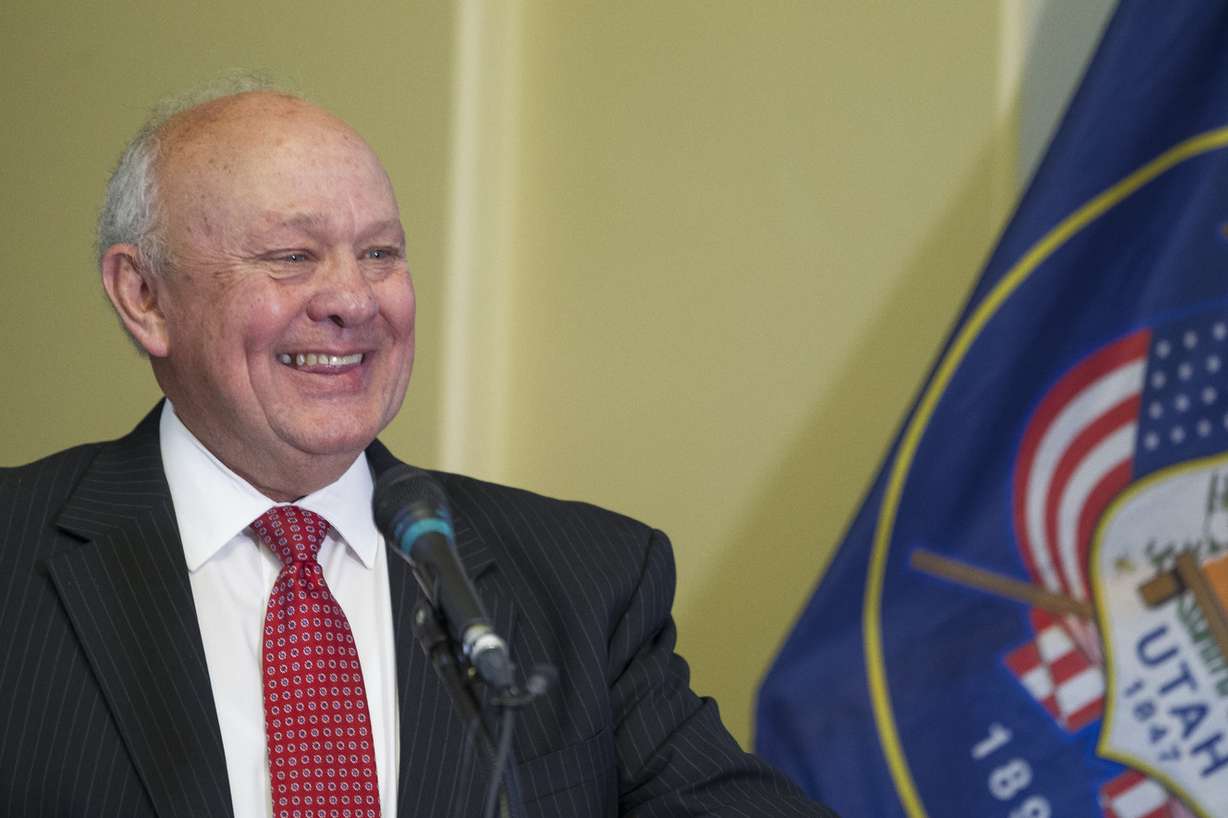
The Salt Lake Chamber kicked off its ninth annual Clear the Air Challenge on Monday.
"We're very excited about the announcement, because … it is taking place in February," said Lane Beattie, president and CEO of the Salt Lake Chamber.
In the past, the challenge took place during the summer. In February, "our air quality is visibly at its worse," the chamber said in a news release.






