Estimated read time: 8-9 minutes
This archived news story is available only for your personal, non-commercial use. Information in the story may be outdated or superseded by additional information. Reading or replaying the story in its archived form does not constitute a republication of the story.
SALT LAKE CITY — A bill making Utah's legal alcohol limit the lowest in the nation is one step closer to becoming law and a bill requiring doctors to tell their patients that drug-induced abortion can be reversed midway through the process advanced.
A bill to bar people with domestic violence convictions or protective orders against them from possessing firearms also received unanimous support from a committee.
Here's a roundup of what's happening during the current legislative session:
Last call for .08? Utah drawing closer to lowest blood-alcohol limit in nation
A bill making Utah's legal alcohol limit the lowest in the nation is one step closer to becoming law Wednesday after a Senate committee voted 4-2 to advance it following nearly two hours of testimony.
HB155, sponsored by Rep. Norm Thurston, R-Provo, has already passed the House, meaning it would be headed to the governor's office for his action if it passes the Senate without changes on the floor.
The bill would lower the legal blood-alcohol level for drivers in Utah from .08 percent to .05 percent, the standard in many countries around the world.
GOP-heavy panel backs abortion-reversal bill, saying intent is 'informed consent'
Rep. Keven Stratton, R-Orem, insists that his bill requiring doctors to tell their patients that drug-induced abortion can be reversed midway through the process is neither anti-abortion nor pro-abortion rights.
Stratton's HB141 would require doctors to tell their patients about the process of a chemical abortion, as well as the odds of its success and the potential for a chemical reversal before the process is complete.
He described his bill as an "informed consent" measure to make pregnant women aware of how chemical abortions work and to help them understand their options for reversing the procedure.
Teresa Durbin, an OB-GYN from Layton, described the process of a drug-induced abortion. Durbin said the two-step process starts with a dose of mifepristone, followed two days later by a secondary drug to complete the process.
Only 15 percent of embryos would be alive after the first drug, she said.
A timely use of progesterone could raise the viability of the embryo by 65 to 70 percent, Durbin said, somewhat reversing the effect of the abortion procedure.
"The patient needs to be made aware of the possibility of reversal," she said.
The Senate Judiciary Committee voted 2-1 in favor of moving the bill to the Senate floor.
Law to reform Utah's juvenile justice system move forward
A Washington County lawmaker described the countless hours spent with working groups, courts and educators to prepare a bill to reform juvenile justice in Utah.
Members of the Utah House took note of the efforts made by Rep. Lowry Snow, R-Santa Clara, to cut costs and meet demands from courts and educators in his bill, HB239, which would favor tiered responses to correct behaviors among juvenile offenders.
"It was not something that was prepared and rubber-stamped by any means," Snow said. "The debate was significant."
The House voted 68-7 to approve the bill Tuesday night and send it to the Senate for its consideration.
Access to firearms a concern in domestic violence cases
House Minority Leader Brian King, D-Salt Lake City, stressed the importance of his work with activists on both sides of gun rights issues as he presented a bill to bar people with domestic violence convictions or protective orders against them from possessing firearms.
King said HB206 would align Utah law with existing federal law.
"It is a crime under federal law currently, but what you see is it is unenforced," he said.
King's bill received unanimous support from the Senate Judiciary Committee during a hearing Wednesday. HB206 previously received unanimous support in the House and now advances to the full Senate for its consideration.
Proposed service animal registry would help ID growing number of companion pets in Utah
Perfect strangers used to ask Maria Tello what was wrong with her.
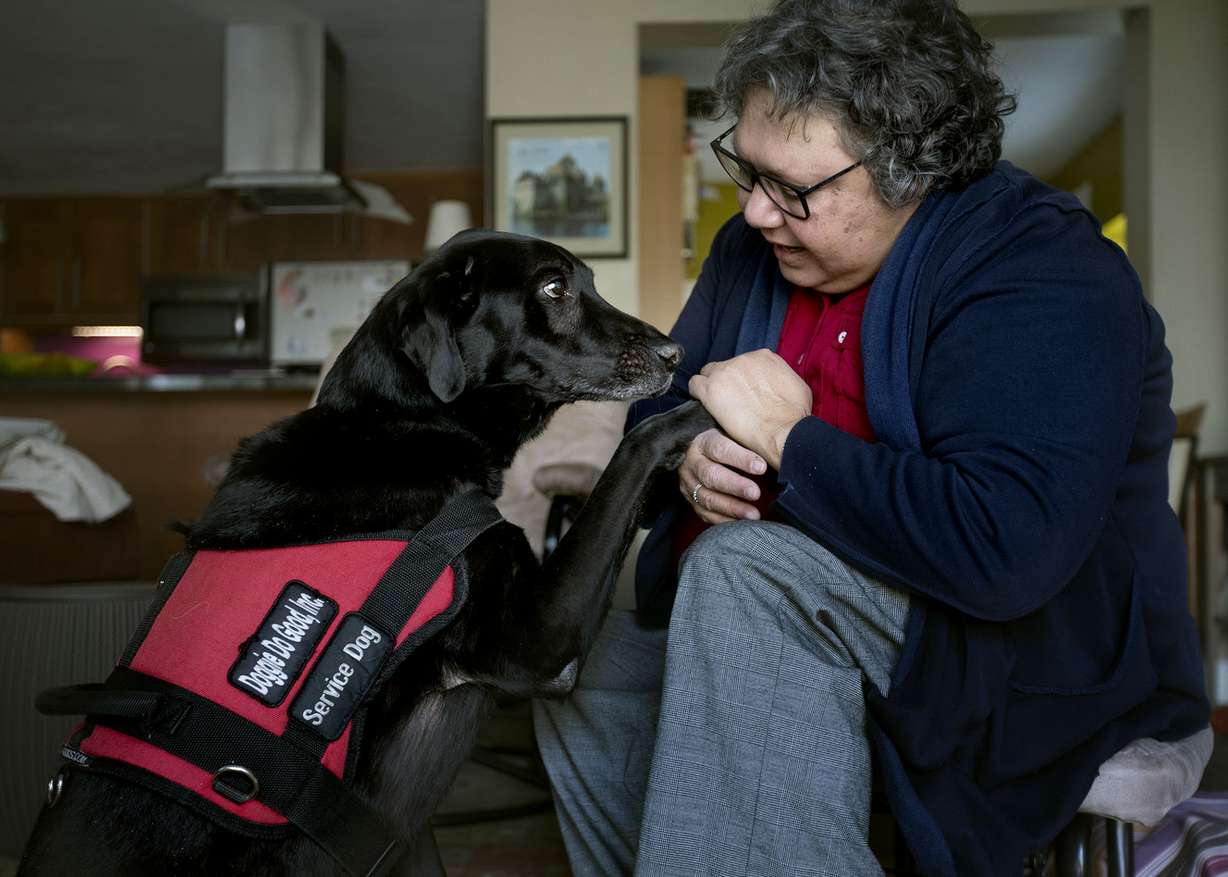
Because she is oft accompanied by a service dog and "because I have an invisible disease," she said, referring to Type 1 diabetes.
Getting proper certification for her black Labrador, Malachi, has helped curtail the questioning. And it protects the dog.
"He's such an integral part of my life," Tello said. "He's so important to me. I wanted to make sure he'll be OK if anything were to happen to me."
Tello is hoping Utah lawmakers will adopt a resolution that creates a voluntary service animal registration program and encourages city officials throughout Utah to take note of the animals helping people in their communities.
In addition to protecting the animals, Rep. Rebecca Chavez-Houck, D-Salt Lake City, who is sponsoring the resolution, said it would help business owners whose hands are often tied from restricting access to patrons with animals because of the Americans with Disabilities Act.
The committee unanimously supported the resolution and pinned it to the House's consent calendar.
Bill to make choking a felony advances at Legislature after emotional testimony
A Utah mother of six told state lawmakers about the time in 2011 when her ex-husband gripped her neck so tightly that she passed out on the bathroom floor.
That came after he had beaten her with a bar stool until it splintered, she said.
A proposal to make attempted strangulation a felony crime “is so important,” Heather Wolsey, a Provo resident who works in newspaper sales, told the Senate Revenue and Taxation Committee on Wednesday.
She recalled preparing to die as her ex, who's now in prison, told her he could take her life at any time.
HB17, which seeks to codify penalties for attempted strangulation, was unanimously forwarded to the full Senate with a favorable recommendation.
GOP tax reform plan includes only partial food tax restoration
House Republicans spent nearly two hours in a closed caucus meeting Wednesday poring over a thick document titled “Tax Reform Options,” but they still aren't ready to sign off on the leadership-driven proposal.
“It’s simple to do. Whether it’s simple to execute politically is another question,” said House Majority Leader Brad Wilson, R-Kaysville.
House Republicans are set to meet again Thursday night.
GOP leaders have been talking throughout much of the 45-day session that ends March 9 about a tax reform package that would restore the full sales tax on food and reduce the amount Utahns can earn before losing income tax exemptions.
The package, intended to be revenue neutral for the first year, would also cut both the sales and income tax rates. It was put together in response to a proposed ballot initiative to raise income taxes to bring in $750 million for schools.
Sobriety program could reduce license suspensions for DUIs
Lawmakers voted in unanimous support of a bill to allow motorists who get a DUI to keep their licenses through a new driver sobriety program.
HB250, sponsored by Rep. Justin Fawson, R-North Ogden, would allow people convicted of driving under the influence to receive a reduced license suspension through participation in a court-ordered sobriety program.
The program would allow participants to take a breathalyzer test twice a day to prove their sobriety and maintain access to a driver's license.
Fawson said the program would reduce an impact to repeat offenses by incentivizing drivers to keep their licenses by continually proving their sobriety.
Committee OKs bill that would add 'targeting' an officer to aggravated murder statute
The House Law Enforcement and Criminal Justice Committee on Wednesday recommended a bill that would include the targeting of a police officer with a list of acts of mass destruction that qualify a homicide as aggravated murder.
HB 433, sponsored by Rep. Rep. Paul Ray, R-Clearfield, also adds language to Utah code that defines the targeting of a law enforcement officer as "unlawful use of force and violence" against said officer, "causing serious bodily injury or death in furtherance of political or social objectives in order to intimidate or coerce a civilian population or to influence or affect the conduct of a government or a unit of government."
American Civil Liberties Union representative Anna Thomas raised concerns about the bill, saying it was redundant under current state law and "does very little to benefit our law enforcement officers."
"In Utah, it's not necessary," Thomas said. "We can (already) seek enhancements against people who murder law enforcement officers, as we should."
The measure passed 8-3.
Contributing: Lisa Riley Roche, Ryan Morgan, Wendy Leonard, Annie Knox, Marjorie Cortez, Ben Lockhart