Estimated read time: 3-4 minutes
This archived news story is available only for your personal, non-commercial use. Information in the story may be outdated or superseded by additional information. Reading or replaying the story in its archived form does not constitute a republication of the story.
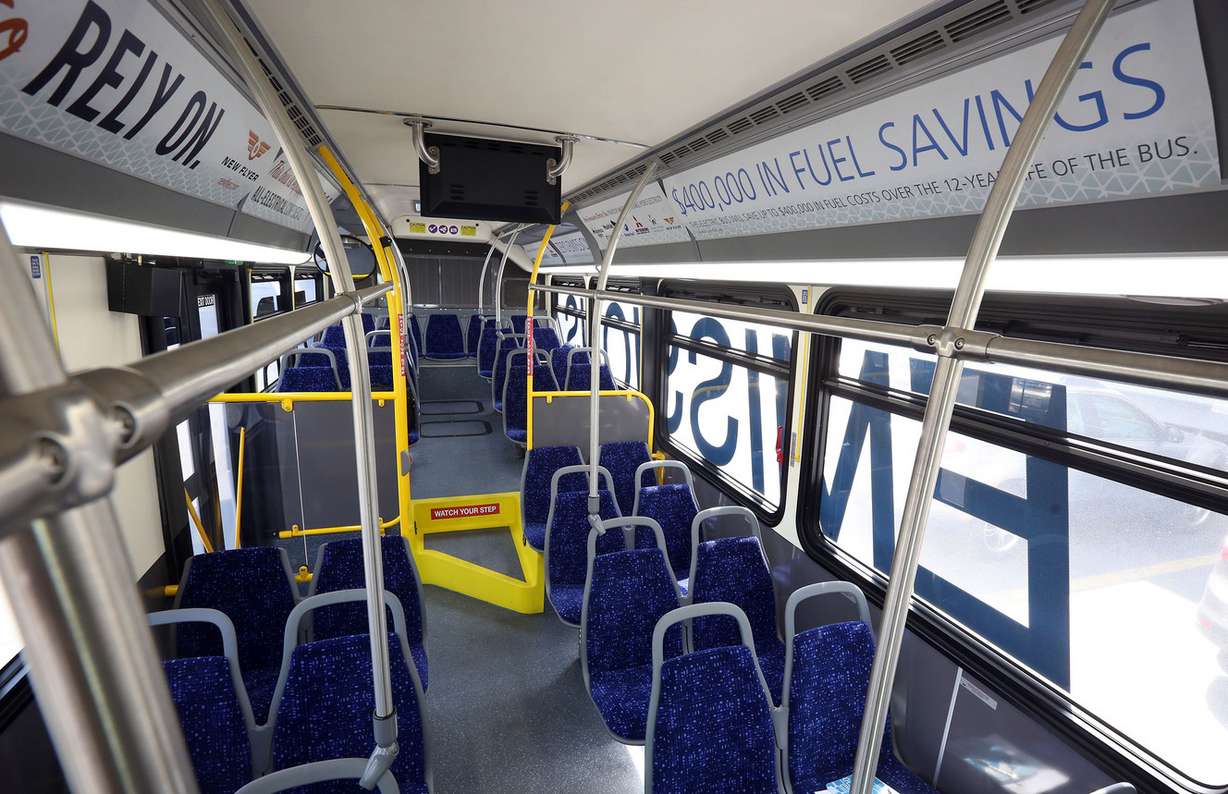
SALT LAKE CITY — In its journey across the country, a demo electric battery-powered bus made its way to Utah on Tuesday, representing the five electric buses that will be serving the public beginning in 2018.
In efforts to decrease emission rates in Salt Lake County, the Utah Transit Authority received a $5.4 million low- or no-emission vehicle deployment grant from the Federal Transit Administration earlier this year for the purchase of the five electric buses.
"We hope to make zero-emission buses part of our effort to become more environmentally friendly," said UTA spokesman Remi Barron.
The University of Utah was involved in securing the grant, supporting its Energy Environmental Stewardship Initiative — 2010 Climate Action Plan.
Two of Salt Lake City's all-electric buses will be used only by the U. to shuttle students through the center of campus, decreasing both pollution and noise. The other three buses will be used by the community and will provide service to the university for students, faculty and staff.
"It's good for everybody," Barron said, "not just the people who ride UTA, not just the people who work up at the University of Utah."
Barron said UTA plans to eventually replace all current buses with electric-powered buses. They will do this by replacing the oldest ones — usually diesel buses — first and then use the new ones in place of the old.
Currently, UTA's 488 buses include 32 hybrid electric and 47 compressed natural gas buses.
Through their environmentally friendly actions to replace diesel buses with compressed natural gas and hybrid electric buses, UTA has decreased nitrogen oxide emissions by more than 70 percent from its bus fleet since 2007, according to Barron.
He recognizes that the electric buses will help fight against Salt Lake City's unfortunate winter inversion patterns.
"This is the best," Barron said. "It doesn't get any better than no particulate matter going up into the air from a bus. These are essentially zero emission."
"These five buses specifically will help this region find out how we can better deploy electric buses on a wider scale in the future," added Alma Haskell, UTA grants development administrator.
The buses will be introduced near the beginning of 2018 for a testing period, where data will be collected and sent to New Flyer, CALSTART and UTA. The three organizations will then work on route planning for full revenue service, according to Haskell.
The buses will be supplied by New Flyer, the country's largest heavy-duty transit bus manufacturer, which built its first fully electric bus prototype about four years ago.
Related

UTA receives grant to purchase electric buses
The Utah Transit Authority has received a $5.4 million low- or no-emission vehicle deployment grant from the Federal Transit Administration for the purchase of five electric buses, the agency announced.Mark Fisher, New Flyer regional sale manager, said even though the electric buses can cost up to $350,000 more than diesel buses initially, electric buses save approximately $400,000 in gas over their lifetime, which can be anywhere from 12 to 20 years long. Additionally, the electric buses are more cost-efficient because they do not require the maintenance a diesel bus requires, he said.
The electric buses run on batteries located within the bus, and each bus can regenerate about 1/3 of its energy while it stops throughout the day, according to Fisher.
"We're definitely very, very active in sustainability," Fisher said, "We're always looking for a best value solution." Email: ahobbs@deseretnews.com