Estimated read time: 5-6 minutes
This archived news story is available only for your personal, non-commercial use. Information in the story may be outdated or superseded by additional information. Reading or replaying the story in its archived form does not constitute a republication of the story.
PROVO — As BYU prepares to travel to Michigan for a college football game Saturday at 10 a.m. MDT, many former players, coaches and fans turn their thoughts to the first and only meeting between the two schools: the 1984 Holiday Bowl won by BYU 24-17 to finish 13-0 and clinch the school's only national championship.
It turns out that the history between Ann Arbor, Michigan, and the state of Utah goes back a little further than that — to a black non-Mormon who grew up in Salt Lake City, became one of the first black football players to join a Wolverines squad, and later joined The Church of Jesus Christ of Latter-day Saints and spent a portion of his final days as a tour guide at the Los Angeles Temple.
Abner Howell was born in 1877 in Louisiana but moved with his family in 1890 to Salt Lake City, where he was a standout high school running back. As a young athlete, he was described as "everything from the bandwagon to the steam Calliope," wrote Wendell J. Ashton in the book "Voice in the West: Biography of a Pioneer Newspaper."
The University of Michigan athletic department and the Bentley Historical Library, in connection with BYU historian Margaret Blair Young, published a tribute to Howell as part of a series that "celebrates the 150th year of Michigan athletics … highlighting the partnership and bringing to life some of the athletics memorabilia that lives in the walls of the Bentley."
Howell, who grew up one of many non-Mormon blacks in Utah, was believed to be a member of the all-black AME church in Salt Lake City. Young writes that he was the first black teenager to graduate from Salt Lake (East) High School before attending the University of Michigan law school, where he shows up in a photo in the university's 1904 calendar with other second-year students.
But Howell wanted to continue his football career in Ann Arbor, as well. The former prep star tried to earn a spot on one of legendary Michigan coach Fielding Yost's squads from 1903 to 1905, when they won 26 straight games and only tied once that was part of a 50-game home winning streak from 1901-07.
Yost finished his coaching career with an overall record of 165-29-10.
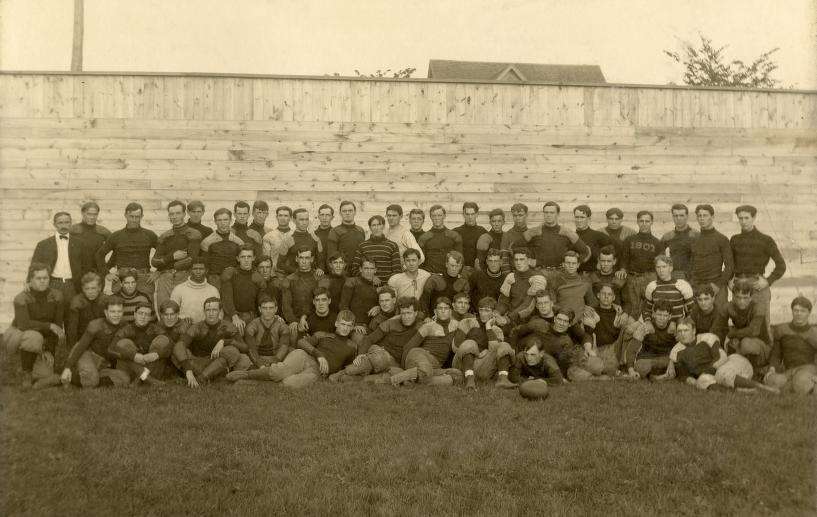
The coach who many historians describe as a racist and who did not award a varsity letter to a black athlete in his 25-year tenure from 1901-26, accepted Howell enough to put him in a full-squad team photo in 1902 — one in which the coach is standing near the player. Howell was a member of the freshman team.
"Coach Yost was known to harbor racist feelings, but he permitted Howell to play because his exceptional athleticism made the Michigan team virtually unbeatable," reads an entry in the Oxford African American Studies Center's biography of Howell. "Yost remained as football coach at Michigan until 1926 and then served as Michigan's athletic director until 1941. With the sole exception of Howell, Yost reportedly excluded all other black student-athletes from playing football for the university until 1932."
Michigan's student newspaper The Michigan Daily reported that Howell played in a scrimmage, and he tried out for the Wolverines' varsity team in 1903 and 1904, but he never got into a game and thus his name does not appear in the football record books.
Two other black student-athletes appeared in photos during Yost's coaching tenure, according to the Michigan athletic department. An unidentified player appears in the 1917 team photo, and Belford Lawson received a "reserve letter" in both 1921 and 1922 while playing for the Wolverines.
Howell married Nina Stevenson in 1904, and moved back to Utah before finishing his education when his father died, Young wrote, continuing the family profession as a bricklayer. His childhood friend and Salt Lake High teammate Nicholas Smith (the son of LDS Church apostle John Henry Smith) returned from serving as a mission president in South Africa in 1921, and he helped lead to the baptism of Howell. The Mormon convert also claimed his wife and family converted to Mormonism at the time, but no historical record exists to verify the claim.
After Nina Howell's death in 1945, the early black Mormon pioneer married Martha Stevenson Perkins, and the two became known as "the black Mormons" who had letters written about them from Elder LeGrand Richards and other apostles, according to historical documents held by BYU Special Collections.
Martha Perkins Howell died in 1954, and Abner Howell moved to California shortly thereafter, where he became a tour guide at the Los Angeles Temple during its open house in 1955-56. He taught about the relationship of blacks and the church during firesides, institute classes and other LDS meetings during his time in California, and received a special card in Los Angeles that designated him an "honorary High Priest" in the LDS Church, a card that currently resides at BYU. He returned to Utah in 1965 and died at a rest home in 1966, a dozen years before the church began ordaining black men to the priesthood.
"We love you for putting your hand into our heaped-up hearts and passing over all the frivolous and weak things that you cannot help but see there," wrote Byrdie Howell Langon in a tribute to AME pastor Jerry E. Forward shortly after Howell's death, with words directed at the black community in which Howell lived, "and drawing out into the light all the beautiful things that many have not looked far enough to find."