Estimated read time: 6-7 minutes
This archived news story is available only for your personal, non-commercial use. Information in the story may be outdated or superseded by additional information. Reading or replaying the story in its archived form does not constitute a republication of the story.
Editor's note: The following is one in a series of tailgating articles that will be posted weekly throughout the football season. This is a follow-up to last week's article and will contain detailed descriptions and graphic pictures of a delicious pig being roasted and carved. So if you find this offensive no need to read on. Also, if you’re already hungry, you may not want to continue reading or you may find yourself headed for the nearest barbecue joint for some roasted pork goodness.
SALT LAKE CITY — Now where were we, ah, we’ve just mixed up the brine for our delicious pig:
Step 5. Injecting the brine
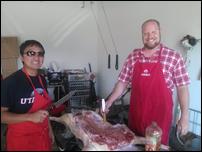
Now that we’ve got our pig properly butterflied, we need to get our flavorful brine into the meat. You can use the brining kits they sell for injecting Thanksgiving turkeys, they’ll work fine, but for a faster approach we recommend getting a nifty new industrial-grade brine injector that allows you to push much more brine into the pig much more quickly.
As we said in our last article, we’re in the “brine camp” because we’ve found that our pork comes out super moist and flavorful when infused directly with the delicious flavors of the herbs and spices in our brine.
If you’re the adventurous type, try two types of brine; one on the shoulder and one on the loin, to see which one you like better. We’ve used mustard, thyme, rosemary, garlic, sea salt, apple juice, pepper, paprika and just about everything in our spice cabinets in the three dozen or so pigs we’ve roasted. Just have fun with it and try something that sounds delicious.
Step 6. Go Time! Roasting Time!
With our pig roasting technique and roasting box, we can vary the flavor and cooking time to achieve several types of pork end products. It can be ‘lechon-style’, which is a more firm and moist product that you can slice and cube, or it can be ‘pulled-pork’ which as describe, you can literally pull off the bone. Really, it’s all about preference, time available and keeping within a temperature range. However, the one element that we can’t stress enough for everyone to follow is the internal temperature of the pig you need to reach before eating it, which is between 145 to 160 degrees for the whole pig; check the pork by sticking the thermometer into the deepest portion of the pig.
Related:
It's time to roast
Call it what you will — a sacrifice to the football gods, a small token of our appreciation, or pure bribery to the forces of the universe to guide the tips, trips and flags in favor of our Utes, against one of the most important opponent we'll face at home all season.Step 7. Cooking Time!
If you follow the La Caja China roasting box instructions, you can cook a 100-pound pig in under 5 1/2 hours and still have come out super moist and tender. But you must follow the instructions closely and only open the box to flip the pig from its back onto its belly as instructed. As a rule, if you want to make sure that the pig is fully cooked, moist and delicious, plan on at least six hours of cooking time. Our roasting preference is to have at least 10 hours of cooking time, using a lower head than the standard La Caja China approach so we end up with more of he pulled-pork tenderness.
NOTE: As much as your tempted to open up your pig box to show everyone the swine that’s sweltering inside, because you want everyone to think you’re super cool, don't open the box! Whenever you open the box, you will add at least 15 minutes in cooking time because the pig box operates like a convection oven that needs to reheat to the desired temp. So when you open it, all of the heat escapes and you have to reheat back up. If you must show the roasting pork to visiting fans or roving camera crews (this is something we at the Pig Bus spend a great deal of time bickering about), do it quick and then immediately add some charcoal to spike the internal cooking temperature to where it was before your impromptu show-and-tell.
Step 8. Carve and eat!
When you’ve reached temperature and are ready to go, pull the pig out and let it rest for at least 30 minutes. With an internal temperature of 150 degrees, the pig is still cooking internally, so it’s important that you allow it to rest and let the juices be reabsorbed back into the meat. If you immediately chop the meat without letting it rest, all of those delicious juices you’ve worked so hard to cultivate for the last eight hours will escape the pork and you’ll more than likely scathe your hands trying to cut or pull it. At this point, we consider ourselves semi-professional butchers (yeah, that’s a thing) but you can easily learn to carve up a pig by watching some of the tutorials available on YouTube. There’s no real wrong way to carve a pig, but some methods definitely show more skill and allow you to collect the most meat, so take notes and enjoy.
Step 9. Pig Roast Accoutrements
There are many ways you can dress up and outfit your pig roast, but our favorite is to create some delicious sauces to enhance the flavor of the pig. For the USC pig roast we offered both a standard BBQ sauce and a South Carolina mustard sauce. Again, ours is a closely guarded secret, but you can make a simple mustard sauce using the recipe below.
Step 10. Win the Game
And finally, and this is really important, after you’ve spent the time to prep and cook a whole pig it really helps if your team wins the “pig roast tribute game.” You’d be surprised how much more enjoyable a victory makes cleaning up the giant mess that’s left behind after the pig has been eaten up. Fortunately for us, our Utes pulled out a victory over the Trojans, for yet another successful Utah Pig Bus pig roast.
We’ll keep writing about tailgating as the season rolls on, and we’d love to answer any questions you might have. Visit www.utahpigbus.com for more info or follow us on Twitter, Instagram or Facebook.
Welby Evangelista (@utahpigbus) and Ryan Lufkin (@ryanLufkin)
Recipe Note – We promised you a quick and dirty recipe for a Carolina Mustard sauce, in our opinion the very best condiment for pulled pork:
- 1 cup yellow mustard
- 2 teaspoons Worcestershire sauce
- 1/4 cup red wine vinegar
- 1/4 cup white vinegar
- 3 teaspoons honey
- Freshly ground pepper Whisk all ingredients in a bowl until combined and add pepper to taste. Refrigerate until ready to serve. - - - - - -