Estimated read time: 4-5 minutes
This archived news story is available only for your personal, non-commercial use. Information in the story may be outdated or superseded by additional information. Reading or replaying the story in its archived form does not constitute a republication of the story.
SALT LAKE CITY — For many people, being mauled or killed by a wild animal ranks near the top among worst possible nightmare situations. In 2010 and 2011, the nightmare was real for at least five individuals killed in grizzly bear attacks in the Intermountain West.
Four of the deaths occurred in the Yellowstone National Park area. The fifth involved two hunters on the Idaho/Montana border. The victim actually died from a gunshot wound when his companion tried to kill the attacking bear.
An elk hunter survived a grizzly bear attack in October 2011 in Grand Teton National Park. On two separate occasions in the summer of 2011, mother grizzly bears with cubs charged at people watching the bears from on top of their cars. No one was hurt in those incidents.
Each year, thousands of Utah residents visit Yellowstone and other areas in the West where grizzly bears roam. With warmer and drier conditions in 2012, the potential exists for another year of increased human/bear conflicts as bears may wander farther in search of food.
The gravity of the situation cannot be overemphasized. The situation is severe and costly.
–Matt Mead
There are currently no grizzly bears in Utah. The accepted distribution range of grizzly bears reaches within 200 miles of the state, and individual bears wander outside that area. The Grizzly Bear Data Analysis Unit in the Wyoming Grizzly Bear Management Plan extends to U.S. 30 in Kemmerer and west to the Utah border.
Utah is home to a healthy population of black bears, which are generally considered less dangerous that the larger grizzly bears. An 11-year-old boy was killed by a black bear in 2007 in American Fork Canyon.
The Wyoming Game and Fish Department (WGFD) devotes a section of its website to grizzly bear management issues. Included is a weekly update detailing all activities related to grizzly bears — from bear-related incidents to research activities and public outreach efforts.
There is disagreement among bear enthusiasts, game managers, ranchers and researchers about the total bear population in the region. Estimates range from 650 to more than 1,000. That is up from a low of 136 in 1975, according to the U.S. Fish and Wildlife Service.
There is no dispute that interactions and conflicts between bears and people have increased.
According to data from annual grizzly bear management reports issued by the WGFD, the number of problem bear relocations rose dramatically between 2005 and 2011. These are bears outside Yellowstone and Grand Teton national parks that were relocated within the grizzly bear recovery zone. The year-by-year totals are 21 in 2005, 18 in 2006, 12 in 2007, 28 in 2008, 26 in 2009, 60 in 2010 and 39 in 2011.
Related:
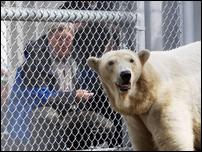
Behind the scenes: Bears returning to Utah's Hogle Zoo
On the northwest corner of Hogle Zoo, a new 3.5 acre animal home is being created that's unlike any other in Utah.So far, there were six relocations before June 2012.
The rise in incidents, attacks and deaths prompted Wyoming Gov. Matt Mead in May to send a letter to U.S. Secretary of the Interior Ken Salazar. He asked the federal government to remove grizzly bears from the endangered species list so the state can begin managing bear populations.
“The gravity of the situation cannot be overemphasized,” Mead wrote. “The situation is severe and costly.” According to Mead’s letter, Wyoming spent $35 million over the past 28 years to deal with grizzly bear issues.
Although the chances of being attacked by a grizzly bear are remote, anyone traveling in grizzly bear country should take precautions. Dennie Hammer, an information and education specialist for the WGFD in Cody, advised visitors in bear areas to carry bear spray and be familiar with its use. Hammer also recommended traveling with a partner and continuously watching for bear signs, which include tracks, scat and areas where bears have been digging.
In February 2010, regulations changed to allow carrying loaded firearms in national parks in accordance with federal, state and local firearms laws. Some traveling in backcountry areas of Yellowstone, Grand Teton or other national parks use the opportunity to carry a firearm as an added protection in bear areas.
If you act appropriately and you carry bear spray, you are much better off than just blundering into bear country with a large firearm.
–Tom S. Smith
However, recent research by BYU biologist and bear expert Tom S. Smith found that firearms were of little value in stopping a bear attack. In the study published in the current issue of the Journal of Wildlife Management, Smith and other researchers analyzed hundreds of bear/human conflicts in Alaska.
He recommended appropriate behavior in bear country as the best method of avoiding an attack. That behavior includes:
- Hiking in groups
- Avoiding areas of poor visibility
- Making noise as appropriate
- Avoiding startling mothers with cubs
- Being more cautious in brown bear (grizzly) country. “If you act appropriately and you carry bear spray, you are much better off than just blundering into bear country with a large firearm,” Smith said in a press release issued by BYU. He recommended carrying bear spray rather than a gun because it is easier to deploy, it is less cumbersome and in the incidents studied it had a higher success rate than guns.There is no way to predict whether or not grizzly bears will kill more people in the West in 2012, but the increase in the grizzly bear population in the greater Yellowstone ecosystem ensures that bear management will be an ongoing topic of concern.
Flint Stephens has a master's degree in communications from Brigham Young University. He is author of "Mormon Parenting Secrets: Time-Tested Methods for Raising Exceptional Children." His blog is www.mormonparentingsecrets.com.