
Estimated read time: 3-4 minutes
This archived news story is available only for your personal, non-commercial use. Information in the story may be outdated or superseded by additional information. Reading or replaying the story in its archived form does not constitute a republication of the story.
It's the same stuff that makes your TV, neon lights, and the Sun all glow. And the list of things it can do aside from letting us watch high-def Netflix movies all day just got longer.
When applied to water, plasma has the interesting effect of turning the water into an incredibly potent disinfectant - so potent, in fact, that it continues to kill 99.9 percent of bacteria even after seven days of just sitting around. Let's see your Lysol wipes do that.
"We know plasmas will kill bacteria in water, but there are so many other possible applications, such as sterilizing medical instruments or enhancing wound healing," said chemical engineer David Graves, one of the authors of the UC Berkeley study showing the effectiveness of plasma.
The upshot of all this is that it is incredibly cheap as well as reusable. The technology to produce the low-temperature plasma needed for the process is cheap - basically similar to what is used in signs and televisions already.
Currently, sterile water and sterile instruments used in thousands of medical procedures, from delivering babies to cleaning wounds, is expensive and hard to produce, requiring special machines and specialized chemicals.
"One of the most difficult problems associated with medical facilities in low-resource countries is infection control," said Graves. "It is estimated that infections in these countries are a factor of three-to-five times more widespread than in the developed world."
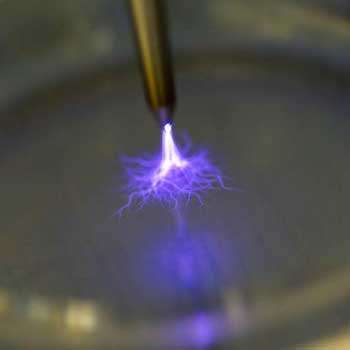
Low-temperature plasma has also been shown to be an incredibly effective disinfectant when applied directly to severely infected wounds in rats, killing 99 percent of microbes and shortening the time it takes for the wound to heal.
This simple and readily available technology could be used in poor countries to provide reliable sterilization in underfunded hospitals or extremely remote areas.
Plasma, the key to all of this, is not so much a thing as a state of matter like a gas or a liquid. It's actually the most common state of matter in the entire universe. Scientists think that perhaps half of the matter in the universe is in the form of hydrogen plasma floating around in between galaxies at a temperature of 10^7 Kelvin - about as hot as the Sun.
When atoms or molecules become ionized, that is when the negative and positive parts of it become separated, the substance can begin to act like a plasma -- sort of like a gas, but with interesting electromagnetic properties.
That's how much of the matter in the universe is trapped, with with electrons and protons separated at a density of about 100 atoms per cubic meter.
You can create plasma by heating a substance up significantly -- like in the sun, or in the intergalactic plasma -- or by using electricity to ionize the substance. In the case of researchers at UC Berkeley, they basically used a low-temperature plasma torch and applied it to water.
When this happens, highly reactive ions that are created react in the air and the water to create disinfectant chemicals in the water, nitrites and nitrates (the same chemicals used to cure meats) as well as peroxides. It also makes the water fairly acidic.
As a result, this isn't the kind of water meant for drinking. It's more for uses in keeping things clean and free from microbes in order to control the rate of exposure to possible pathogens in some are - like a hospital, or even a home.
What's especially interesting is that even after most of these chemicals react and dissipate from the water, it somehow still stays antimicrobial. The team isn't exactly sure why this happens, but it is something they intend to look into.
Email: [dnewlin@ksl.com](<mailto: dnewlin@ksl.com>)






