
Estimated read time: 2-3 minutes
This archived news story is available only for your personal, non-commercial use. Information in the story may be outdated or superseded by additional information. Reading or replaying the story in its archived form does not constitute a republication of the story.
SALT LAKE CITY -- Residents in North Dakota and other parts of the Midwest are still dealing with the damage caused by the recent spring floods.
Many spots were declared disaster areas, which meant federal agencies responded to monitor the damage and to help determine where other problem areas might be. A Utah man, specially trained in using high-tech imaging equipment, was called in to participate in that effort.
The camera looks straight down out of the airplane. As it moves along, instead of taking a rectangular picture, it's a grid of dots.
–Maj. Mark Wilkinson, US CAP
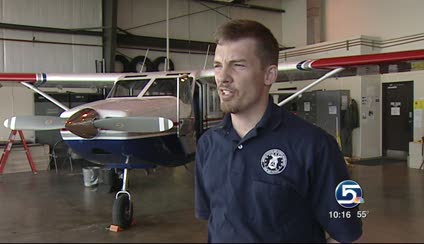
Maj. Mark Wilkinson is a member of the Utah wing of the Civil Air Patrol. He's one of 30 CAP volunteers -- and the only one from Utah -- who were called in from around the country to do a special mission for the Federal Emergency Management Agency (FEMA).
"The dams were of great interest. Communities that were flooding were of great interest, as well as the rivers and the tributaries," Wilkinson said.
Wilkinson was one of nine three-man crews flying above the flood zones and photographing the area, using an imaging device called ARCHER, or "Airborne Real-time Cueing Hyperspectral Enhanced Reconnaissance."
Simply put, the device can see much more detail than a normal camera or the human eye can.
"The camera looks straight down out of the airplane," Wilkinson explained. "As it moves along, instead of taking a rectangular picture, it's a grid of dots. This only takes a single line of dots and it continually snaps pictures at a very rapid rate as you're flying along."

That technology helps FEMA, Wilkinson says.
"They get real high resolution of where the water lines are, and they can determine what the water table is doing," Wilkinson said. "They're still planning on when all this begins to drain, where it's going to go."
The ARCHER imaging device was developed for the CAP about five years ago, and Wilkinson is one of a few in the country who knows how to operate one.
He spent a week in North Dakota last month, flying and crunching data 10 hours a day, on a mission to better understand what might happen next time.
"They're not looking at only this current emergency," he says, "but they're looking to the future also. They want to know what's the best thing to do in the future, because this is going to occur again; it always does."
The CAP was formed 68 years ago as an auxiliary of the United States Air Force. It has about 60,000 volunteers in the U.S., and about 400 in Utah.
Besides helping in disaster relief efforts, such as in North Dakota, CAP volunteers perform hundreds of search and rescue missions in the country each year.
E-mail: kmccord@ksl.com