
- Three Weber State students seek the resurrection of the cultural centers closed in response to anti-diversity legislation approved in 2024.
- The trio met with the university president, are reaching out to student leaders and have launched a petition drive.
- HB261 contemplated creation of "student success" centers geared to all to replace cultural centers serving Latino, Black and other students.
OGDEN — The cultural centers at Weber State University may be gone, eliminated after the passage of anti-diversity legislation in 2024, but Nick Eckstrom would like to see them return.
"These historically underrepresented groups need that place to feel safe and welcome, and the research shows that they perform better academically when they have these safe spaces," said Eckstrom, a senior at the Ogden-based university.
Weber State had been home to several university-hosted cultural centers, some already formed and others taking shape, when lawmakers passed HB261 during the 2024 legislative session. The measure required Utah's public universities to dismantle diversity, equity and inclusion programming, traditionally geared to minority and marginalized students, and instead focus on aiding all students regardless of race and other personal identities.
One of the many upshots was the elimination, effective July 1, 2024, of the cultural centers geared to Black, Latino, female, LGBTQ and other students, which were supplanted by the Student Success Center. The university-sponsored centers, when in operation, served as spaces where students could meet, get support and commiserate over challenges they were facing. The University of Utah also eliminated its varied cultural centers after HB261's passage.
Now, Eckstrom, Evan Burnett and Kolby Ferrell, Weber State seniors, are spearheading efforts to resurrect the cultural centers. They've launched an online petition, met recently with Weber State President Chris Mallett and are reaching out to student government leaders and others to push the cause.
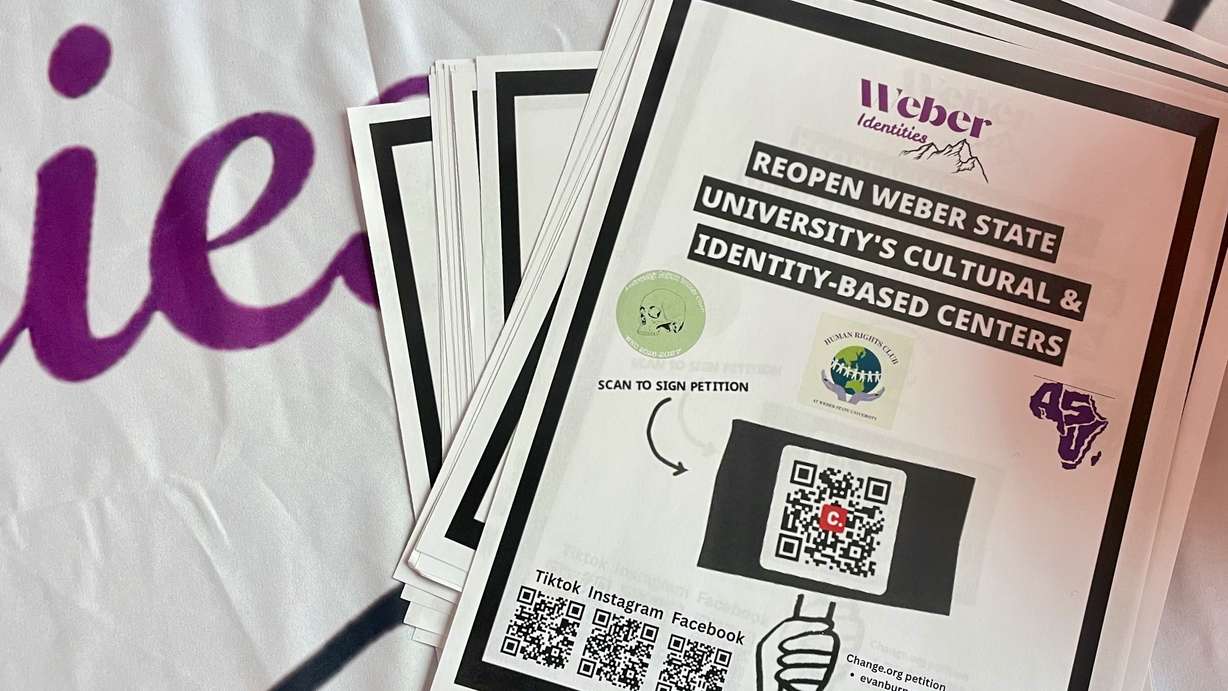
Ferrell said student-led groups serving the Latino, Pacific Islander, Black and LGBTQ communities back the efforts while Burnett manned a desk in the Shepherd Union on Tuesday to drum up interest among students passing between classes.
The removal of the cultural centers, whatever group they represent, "kind of sends a message that we don't really care about them," Burnett said. The centers, he added, "gave specialized care. They gave cultural and heritage celebrations. There's student leadership. There was a whole lot that they gave."
The Student Success Center — offering a range of programs "that aim to help you find a sense of belonging at WSU and support your success," according to its website — is good, he said. "But we feel that specialized representation will be most effective," he continued.
In Thursday's meeting, Mallett was open to discussing the notion and supported the idea of celebrating the varied cultures on the Weber State campus, Eckstrom said.
"But he definitely had a lot of questions, like what the logistics of it would (be) — Where would it be? Who would run it? There's also the legality issue when considering House Bill 261," Eckstrom said.
Commissioner: Adjusting to Utah's diversity bill may 'hurt,' but schools can 'make it successful'
Utah Commissioner of Higher Education Geoffrey Landward addressed moves to adjust to the new state law revamping diversity programs, HB261, noting both challenges and possibilities.'Inclusion not exclusion'
Underlying the passage of HB261 was a sense among proponents of the controversial measure that diversity programming and cultural centers excluded students who didn't belong to the particular group the initiatives targeted. But Eckstrom said that's not the case with cultural centers.
Just as the Student Success Center welcomes all students, "everyone's welcome at these diversity centers," he said. "These centers are about inclusion not exclusion."
Eckstrom reached out to Utah Rep. Katy Hall, R-South Ogden, one of the HB261 sponsors, on the issue. In an emailed response, she told him that the measure didn't require the centers to close "if they were not exclusive," among other things. But she also noted that services for students needing help can't be provided through centers that are "based on personal identity characteristics" and are instead to be offered through the "student success and support" offices outlined in HB261.
"I think each university had to look at their own resources and decide if it made sense to have offices that didn't offer services," she wrote.
At the same time, guidance from the Utah System of Higher Education, or USHE, in the wake of HB261's passage doesn't specifically say cultural centers are not permitted, but sets parameters for their operation. They must focus on cultural awareness, be open to all students and can't "promote differential treatment of students" based on their particular identities, among other things.
Read more:
Multicultural Utah
Looking for more news about the different cultures that call Utah home? Visit our Multicultural Utah section for more stories, events and features.A university seeking approval for creation of a cultural center must get approval from the Utah Board of Higher Education, which governs USHE. "The proposal shall include the culture, population or group the center serves or will serve, as well as information about how the center will meet the requirements of subsections 4.1 through 4.3," the guidance reads, referencing the guidelines governing cultural center operation.
In a statement, Weber State spokeswoman Rachel Badali said the shuttering of the cultural centers wasn't a legal requirement, but rather a bid to better serve students. "Instead of focusing on broad identity categories, support is now customized for each and every Wildcat," she said.
The change, she went on, has generated mixed reactions.
"Some students share that they miss the cultural centers and others value the Student Success Center's resources and programming, which often encourages students to explore culture, identity and different viewpoints," she said.